India-Oman Comprehensive Economic Partnership Agreement (CEPA)
#GS-2 #GS-3 #Economy #Infrastructure #International Relations #Growth #Agriculture #Current Events #International
Key takeaways
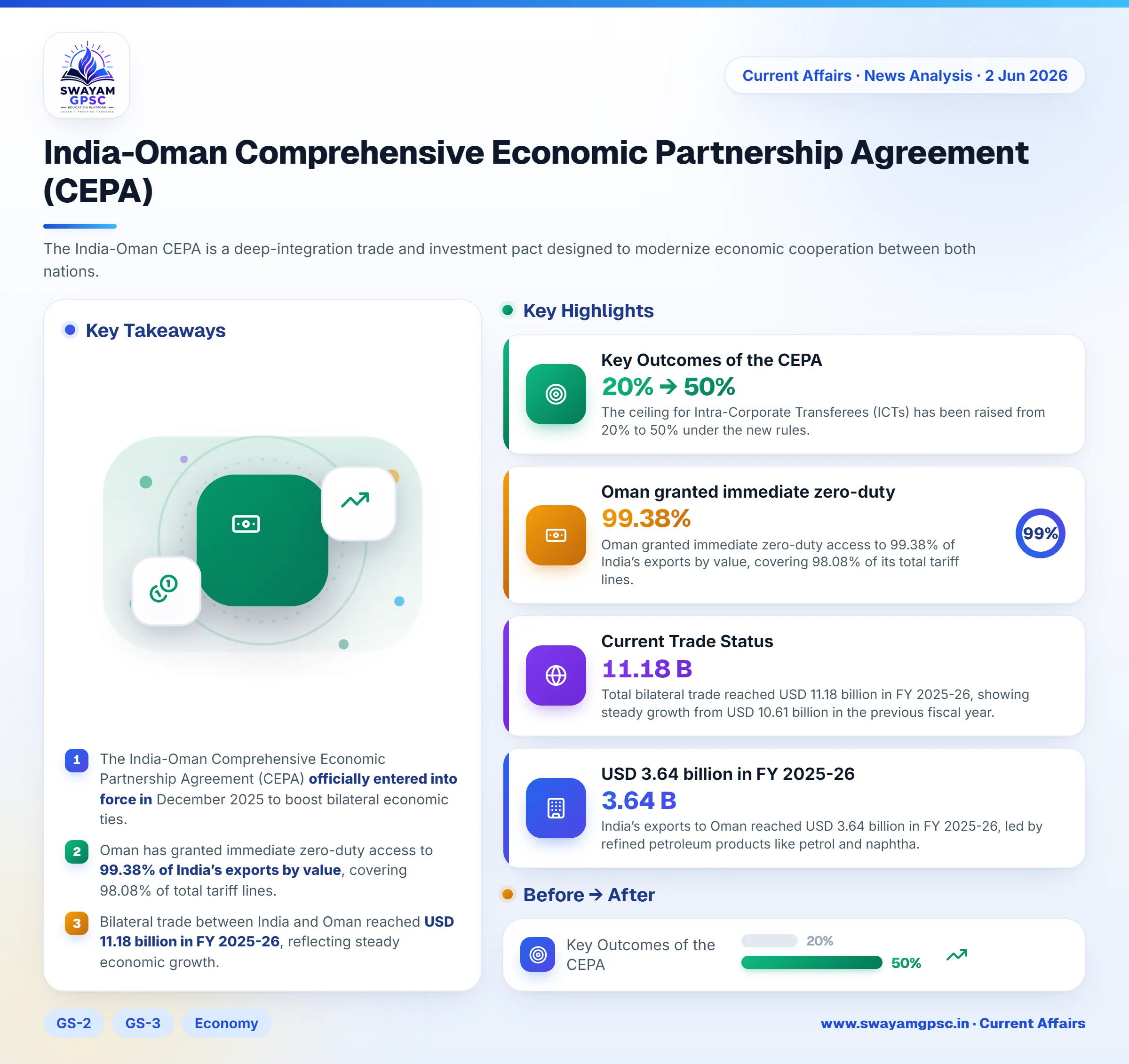
- The India-Oman Comprehensive Economic Partnership Agreement (CEPA) officially entered into force in December 2025 to boost bilateral economic ties.
- Oman has granted immediate zero-duty access to 99.38% of India’s exports by value, covering 98.08% of total tariff lines.
- Bilateral trade between India and Oman reached USD 11.18 billion in FY 2025-26, reflecting steady economic growth.
- The pact provides a reliable alternative trade route that bypasses the volatile Strait of Hormuz using Omani ports like Salalah and Duqm.
Why in News
- The landmark India-Oman Comprehensive Economic Partnership Agreement (CEPA) officially entered into force to boost trade and economic ties.
- Signed in December 2025, this trade pact creates a strategic economic corridor by removing tariffs on major sectors.
- It provides a vital trade route to the Gulf that completely bypasses the conflict-ridden Strait of Hormuz.
About India-Oman Comprehensive Economic Partnership Agreement
- The India-Oman CEPA is a deep-integration trade and investment pact designed to modernize economic cooperation between both nations.
- It goes beyond simple tariff cuts to cover trade in goods, 127 service sub-sectors, professional labor movement, and regulatory cooperation.
- With this treaty, India becomes only the second nation after the United States to secure a bilateral trade pact with Oman.
Key Outcomes of the CEPA
- Oman granted immediate zero-duty access to 99.38% of India’s exports by value, covering 98.08% of its total tariff lines.
- Medicines approved by global regulators like the USFDA, EMA, UK MHRA, and TGA will receive Omani marketing clearance within 90 days.
- Oman expanded service access across 127 service sub-sectors, including clear entry paths for Indian doctors, engineers, and teachers.
- The ceiling for Intra-Corporate Transferees (ICTs) has been raised from 20% to 50%** under the new rules.
- Oman will mandatorily accept inspection certificates issued by India’s Export Inspection Council (EIC) and recognize domestic certification systems.
- India placed sensitive agricultural items on a strict exclusion list to protect local livelihoods and domestic food security.
Current Trade Status
- Total bilateral trade reached USD 11.18 billion in FY 2025-26, showing steady growth from USD 10.61 billion in the previous fiscal year.
- India’s exports to Oman reached USD 3.64 billion in FY 2025-26, led by refined petroleum products like petrol and naphtha.
- India imported USD 7.2 billion worth of goods from Oman, dominated by crude oil, liquefied natural gas, and fertilizers.
- While regional trade faced challenges, India’s imports from Oman surged by 246.4% as energy buys shifted to safer waters.
Challenges Associated with the Treaty
- The overall expansion of Indian merchandise exports is capped by the modest size of the domestic Omani market.
- Oman operates with a small population of 55 lakh and a GDP of USD 110 billion, which limits high-volume consumer goods ingestion.
- In luxury sectors like jewelry, India’s historical market share in Oman was low, requiring a major ramp-up from scratch.
- Indian electronics exports stood at just USD 146 million out of Oman's USD 1.7 billion import market, facing stiff global competition.
- The lack of a finalized Social Security Agreement (SSA) means Indian employers currently face dual contribution penalties.
Significance of the CEPA for India
- Oman ports like Salalah and Duqm lie outside the Strait of Hormuz, ensuring uninterrupted energy access during regional conflicts.
- The removal of import duties gives Indian products a price edge, benefiting sectors like gems, jewelry, and textiles.
- The pact offers a liberal services framework, improving market certainty for businesses operating in both nations.
- Lower tariffs enhance India’s competitiveness in food exports, reinforcing its role as a major supplier to Oman.
- Oman free zones at Sohar and Duqm can serve as hubs for Indian firms to access wider GCC and African markets.
Way Forward
- The operationalization of the India-Oman CEPA marks a major milestone toward global trade integration under Viksit Bharat @2047.
- India must quickly resolve pending labor protection pacts to ensure smooth movement of professionals.
- Local industries need to aggressively market high-value goods to capture a larger share of the Omani import market.