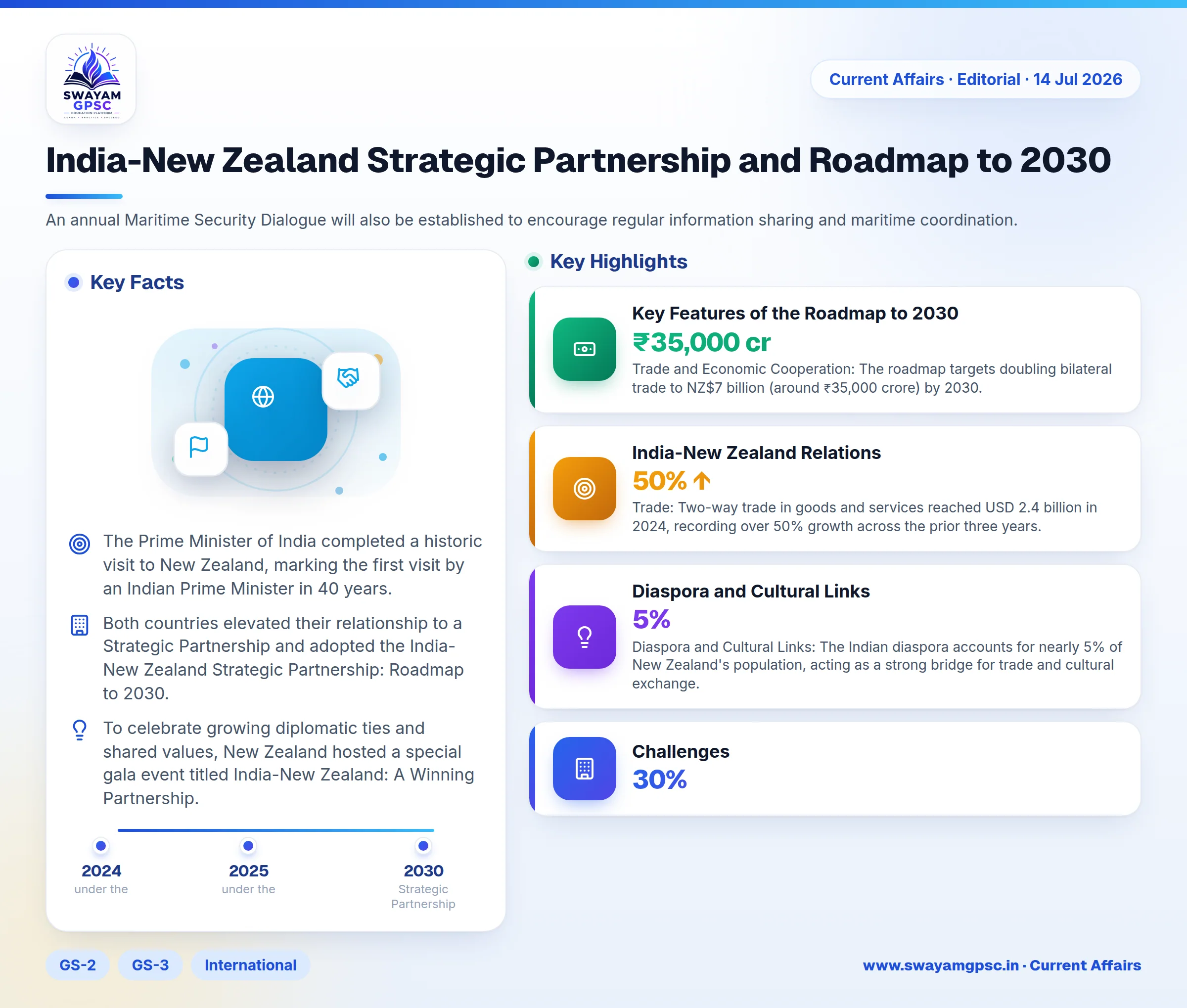
India-New Zealand Strategic Partnership and Roadmap to 2030
#GS-2 #GS-3 #International #National #Growth #Bilateral Relations #Strategic Partnership #India-New Zealand Relations #Māori Tribe
Why in News
- The Prime Minister of India completed a historic visit to New Zealand, marking the first visit by an Indian Prime Minister in 40 years.
- Both countries elevated their relationship to a Strategic Partnership and adopted the India-New Zealand Strategic Partnership: Roadmap to 2030.
- To celebrate growing diplomatic ties and shared values, New Zealand hosted a special gala event titled India-New Zealand: A Winning Partnership.
Key Features of the Roadmap to 2030
- Political and Diplomatic Engagement: The framework sets up regular high-level visits, Foreign Ministers Dialogues, parliamentary exchanges, and annual Secretary-level meetings.
- Defence and Maritime Security: Both nations will expand military exercises and execute agreements on Maritime Cooperation, Hydrography and Nautical Cartography, and Mutual Logistics Support.
- An annual Maritime Security Dialogue will also be established to encourage regular information sharing and maritime coordination.
- Counter-Terrorism and Security: A new Joint Working Group on Counter-Terrorism will target illegal networks, while the India-New Zealand Cyber Dialogue strengthens cybersecurity.
- Trade and Economic Cooperation: The roadmap targets doubling bilateral trade to NZ$7 billion (around ₹35,000 crore) by 2030.
- Trusted trade will be simplified through the 2025 Authorised Economic Operators Mutual Recognition Arrangement (AEO-MRA) under the 2024 Customs Cooperation Arrangement (CCA) while promoting early progress on the India-New Zealand Free Trade Agreement.
- Agriculture and Primary Industries: Cooperation will grow in horticulture, forestry, animal husbandry, and dairying through a new Memorandum of Cooperation (MoC) on Animal Husbandry and Dairying.
- Under the Agricultural Productivity Partnership, both sides will implement a Kiwifruit Action Plan and build two Centres of Excellence in Nagaland and Uttarakhand.
- Tourism, Culture, and Sports: A new Tourism Cooperation Agreement will boost travel, while an updated Air Services Agreement aims to introduce direct non-stop flights between both nations.
- The India-New Zealand Joint Action Plan on Sport will broaden sports cooperation beyond cricket as India prepares for the 2030 Commonwealth Games.
- A Cultural Cooperation Arrangement will boost exchanges in arts, alongside heritage collaboration between the National Maritime Heritage Complex, Lothal and the New Zealand Maritime Museum.
- Education, Research, and Technology: Research ties between the National Centre for Polar and Ocean Research (NCPOR) and the University of Canterbury will advance Antarctic studies.
- Academic cooperation between NIFTEM-K in Kundli and Massey University in New Zealand will foster student mobility and joint food science research.
- Clean Energy and Disaster Resilience: New Zealand officially joined the Global Biofuels Alliance, while an MoC between India's NDMA and New Zealand's NEMA will boost earthquake resilience and tsunami preparedness.
- Indo-Pacific and Multilateral Cooperation: New Zealand prioritized the Maritime Security pillar of the Indo-Pacific Oceans Initiative (IPOI) to combat Illegal, Unreported and Unregulated (IUU) Fishing.
- Both nations affirmed their commitment to UNCLOS, multilateral reforms, and India's permanent membership in a reformed UNSC.
- Legal Nature of the Roadmap: The Roadmap to 2030 is a non-binding policy document that creates no immediate financial commitments or legally binding obligations.
India-New Zealand Relations
- Historical Background: Indian troops fought alongside the ANZAC forces at Gallipoli in 1915 during World War I, establishing early historic connections before official diplomatic relations began in 1952.
- Trade: Two-way trade in goods and services reached USD 2.4 billion in 2024, recording over 50% growth across the prior three years.
- India imports wool, iron, steel, fruits, nuts, and aluminium, while exporting pharmaceuticals, machinery, textiles, and precious stones to New Zealand.
- Defence Cooperation: A bilateral defence agreement signed in early 2025 strengthened regular military engagements, joint exercises, and naval port visits.
- Multilateral Cooperation: New Zealand supports India's permanent membership in the UNSC and entry into the Nuclear Suppliers Group (NSG), while participating in the ISA and CDRI.
- Diaspora and Cultural Links: The Indian diaspora accounts for nearly 5% of New Zealand's population, acting as a strong bridge for trade and cultural exchange.
Challenges
- Dairy Sector Friction: India protects millions of small dairy farmers, whereas New Zealand relies heavily on dairy exports, creating trade friction over market access.
- Agri-Tech Transfer Concerns: New Zealand producers fear that sharing agricultural technology in kiwifruit or apples might create strong Indian competitors in global markets.
- Divergent China Calculus: China buys about 30% of New Zealand's exports, creating an economic dependence that restricts New Zealand from joining India's strategy to balance China.
- Strategic and Governance Differences: New Zealand's membership in the Five Eyes Alliance and its emphasis on human rights can clash with India's focus on strategic autonomy.
- Transnational Extremism Concerns: India remains concerned about anti-India extremist groups operating in New Zealand, making security cooperation delicate under local free-speech laws.
- Labour Mobility Constraints: India seeks easier visa access for skilled workers, but New Zealand's shifting immigration policies and domestic economic pressures limit worker mobility.
How Many Strategic Partnerships Does India Have?
- With New Zealand added, India now maintains Strategic Partnerships or equivalent high-level ties with nearly 46 countries and regional blocs.
- India signed its first strategic partnership with France, later adding Russia, the United States, the United Kingdom, and the European Union.
- India uses different levels of alignment, such as Strategic Partnership, Comprehensive Strategic Partnership, and Special Strategic Partnership.
- Japan is designated as a Special Strategic and Global Partner, whereas Russia holds a Special and Privileged Strategic Partnership with India.
- India's 1949 Treaty of Friendship with Bhutan predates these modern frameworks and remains a unique treaty-based relationship.
Way Forward
- Institutionalizing Dispute Resolution: Both nations should use new Sectoral Working Groups to resolve agricultural sanitary disputes without threatening India's core dairy sector.
- Upgrading Air Services: Establishing direct non-stop flights must be prioritized by top leaders to improve travel and help reach the NZ$7 billion trade target.
- Deepening Non-Traditional Maritime Ties: Strategic cooperation under the IPOI should focus on IUU Fishing, hydrography, disaster relief, and maritime governance.
- Fostering Niche Technologies: Both sides should focus on non-contentious areas like Green Hydrogen, precision farming, space exploration, and the Global Biofuels Alliance.
- Joint Outreach in the Pacific: Expanding cooperation between India's NDMA and New Zealand's NEMA can build disaster resilience and tsunami readiness across Pacific Island Countries.
Conclusion
- The success of the Roadmap to 2030 relies on compartmentalized cooperation that separates sensitive trade issues from shared strategic goals.
- By expanding collaboration in clean energy, marine security, polar research, and skilled mobility, India and New Zealand can build a resilient partnership in the Indo-Pacific.
Prelims in Focus: The Māori Tribe and Waka
- Context: During his address to the Indian diaspora in Auckland, India's Prime Minister highlighted the Māori cultural term Waka to symbolize shared values and joint progress.
- About the Māori Tribe: The Māori are the indigenous Polynesian people of New Zealand (Aotearoa), who arrived in canoe voyages between 1200 and 1300 CE.
- Geographic Distribution: The Māori population is mostly concentrated on the North Island of New Zealand in volcanic valleys and coastal areas.
- Social Structure: Māori society relies on Whakapapa (genealogy), organized into Iwi (tribes) and Hapū (sub-tribes), with community life centered around the Marae meeting complex.
- Artistic Traditions: Key cultural practices include Tā Moko (sacred body tattooing) and intricate carvings on wood and Pounamu (greenstone).
- Cultural Practices: Ceremonial traditions feature the Haka posture dance and the Hongi greeting, where touching foreheads represents sharing the breath of life.
- The Concept of Waka: A Waka is a traditional ocean canoe symbolizing community identity, shared journeys, and joint goals.
- Types of Waka: Historically, Māori crafted Waka Taua (war canoes), Waka Tētē (fishing and transport canoes), and Waka Kōrari (flax river vessels).