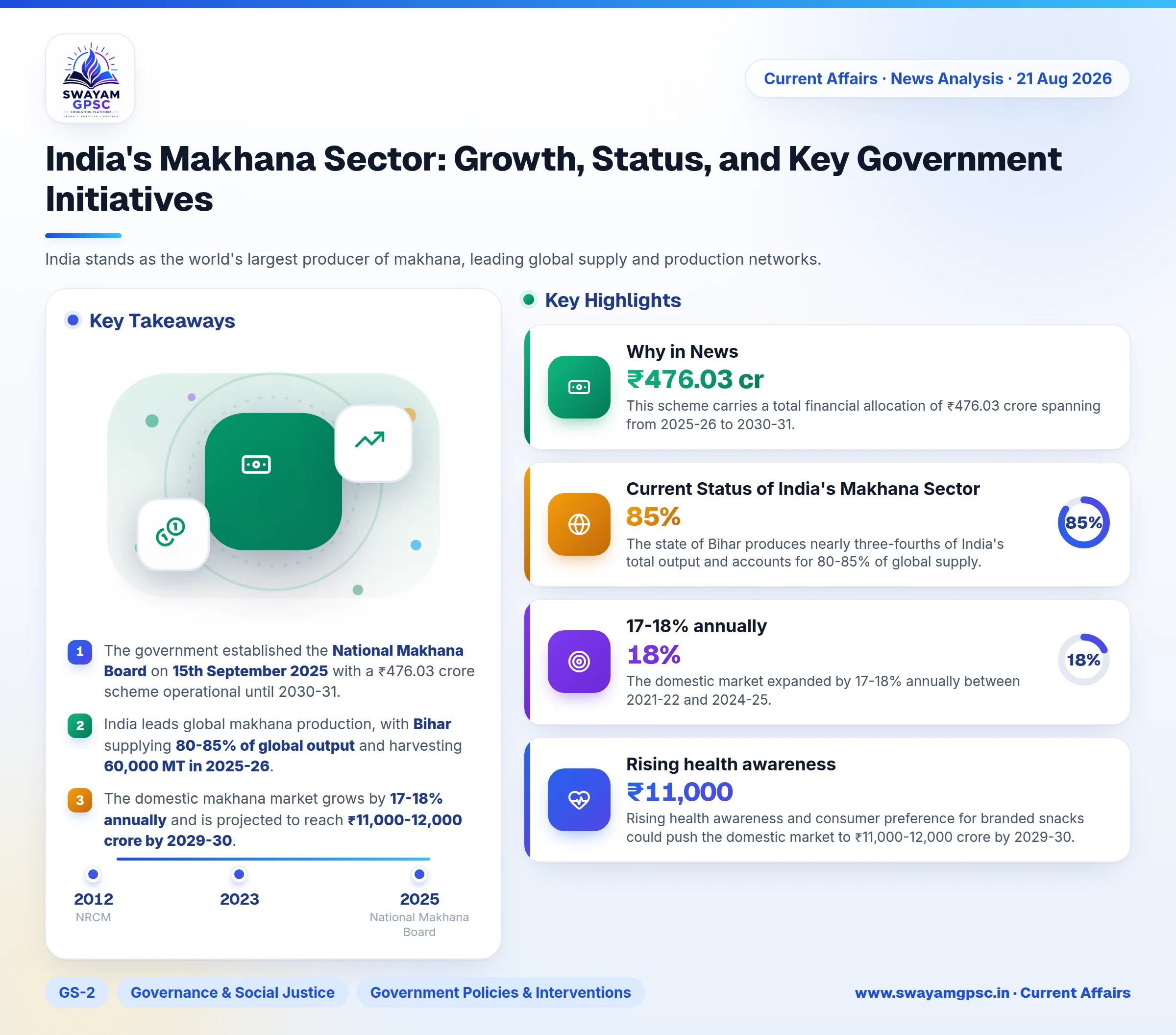
India's Makhana Sector: Growth, Status, and Key Government Initiatives
#GS-2 #Governance & Social Justice #Government Policies & Interventions #GS-3 #Economy #Agriculture #Food Processing
Key takeaways
- The government established the National Makhana Board on 15th September 2025 with a ₹476.03 crore scheme operational until 2030-31.
- India leads global makhana production, with Bihar supplying 80-85% of global output and harvesting 60,000 MT in 2025-26.
- The domestic makhana market grows by 17-18% annually and is projected to reach ₹11,000-12,000 crore by 2029-30.
- Following dedicated HSN codes introduced in 2025, India exported 7,264.89 MT of makhana worth ₹19,296.08 lakh during 2025-26.
Why in News
- The Indian government recently highlighted the rapid growth of India's makhana sector across national and global markets.
- This update follows the formal establishment of the National Makhana Board in Bihar on 15th September 2025.
- The government approved a dedicated Central Sector Scheme for the Development of Makhana to boost production.
- This scheme carries a total financial allocation of ₹476.03 crore spanning from 2025-26 to 2030-31.
Current Status of India's Makhana Sector
- India stands as the world's largest producer of makhana, leading global supply and production networks.
- The state of Bihar produces nearly three-fourths of India's total output and accounts for 80-85% of global supply.
- Cultivation centers mostly in North Bihar, particularly across the Kosi basin districts of Supaul, Saharsa and Madhepura.
- The Mithila and Seemanchal regions also serve as major production hubs for the crop.
- National production increased from 63,910 MT in 2024-25 to an estimated 80,590 MT in 2025-26.
- Average crop productivity improved from 2.03 MT/ha to 2.34 MT/ha during the same period.
- Bihar alone harvested around 60,000 MT in 2025-26, recording an average yield of 2.00 MT/ha.
- The domestic market expanded by 17-18% annually between 2021-22 and 2024-25.
- Rising health awareness and consumer preference for branded snacks could push the domestic market to ₹11,000-12,000 crore by 2029-30.
- Average market prices rose from ₹500/kg during 2020-22 to nearly ₹1,250/kg in 2025 due to strong demand.
- Monthly domestic consumption of popped makhana ranges between 3,000-3,500 MT.
- Monthly demand surges to nearly 5,000 MT during festive seasons across the country.
- The Directorate General of Foreign Trade (DGFT) assigned unique HSN codes for makhana products in 2025.
- India exported 7,264.89 MT of makhana valued at ₹19,296.08 lakh during 2025-26.
- The US (40%), Canada (20%), and UAE (17%) together absorb about 77% of total exports.
- Emerging shipments to Germany, Nepal, and Australia offer higher unit returns, showing room for premium market growth.
Key Facts about Makhana
- Makhana, scientifically named Euryale ferox or fox nut, is an aquatic crop grown in shallow wetlands and ponds.
- Growers cultivate it predominantly in Bihar, West Bengal, and Assam under favourable climate conditions.
- Mithila Makhana holds a recognized Geographical Indication (GI) tag honoring its traditional origin and distinct quality.
- Farmers are increasingly adopting modern field-system farming alongside traditional pond cultivation methods.
- High-yielding seed varieties like Swarna Vaidehi and Sabour Makhana-1 have significantly improved crop yields.
- Makhana provides rich nutrients including carbohydrates, protein, dietary fibre, magnesium, potassium, phosphorus, and iron.
- Its low fat content, zero cholesterol, and low glycaemic load have made it a preferred global health food.
Government Initiatives for Makhana Sector
- The government announced the National Makhana Board in Union Budget 2025-26 and launched it on 15 September 2025.
- The Central Sector Scheme for the Development of Makhana provides ₹476.03 crore in total funding up to 2030-31.
- The scheme covers research, seed quality, grower training, harvesting, post-harvest care, value addition, marketing, and exports.
- Financial allocations stand at ₹30 crore for 2025-26 and ₹90 crore for 2026-27.
- The initiative directly supported 8,159 farmers during 2025-26.
- Program interventions added 1,010 hectares under makhana farming and 73 hectares under dedicated seed production.
- Agricultural universities and ICAR institutes conducted 89 Front Line Demonstrations to train local farmers.
Processing, Research and Technology in Makhana Value Chain
- Farm production involves pond preparation, seed sowing, crop care, and labor-intensive underwater seed collection.
- Primary processing steps require seed drying, cleaning, roasting, popping, polishing, and size grading.
- Secondary processing creates value-added products like flavoured makhana, ready-to-eat snacks, and makhana flour.
- Agri-startups and Farmer Producer Organisations (FPOs) are improving processing standards, branding, and supply links.
- The National Research Centre for Makhana (NRCM) promotes advanced methods like integrated makhana-cum-fish farming.
- Between 2012 and 2023, the NRCM supplied 15,824.1 kg of high-yielding seeds and trained over 3,000 farmers.
- The NRCM assisted 24 enterprises and developed commercial machinery for seed washing, grading, roasting, and popping.
- Modern technology and processing will increase farmer income, create rural jobs, and boost India's agri-exports.
Conclusion
- India's makhana sector has successfully evolved from a regional aquatic crop into a high-value superfood economy.
- Targeted government schemes, technology adoption, and processing infrastructure will turn makhana into a key driver of rural prosperity.