India Leads the Global Ship Recycling Sector
#GS-2 #GS-3 #Government Policies & Interventions #Growth & Development #Infrastructure #Economy #National
Key takeaways
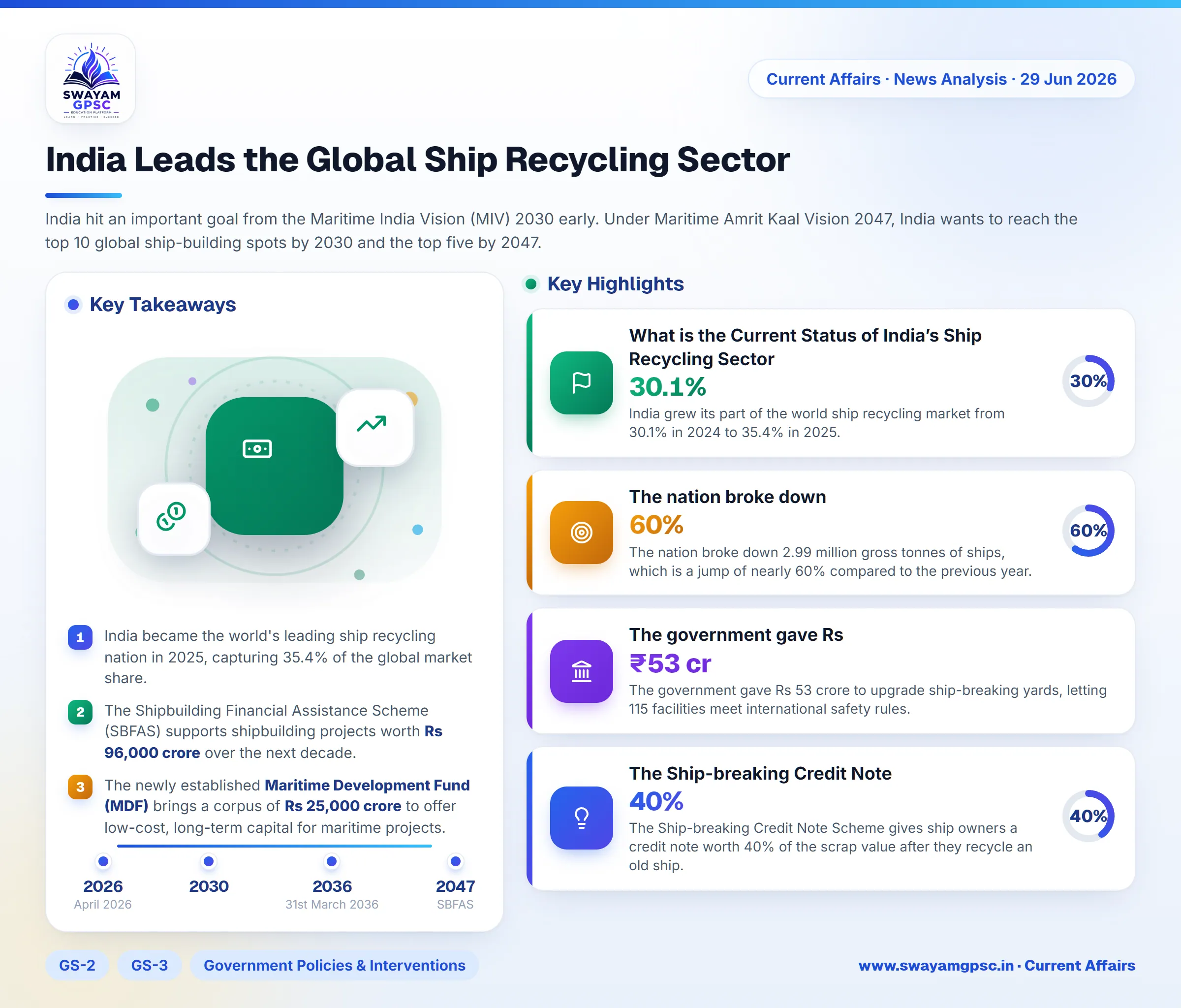
- India became the world's leading ship recycling nation in 2025, capturing 35.4% of the global market share.
- The Shipbuilding Financial Assistance Scheme (SBFAS) supports shipbuilding projects worth Rs 96,000 crore over the next decade.
- The newly established Maritime Development Fund (MDF) brings a corpus of Rs 25,000 crore to offer low-cost, long-term capital for maritime projects.
- India aims to rank among the top 10 global shipbuilding nations by 2030 and the top five by 2047.
Why in News
- The United Nations Conference on Trade and Development (UNCTAD) announced that India emerged as the world’s leading ship recycling nation in 2025. This milestone was reached well ahead of the schedule set in the Maritime India Vision (MIV) 2030.
- During his state visit to India in April 2026, South Korean President Lee Jae Myung helped set the stage for India to grow into a major global shipbuilding power.
Summary
- India has become the top global destination for breaking old ships. The country is now using this strength alongside big policy updates, money support, and foreign partnerships to build new ships.
- Programs like SBFAS, SbDS, the Maritime Development Fund, and teamwork with South Korea will help fix old problems, create local jobs, boost sea security, and push India into the top five global ship producers by 2047.
What is the Current Status of India’s Ship Recycling Sector
- India grew its part of the world ship recycling market from 30.1% in 2024 to 35.4% in 2025.
- The nation broke down 2.99 million gross tonnes of ships, which is a jump of nearly 60% compared to the previous year.
- India hit an important goal from the Maritime India Vision (MIV) 2030 early. Under Maritime Amrit Kaal Vision 2047, India wants to reach the top 10 global ship-building spots by 2030 and the top five by 2047.
- After passing the Recycling of Ships Act, 2019, India matched its ship-breaking rules with the Hong Kong International Convention for the Safe and Environmentally Sound Recycling of Ships.
- The government gave Rs 53 crore to upgrade ship-breaking yards, letting 115 facilities meet international safety rules.
- The Ship-breaking Credit Note Scheme gives ship owners a credit note worth 40% of the scrap value after they recycle an old ship.
- Owners can use this credit, up to 5% of a new ship value, to build a brand new vessel at an Indian yard. This links recycling directly with building new ships.
- The Shipbuilding Financial Assistance Scheme (SBFAS) gives financial support between 15% and 25% of vessel costs to local shipyards. This helps them compete against heavily subsidized foreign shipyards.
- This scheme sets up a National Shipbuilding Mission and launches the Shipbreaking Credit Note worth 40% of the scrap value to push recycling and new ship building.
- The scheme aims to back Rs 96,000 crore worth of ship-building projects over the next ten years.
- The Shipbuilding Development Scheme (SbDS) focuses on growing India's ship-building size by setting up greenfield building clusters, upgrading old yards, and creating an India Ship Technology Centre at the Indian Maritime University (Tamil Nadu).
- It provides full capital support for shared infrastructure in new clusters and 25% cash help for expanding old yards. It also uses a Credit Risk Coverage Framework to make project funding easier.
- Both SBFAS and SbDS aim to push India's commercial ship building capacity to 4.5 million Gross Tonnage (GT) per annum by 2047, while creating local tech, jobs, security, and global competition.
- These two schemes will stay active until 31st March 2036, with an in-principle extension ready up to 2047.
- The Maritime Development Fund (MDF) is a special Rs 25,000 crore pool created to offer long-term and low-cost money.
- The Maritime Investment Fund (MIF) is a Rs 20,000 crore equity fund where the government puts in 49% to bring in private money.
- The Interest Incentivization Fund (IIF) is a Rs 5,000 crore grant fund designed to cut high loan costs for ship builders over 10 to 15 years, solving the heavy 10-11% local interest rates.
- Sagarmala Finance Corporation Limited (SMFCL) is India's first special non-banking finance company built only to fund sea and ship projects.
- The Green Tug Transition Programme (GTTP) and Harit Nauka Guidelines push boat owners to use clean fuels like LNG, battery power, hydrogen, and methanol. This gives local yards an early start in green ship building.
- The Alang Ship Recycling Yard in Gujarat, the biggest in the world, is growing to almost double its size to near 9 million light displacement tons.
- India is also trying to get added to the European Union approved list of ship recycling yards.
How Can South Korea Accelerate India's Shipbuilding Ambitions
- Under the India-ROK Comprehensive Framework, VOYAGES (Shared Vision for Operation of Yard Assisted Growth with Efficiency and Scale), South Korea helps build India's first mega greenfield shipyard at Thoothukudi with a size of 2.5 million GT and a job creation power of 15,000 direct jobs.
- Top South Korean ship firms like HD Hyundai, Samsung Heavy Industries (SHI), and Hanwha Ocean are sharing high-level skills in ship design, automation, clean power, and costly vessel building.
- The Korea Marine Equipment Association (KOMEA) represents over 300 companies and has opened an office in Mumbai to build a local supply chain for boat parts.
- Working together on naval and water vehicle building will boost local defense production under the Make in India plan.
- Partnerships involving the Korea International Cooperation Agency (KOICA), India’s Ministry of Ports, Shipping and Waterways (MoPSW), Indian Maritime University (IMU), and the Korea Maritime & Ocean University (KMOU) will improve worker skills and research in marine engineering.
- South Korean money, tech, and industrial skill will help India update yards, join global supply chains, and reach the goal of joining the top 10 ship-making nations by 2030 and top five by 2047.
Challenges
- India moves nearly 95% of its trade goods and 70% of its trade value by sea. Yet, its true ship building size is a small 0.072 million Gross Tonnage (GT), holding less than 1% of world output and ranking 18th globally.
- Over 90% of global trade moves on water, but the USD 150 billion annual shipbuilding market is almost entirely run by just three countries.
- China, South Korea, and Japan control 95% of all new shipbuilding orders by weight.
- Ship building needs a lot of money up front, often taking 25% to 35% of total ship costs as working cash.
- Indian ship builders face high local loan rates around 10-10.5%, while rival nations offer cheap help at 4-8%.
- Local yards lack direct government refund guarantees, which hurts them when bidding for big global commercial contracts.
- Unlike South Korea, India lacks a connected network of local part makers.
- Because of this, Indian yards must import 60-70% of vital marine parts, such as special steel, navigation tools, and engines.
- This heavy import need raises prices, ruins fast manufacturing plans, and exposes yards to global supply shocks.
- Many local shipyards run on old, small physical tools. The lack of mega dry docks (most local docks are under 310 meters) stops the country from building or fixing ultra-large crude carriers and huge container ships.
- Indian shipping firms often prefer buying cheap, ready-made foreign used ships instead of placing orders for new local vessels.
- India holds less than a 1% share in the global Maintenance, Repair, and Operations (MRO) market, as Indian ships often sail to Singapore, Dubai, or Colombo for quick service.
- While India has many engineers, it lacks experts trained specifically in advanced marine engineering, automated ship design, and clean power tech.
- This skill gap stops fast learning of new tech shared through global partnerships.
- Even with ease-of-business steps, slow rule updates, tough land buying for new projects, and long legal times slow down foreign investors and delay project work.
Way Forward
- Plans aim to copy South Korea's successful Ulsan model, which uses a cluster-based design connecting shipyards with part makers and training schools.
- India must use steel and items saved from its top ship-breaking industry to feed local ship-building supply chains, building a real circular sea economy.
- Foreign partnerships must include clear rules for local value addition, tech sharing, and worker training so India becomes a tech owner rather than a simple assembler.
- Focus must shift quickly to building local part-making units inside new clusters to lower import bills for vital parts.
- Instead of just copying old shipping methods, India must jump into building next-gen ships.
- Pushed by the International Maritime Organization (IMO) green rules, plans like the Green Tug Transition Programme are vital to make India a leader in hydrogen and methanol dual-fuel engines.
- The Right of First Refusal (RoFR) rule for Indian-built and Indian-flagged ships must be strictly forced in all government and public sector cargo tenders, like ONGC or Coal India, to guarantee local orders.
Conclusion
- Building up the ship industry, known as the mother of heavy engineering, is both an economic goal and a strategic need.
- It brings big job growth by creating up to 30 lakh jobs and helps basic sectors like steel and electronics.
- By mixing big money inputs, strict rule enforcement for local demand, and the local manufacturing spirit of Aatmanirbhar Bharat, India is ready to move from a weak consumer of sea logistics to a strong global producer.