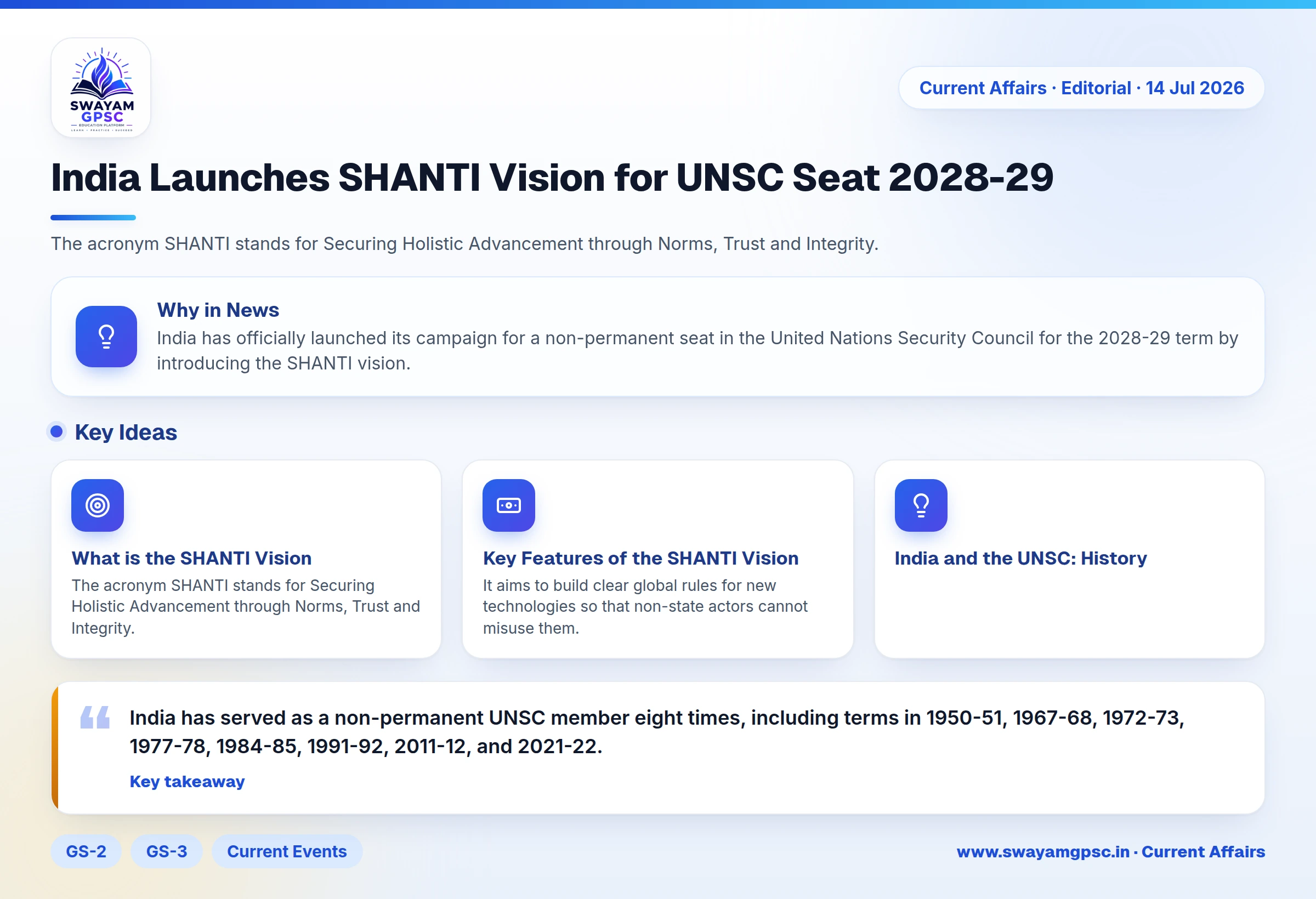
India Launches SHANTI Vision for UNSC Seat 2028-29
#GS-2 #GS-3 #Current Events #International #International Relations #UNSC #Global South #Foreign Policy
Why in News
- India has officially launched its campaign for a non-permanent seat in the United Nations Security Council for the 2028-29 term by introducing the SHANTI vision.
What is the SHANTI Vision
- The acronym SHANTI stands for Securing Holistic Advancement through Norms, Trust and Integrity.
- It serves as the core framework for India's 2028-29 UNSC bid, emphasizing that world peace cannot exist in pieces.
- This initiative addresses a major modern problem where global economic ties grow while wars and violence also increase.
Key Features of the SHANTI Vision
- It focuses on giving a stronger voice to the Global South by bringing their economic and development concerns into global decisions.
- The framework calls for modern technology in UN peacekeeping while supporting the Women, Peace and Security agenda.
- It prioritizes international legal rules to fight terrorism, tackle climate change, and protect sea trade routes.
- It aims to build clear global rules for new technologies so that non-state actors cannot misuse them.
- It highlights India's identity as a reliable partner with funded development projects operating in 79 countries to encourage peaceful dialogue.
India and the UNSC: History and Membership
- The UNSC has 5 permanent and 10 non-permanent members, where elected members serve for two years after gaining a two-thirds vote in the UNGA.
- India has served as a non-permanent UNSC member eight times, including terms in 1950-51, 1967-68, 1972-73, 1977-78, 1984-85, 1991-92, 2011-12, and 2021-22.
- India has sent nearly 3 lakh troops across 50 UN peacekeeping missions, making it one of the largest contributors worldwide.
- India demands complete structural reform of the UNSC because the 1945 setup does not match modern global reality.