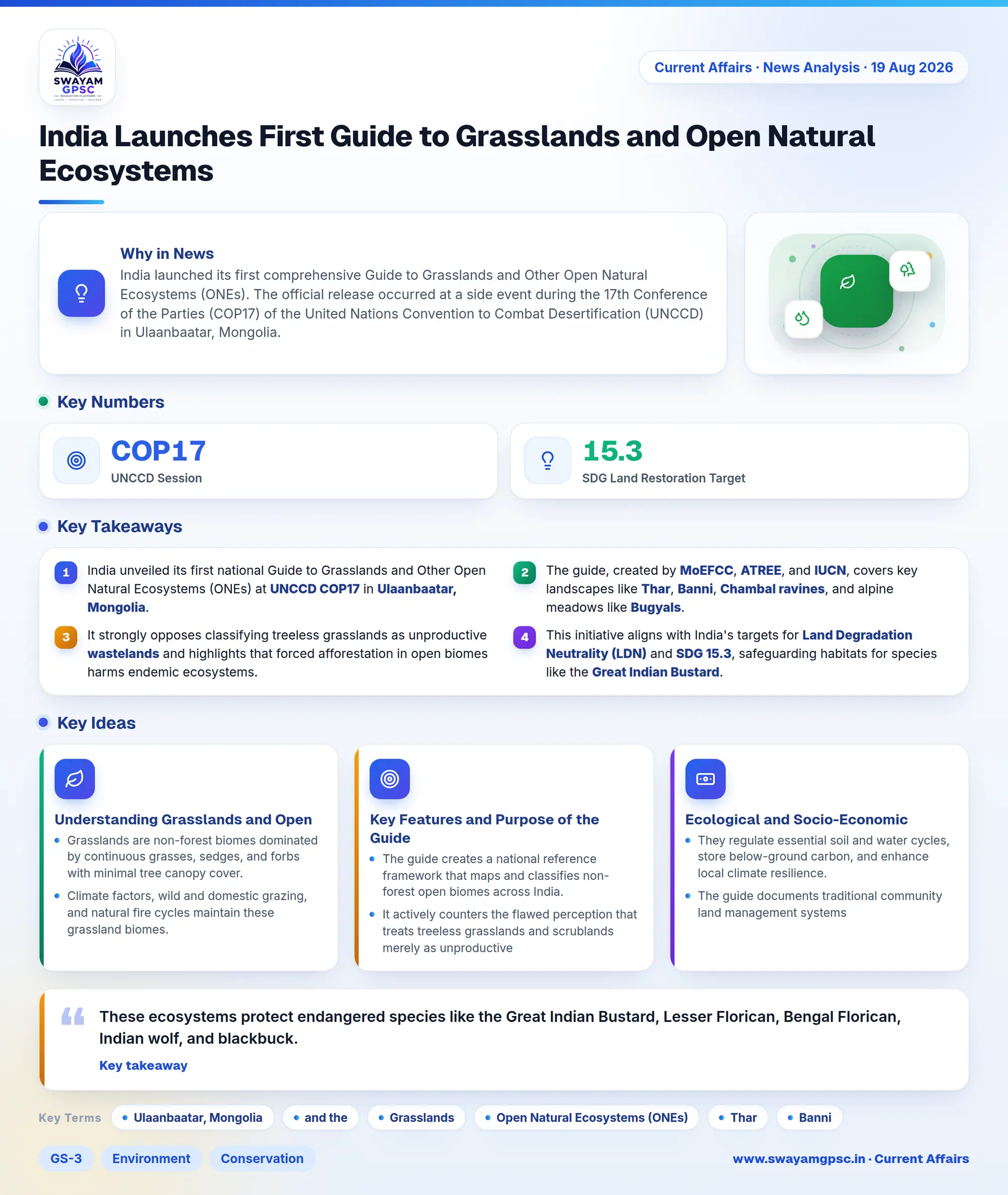
India Launches First Guide to Grasslands and Open Natural Ecosystems
#GS-3 #Environment #Conservation #Land Resources #Biodiversity #UNCCD
Key takeaways
- India unveiled its first national Guide to Grasslands and Other Open Natural Ecosystems (ONEs) at UNCCD COP17 in Ulaanbaatar, Mongolia.
- The guide, created by MoEFCC, ATREE, and IUCN, covers key landscapes like Thar, Banni, Chambal ravines, and alpine meadows like Bugyals.
- It strongly opposes classifying treeless grasslands as unproductive wastelands and highlights that forced afforestation in open biomes harms endemic ecosystems.
- This initiative aligns with India's targets for Land Degradation Neutrality (LDN) and SDG 15.3, safeguarding habitats for species like the Great Indian Bustard.
Why in News
- India launched its first comprehensive Guide to Grasslands and Other Open Natural Ecosystems (ONEs).
- The official release occurred at a side event during the 17th Conference of the Parties (COP17) of the United Nations Convention to Combat Desertification (UNCCD) in Ulaanbaatar, Mongolia.
- The Ministry of Environment, Forest and Climate Change (MoEFCC) led the development of this guide.
- Key institutional partners included the Ashoka Trust for Research in Ecology and the Environment (ATREE) and the International Union for Conservation of Nature (IUCN).
Understanding Grasslands and Open Natural Ecosystems
- Grasslands are non-forest biomes dominated by continuous grasses, sedges, and forbs with minimal tree canopy cover.
- Climate factors, wild and domestic grazing, and natural fire cycles maintain these grassland biomes.
- Open Natural Ecosystems (ONEs) serve as a broader umbrella category for naturally open non-forest landscapes with low tree density.
- These biomes include cold and hot deserts like Thar, Spiti, and Ladakh, along with tropical savannas and scrublands.
- ONEs also cover saline wetlands like Banni and the Rann of Kutch, badlands like the Yamuna-Chambal ravines, and high-altitude alpine meadows known as Bugyals and Margas.
- Other key regions mapped include the Deccan savannas, Aravalli scrublands, Western Ghats rocky plateaus, Nicobar grasslands, and Tamil Nadu's Theri Kaadu.
Key Features and Purpose of the Guide
- The guide creates a national reference framework that maps and classifies non-forest open biomes across India.
- It actively counters the flawed perception that treats treeless grasslands and scrublands merely as unproductive wastelands.
- The document includes thematic scientific sections detailing pastoral mobility, rangeland dynamics, fire ecology, and soil organic carbon storage.
- It cautions against misguided afforestation, noting that planting trees in naturally treeless biomes harms endemic species and alters groundwater tables.
- The guide provides standardized metrics to support Land Degradation Neutrality (LDN) commitments under UNCCD and SDG 15.3.
Ecological and Socio-Economic Significance
- These ecosystems protect endangered species like the Great Indian Bustard, Lesser Florican, Bengal Florican, Indian wolf, and blackbuck.
- They regulate essential soil and water cycles, store below-ground carbon, and enhance local climate resilience.
- The guide documents traditional community land management systems, including Orans (sacred groves) and Gauchars (village commons).
- These open lands sustain pastoralist, livestock-dependent, and agricultural communities, including nomadic tribes.
- Presenting this guide at UNCCD COP17 elevates India's role in global discussions on rangeland conservation and land restoration.