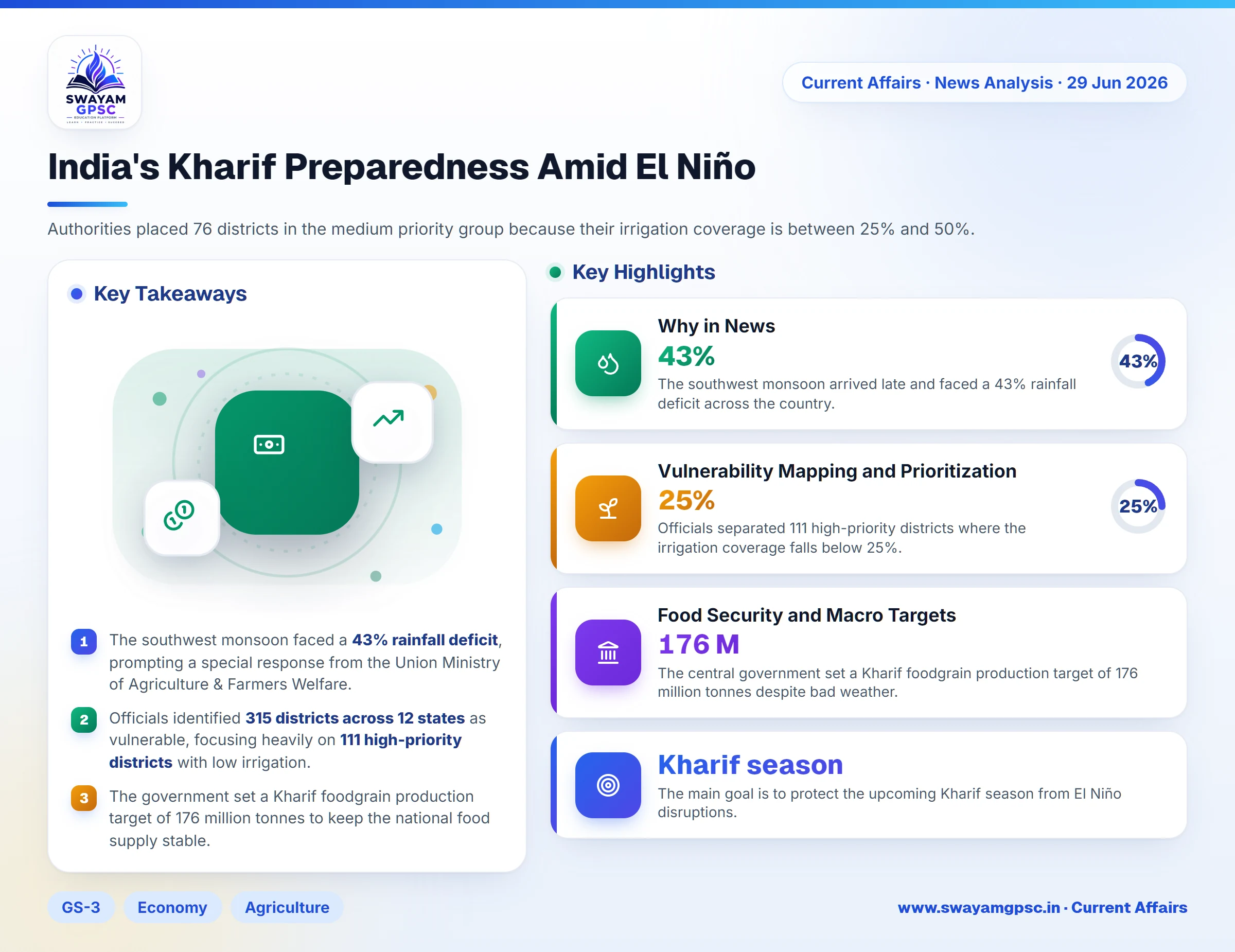
India's Kharif Preparedness Amid El Niño
#GS-3 #Economy #Agriculture #Infrastructure #GS-2 #Government Policies & Interventions #Rapid Fire CA #Quick Facts For Prelims #GS-1 #Important Geophysical Phenomena
Key takeaways
- The southwest monsoon faced a 43% rainfall deficit, prompting a special response from the Union Ministry of Agriculture & Farmers Welfare.
- Officials identified 315 districts across 12 states as vulnerable, focusing heavily on 111 high-priority districts with low irrigation.
- The government set a Kharif foodgrain production target of 176 million tonnes to keep the national food supply stable.
- Agencies are utilizing 731 Krishi Vigyan Kendras (KVKs) alongside financial safety nets like PM-KISAN and PMFBY to protect farmers.
Why in News
- The southwest monsoon arrived late and faced a 43% rainfall deficit across the country.
- The Union Ministry of Agriculture & Farmers Welfare introduced a multi-layered contingency framework.
- The main goal is to protect the upcoming Kharif season from El Niño disruptions.
Vulnerability Mapping and Prioritization
- The government marked 315 districts across 12 states as at risk due to weak monsoon conditions.
- Some of these vulnerable states include Madhya Pradesh, Maharashtra, Gujarat, Uttar Pradesh, and Rajasthan.
- Officials separated 111 high-priority districts where the irrigation coverage falls below 25%.
- Authorities placed 76 districts in the medium priority group because their irrigation coverage is between 25% and 50%.
- They categorized 128 districts as low priority because those areas have much better irrigation facilities.
Contingency Planning
- The Indian Council of Agricultural Research (ICAR) prepared District Agriculture Contingency Plans.
- These local blueprints are moving out of office files and becoming real actions in the fields.
Climate-Resilient Crop Diversification
- State governments must push for short-duration, low-water, and drought-resistant crop varieties.
- Farmers are getting help to grow pulses, oilseeds, and Shree Anna (millets) to spread risk in rainfed areas.
Macro Water Harvesting Framework
- Workers are repairing and cleaning community water assets like check dams, farm ponds, and reservoirs.
- This work is tied directly to MGNREGA (now VB-GRAMG) to create local jobs and refill underground water.
Three-Tier Financial Safety Nets
- Farmers get financial cover through three major government schemes working together.
- The Pradhan Mantri Fasal Bima Yojana (PMFBY) helps farmers with fast crop-loss insurance payouts.
- The government speeds up giving out Kisan Credit Cards (KCC) so farmers have money for their daily farming needs.
- Direct cash support goes to farmers through the PM-KISAN scheme.
Real-Time Institutional Monitoring
- The government set up an El Niño Monitoring Cell and a Crop Weather Watch Group in New Delhi.
- Leaders hold weekly meetings at the secretary and ministerial levels to check the situation.
- A network of 731 Krishi Vigyan Kendras (KVKs) gives scientific advice directly to farmers on the ground.
Food Security and Macro Targets
- The central government set a Kharif foodgrain production target of 176 million tonnes despite bad weather.
- Strong national buffer stocks of wheat and rice keep the local market safe from food shortages.