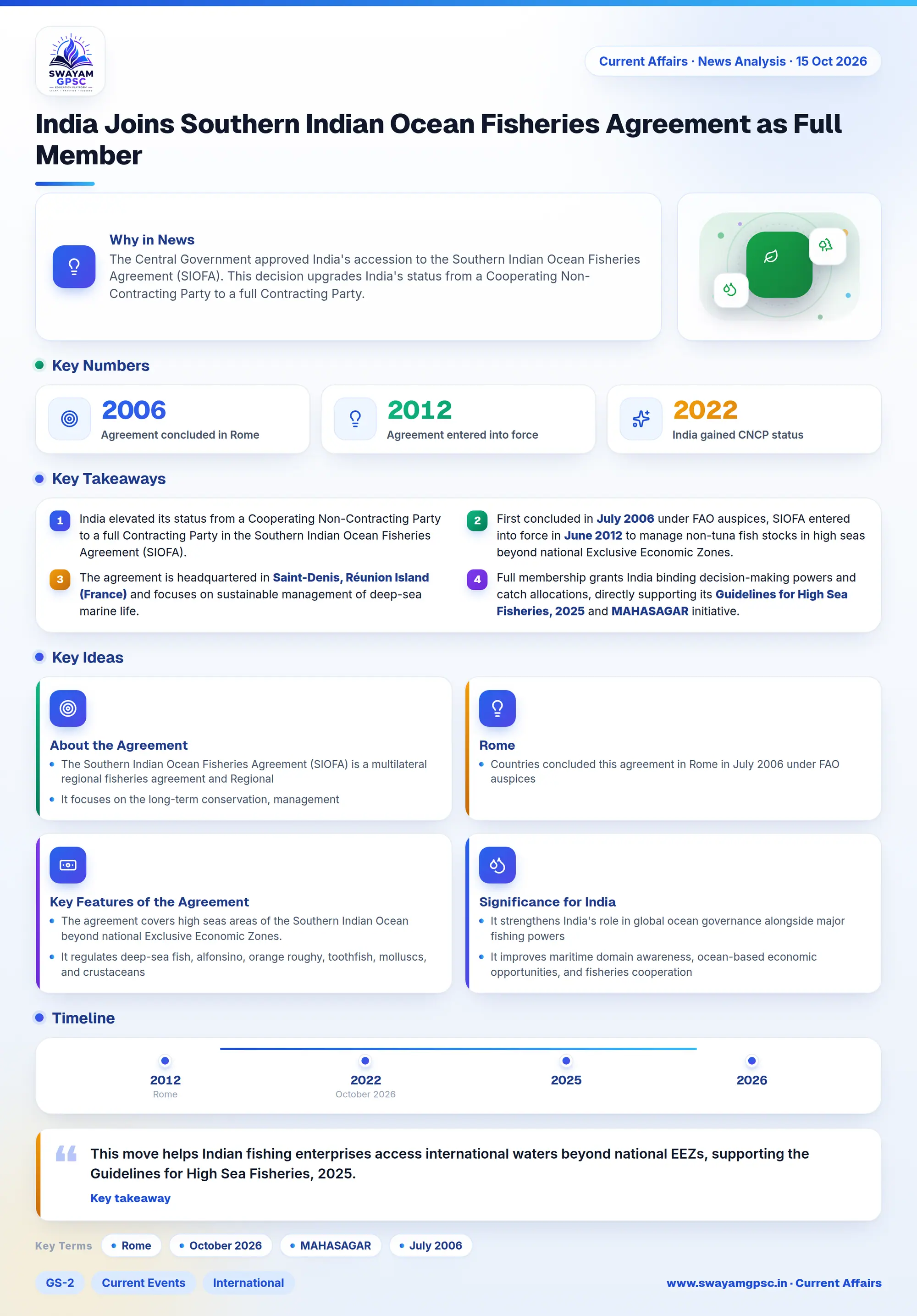
India Joins Southern Indian Ocean Fisheries Agreement as Full Member
#GS-2 #Current Events #International #GS-3 #Economy #Agriculture #Environment #Biodiversity #MAHASAGAR #SIOFA
Key takeaways
- India elevated its status from a Cooperating Non-Contracting Party to a full Contracting Party in the Southern Indian Ocean Fisheries Agreement (SIOFA).
- First concluded in July 2006 under FAO auspices, SIOFA entered into force in June 2012 to manage non-tuna fish stocks in high seas beyond national Exclusive Economic Zones.
- The agreement is headquartered in Saint-Denis, Réunion Island (France) and focuses on sustainable management of deep-sea marine life.
- Full membership grants India binding decision-making powers and catch allocations, directly supporting its Guidelines for High Sea Fisheries, 2025 and MAHASAGAR initiative.
Why in News
- The Central Government approved India's accession to the Southern Indian Ocean Fisheries Agreement (SIOFA).
- This decision upgrades India's status from a Cooperating Non-Contracting Party to a full Contracting Party.
About the Agreement
- The Southern Indian Ocean Fisheries Agreement (SIOFA) is a multilateral regional fisheries agreement and Regional Fisheries Management Organization (RFMO).
- It focuses on the long-term conservation, management, and sustainable utilization of non-tuna fishery resources in the high seas of the Southern Indian Ocean.
- It is an independent RFMO headquartered in Saint-Denis, Réunion Island (France).
- The organization is governed by the Meeting of the Parties and gets support from Scientific and Compliance Committees.
Background
- Countries concluded this agreement in Rome in July 2006 under FAO auspices, and it officially entered into force in June 2012.
- Unlike the Indian Ocean Tuna Commission (IOTC) that regulates tuna, SIOFA manages non-highly migratory fish stocks in international waters.
- India originally obtained Cooperating Non-Contracting Party status in 2022, which allowed limited participation without decision-making rights before its October 2026 full accession approval.
Key Features of the Agreement
- The agreement covers high seas areas of the Southern Indian Ocean beyond national Exclusive Economic Zones.
- It regulates deep-sea fish, alfonsino, orange roughy, toothfish, molluscs, and crustaceans, while excluding highly migratory tuna species.
- It uses Scientific Committee assessments to set catch limits, gear restrictions, and protected zones around Vulnerable Marine Ecosystems like seamounts.
- Authorized member vessels can inspect fishing operations on the high seas to combat Illegal, Unreported, and Unregulated fishing.
- Full Contracting Parties get binding voting rights, catch-allocation options, scientific cooperation, and vessel authorization.
Significance for India
- This move helps Indian fishing enterprises access international waters beyond national EEZs, supporting the Guidelines for High Sea Fisheries, 2025.
- It strengthens India's role in global ocean governance alongside major fishing powers, ensuring equitable access to high-seas marine resources.
- It improves maritime domain awareness, ocean-based economic opportunities, and fisheries cooperation, aligning with India's MAHASAGAR vision.