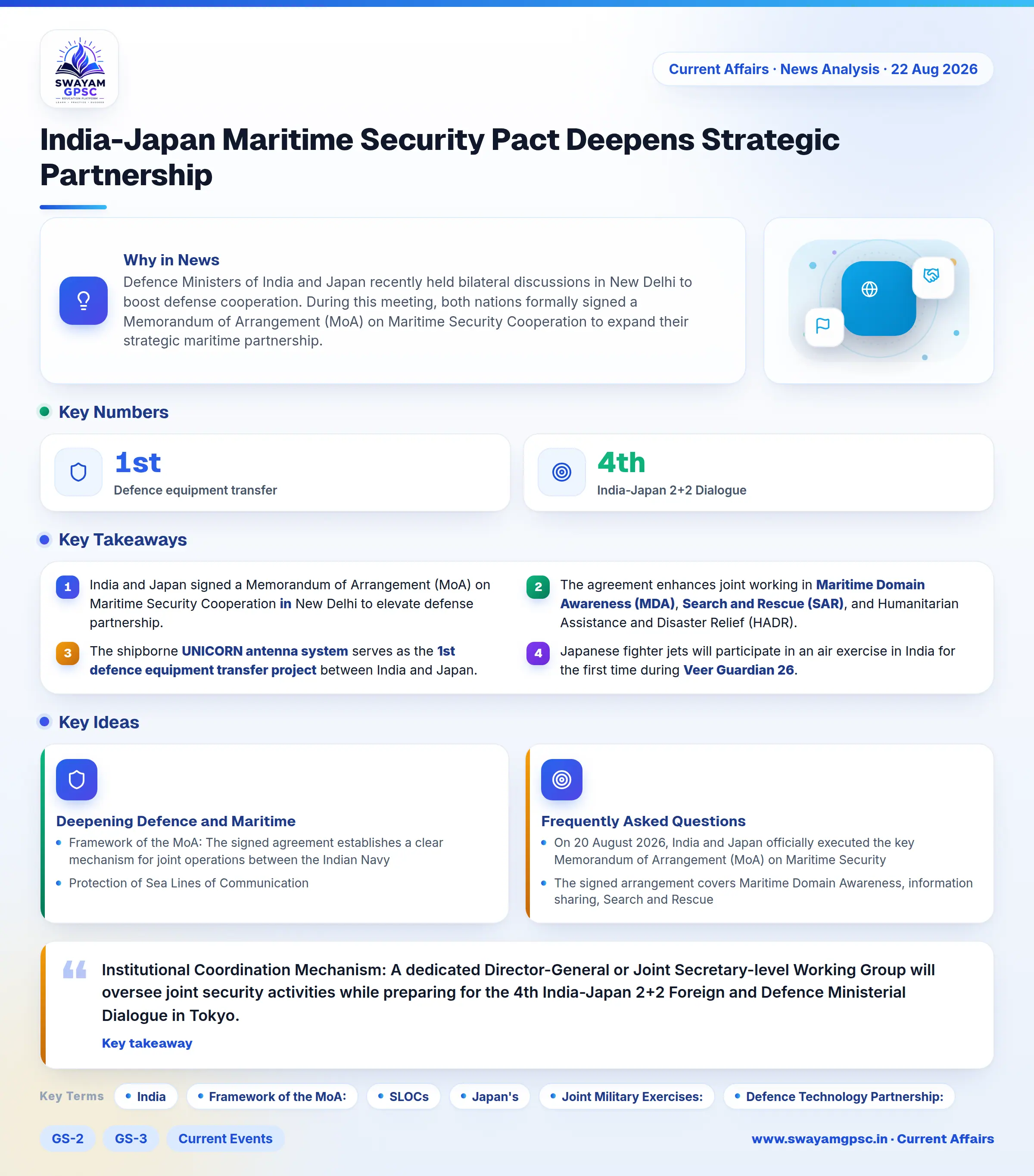
India-Japan Maritime Security Pact Deepens Strategic Partnership
#GS-2 #GS-3 #Current Events #International #Science & Technology #Defence #Maritime Security #India-Japan Relations
Key takeaways
- India and Japan signed a Memorandum of Arrangement (MoA) on Maritime Security Cooperation in New Delhi to elevate defense partnership.
- The agreement enhances joint working in Maritime Domain Awareness (MDA), Search and Rescue (SAR), and Humanitarian Assistance and Disaster Relief (HADR).
- The shipborne UNICORN antenna system serves as the 1st defence equipment transfer project between India and Japan.
- Japanese fighter jets will participate in an air exercise in India for the first time during Veer Guardian 26.
- Both nations are finalizing arrangements for the 4th India-Japan 2+2 Foreign and Defence Ministerial Dialogue in Tokyo.
Why in News
- Defence Ministers of India and Japan recently held bilateral discussions in New Delhi to boost defense cooperation.
- During this meeting, both nations formally signed a Memorandum of Arrangement (MoA) on Maritime Security Cooperation to expand their strategic maritime partnership.
Deepening Defence and Maritime Cooperation
- Framework of the MoA: The signed agreement establishes a clear mechanism for joint operations between the Indian Navy and the Japan Maritime Self-Defense Force (JMSDF) in Maritime Domain Awareness (MDA), Search and Rescue (SAR), and Humanitarian Assistance and Disaster Relief (HADR).
- Protection of Sea Lines of Communication: Both nations pledged to protect critical sea routes (SLOCs) through reciprocal naval visits, combined military exercises, expert exchanges, port access, logistics sharing, and ship repair services.
- Naval Shipbuilding and Maintenance: India and Japan decided to combine Japan's high-end technology with India's manufacturing capacity for joint ship design, while encouraging foreign ship repairs in Indian yards under Make in India.
- Joint Military Exercises: Both defense forces will widen existing drills like Dharma Guardian and JAIMEX, while Japanese combat jets will participate in India for the first time during Veer Guardian 26.
- Defence Technology Partnership: India's DRDO and Japan's Acquisition, Technology & Logistics Agency (ATLA) will advance technical cooperation in modern defense hardware through a dedicated Defence Industry Forum.
- The UNICORN Project: The ship-mounted UNICORN integrated communications antenna system was highlighted as a landmark project, serving as the 1st defence equipment transfer project between the two countries.
- Special Forces and Command Coordination: The bilateral pact encourages interaction between Special Operations Forces of both nations and opens opportunities to engage with India's forthcoming integrated theatre commands.
- Vision for the Indo-Pacific: Both countries reaffirmed their commitment to a free and open Indo-Pacific zone, rejecting unilateral actions that alter the maritime status quo and agreeing to support third-party initiatives like the Indo-Pacific Logistics Network.
- Institutional Coordination Mechanism: A dedicated Director-General or Joint Secretary-level Working Group will oversee joint security activities while preparing for the 4th India-Japan 2+2 Foreign and Defence Ministerial Dialogue in Tokyo.
Frequently Asked Questions
- On 20 August 2026, India and Japan officially executed the key Memorandum of Arrangement (MoA) on Maritime Security Cooperation.
- The signed arrangement covers Maritime Domain Awareness, information sharing, Search and Rescue, Humanitarian Assistance and Disaster Relief, logistics support, and SLOC protection.
- JAIMEX is a dedicated bilateral naval exercise held periodically between India and Japan to boost operational readiness.
- The UNICORN initiative focuses on advanced shipborne antenna tech, marking the 1st defence equipment transfer project between both friendly nations.
- The India-Japan 2+2 Dialogue serves as a high-level strategic panel involving the Foreign and Defence Ministers of both partner countries.