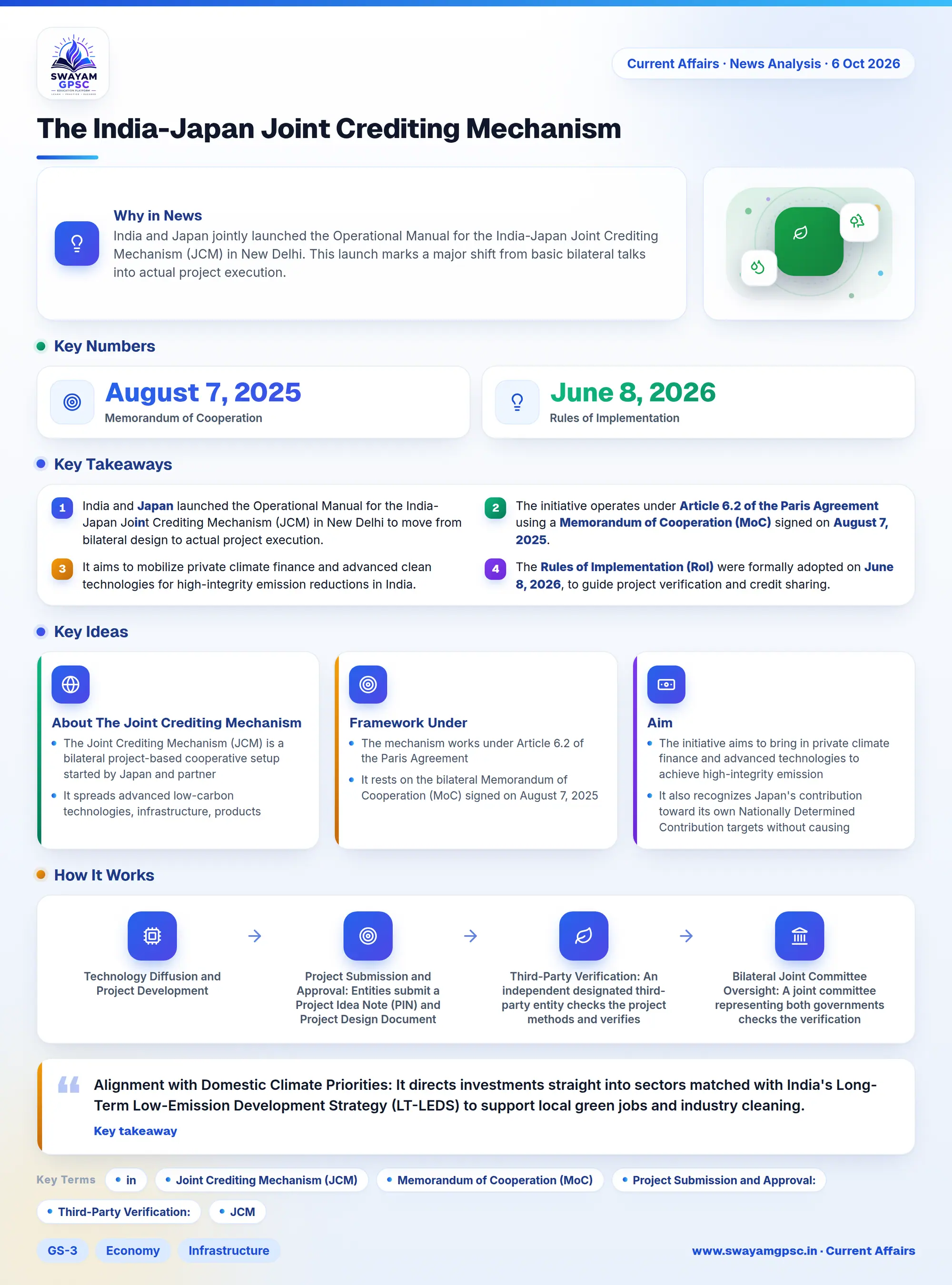
The India-Japan Joint Crediting Mechanism
#GS-3 #Economy #Infrastructure #Environment #Climate Change #Sustainable Development #Current Events #International
Key takeaways
- India and Japan launched the Operational Manual for the India-Japan Joint Crediting Mechanism (JCM) in New Delhi to move from bilateral design to actual project execution.
- The initiative operates under Article 6.2 of the Paris Agreement using a Memorandum of Cooperation (MoC) signed on August 7, 2025.
- It aims to mobilize private climate finance and advanced clean technologies for high-integrity emission reductions in India.
- The Rules of Implementation (RoI) were formally adopted on June 8, 2026, to guide project verification and credit sharing.
Why in News
- India and Japan jointly launched the Operational Manual for the India-Japan Joint Crediting Mechanism (JCM) in New Delhi.
- This launch marks a major shift from basic bilateral talks into actual project execution.
About The Joint Crediting Mechanism
- The Joint Crediting Mechanism (JCM) is a bilateral project-based cooperative setup started by Japan and partner developing countries.
- It spreads advanced low-carbon technologies, infrastructure, products, and services to create verified greenhouse gas emission reduction and removal credits.
Framework Under
- The mechanism works under Article 6.2 of the Paris Agreement, which sets up a formal accounting system for voluntary bilateral cooperation and the transfer of Internationally Transferred Mitigation Outcomes (ITMOs).
- It rests on the bilateral Memorandum of Cooperation (MoC) signed on August 7, 2025, and the Rules of Implementation (RoI) adopted on June 8, 2026.
Aim
- The initiative aims to bring in private climate finance and advanced technologies to achieve high-integrity emission reductions in India.
- It also recognizes Japan's contribution toward its own Nationally Determined Contribution targets without causing double counting.
How It Works
- Technology Diffusion and Project Development: Japanese and Indian participants work together to bring advanced clean technologies into Indian industries.
- Project Submission and Approval: Entities submit a Project Idea Note (PIN) and Project Design Document according to the new Operational Manual.
- Third-Party Verification: An independent designated third-party entity checks the project methods and verifies baseline emission cuts.
- Bilateral Joint Committee Oversight: A joint committee representing both governments checks the verification reports and approves the final amount of pollution reduced.
- Credit Issuance and NDC Allocation: JCM credits are issued and shared between India and Japan, where Japan uses its share for its targets while India keeps its share and gains cleaner infrastructure.
Key Features
- Comprehensive Full-Cycle Operational Manual: It provides clear and standard rules for every step of project building, method creation, monitoring, reporting, checking, and digital credit transfers.
- Article 6.2 High-Integrity Accounting: It uses strict corresponding adjustments to stop the double counting of emission cuts, keeping global carbon markets transparent.
- Co-Financing and Risk Mitigation: It combines Japanese public and private financial subsidies to lower investment risks for expensive green projects in India.
- Alignment with Domestic Climate Priorities: It directs investments straight into sectors matched with India's Long-Term Low-Emission Development Strategy (LT-LEDS) to support local green jobs and industry cleaning.