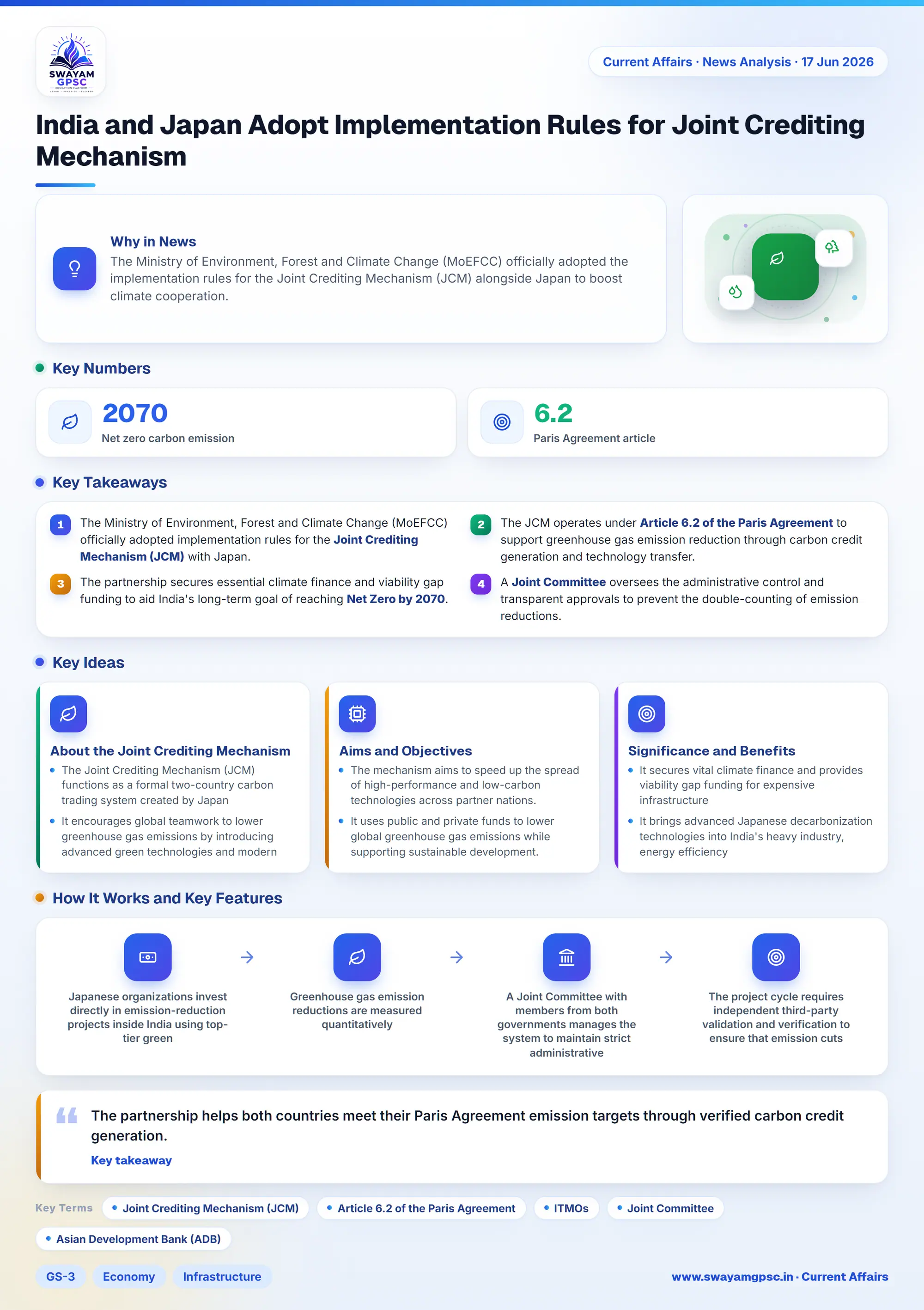
India and Japan Adopt Implementation Rules for Joint Crediting Mechanism
#GS-3 #Economy #Infrastructure #Environment #Climate Change #Sustainable Development #Current Events #National #International #Groupings & Agreements Involving India and/or Affecting India's Interests
Key takeaways
- The Ministry of Environment, Forest and Climate Change (MoEFCC) officially adopted implementation rules for the Joint Crediting Mechanism (JCM) with Japan.
- The JCM operates under Article 6.2 of the Paris Agreement to support greenhouse gas emission reduction through carbon credit generation and technology transfer.
- The partnership secures essential climate finance and viability gap funding to aid India's long-term goal of reaching Net Zero by 2070.
- A Joint Committee oversees the administrative control and transparent approvals to prevent the double-counting of emission reductions.
Why in News
- The Ministry of Environment, Forest and Climate Change (MoEFCC) officially adopted the implementation rules for the Joint Crediting Mechanism (JCM) alongside Japan to boost climate cooperation.
- This important operational step activates a two-country carbon market framework under Article 6.2 of the Paris Agreement.
About the Joint Crediting Mechanism
- The Joint Crediting Mechanism (JCM) functions as a formal two-country carbon trading system created by Japan with various partner countries.
- It encourages global teamwork to lower greenhouse gas emissions by introducing advanced green technologies and modern infrastructure in developing economies.
- The system operates internationally under Article 6.2 of the Paris Agreement set by the United Nations Framework Convention on Climate Change (UNFCCC).
- It regulates cooperative climate approaches and the transfer of Internationally Transferred Mitigation Outcomes (ITMOs).
Aims and Objectives
- The mechanism aims to speed up the spread of high-performance and low-carbon technologies across partner nations.
- It uses public and private funds to lower global greenhouse gas emissions while supporting sustainable development.
- The system helps both participating countries achieve their individual Nationally Determined Contributions (NDCs).
How It Works and Key Features
- Japanese organizations invest directly in emission-reduction projects inside India using top-tier green innovations across renewable energy and low-carbon infrastructure.
- Greenhouse gas emission reductions are measured quantitatively, and the resulting carbon credits are split between Japan and India to count toward climate goals.
- A Joint Committee with members from both governments manages the system to maintain strict administrative control and transparent approvals.
- The project cycle requires independent third-party validation and verification to ensure that emission cuts are real and permanent.
- The system relies on strong national registries to track, issue, and transfer credits, which prevents double-counting and maintains high environmental integrity.
- Projects receive support from multiple funding channels, including JCM model projects via the Ministry of the Environment of Japan (MOEJ), Asian Development Bank (ADB) trust funds, and demonstration projects managed by the New Energy and Industrial Technology Development Organization (NEDO).
Significance and Benefits
- The partnership helps both countries meet their Paris Agreement emission targets through verified carbon credit generation.
- It secures vital climate finance and provides viability gap funding for expensive infrastructure, helping India reach its long-term goal of Net Zero by 2070.
- It brings advanced Japanese decarbonization technologies into India's heavy industry, energy efficiency, and renewable energy sectors, making clean energy projects more affordable.