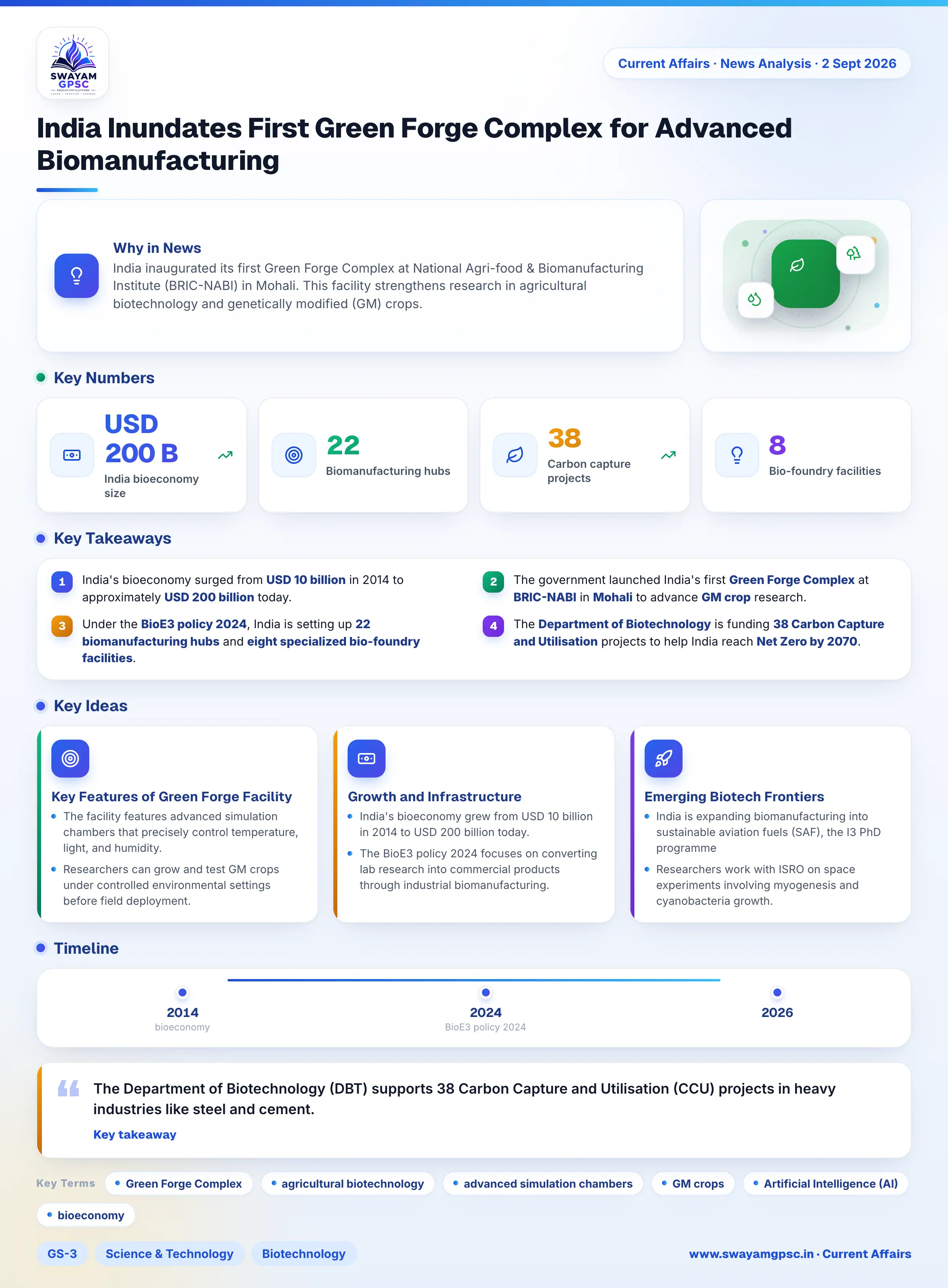
India Inundates First Green Forge Complex for Advanced Biomanufacturing
#GS-3 #Science & Technology #Biotechnology #Environment #Sustainable Development #Government Policies & Interventions #Economy #Agriculture
Key takeaways
- India's bioeconomy surged from USD 10 billion in 2014 to approximately USD 200 billion today.
- The government launched India's first Green Forge Complex at BRIC-NABI in Mohali to advance GM crop research.
- Under the BioE3 policy 2024, India is setting up 22 biomanufacturing hubs and eight specialized bio-foundry facilities.
- The Department of Biotechnology is funding 38 Carbon Capture and Utilisation projects to help India reach Net Zero by 2070.
Why in News
- India inaugurated its first Green Forge Complex at National Agri-food & Biomanufacturing Institute (BRIC-NABI) in Mohali.
- This facility strengthens research in agricultural biotechnology and genetically modified (GM) crops.
- The launch took place during the National Conclave on BioE3 2026 to encourage high-performance biomanufacturing.
Key Features of Green Forge Facility
- The facility features advanced simulation chambers that precisely control temperature, light, and humidity.
- Researchers can grow and test GM crops under controlled environmental settings before field deployment.
- It integrates biotechnology with Artificial Intelligence (AI) to accelerate agricultural and medical science research.
Growth and Infrastructure in Bioeconomy
- India's bioeconomy grew from USD 10 billion in 2014 to USD 200 billion today.
- The BioE3 policy 2024 focuses on converting lab research into commercial products through industrial biomanufacturing.
- The government is establishing 22 biomanufacturing hubs across the country.
- A National Bio-Foundry Network with eight specialized facilities will support start-ups and small businesses.
- The Department of Biotechnology (DBT) supports 38 Carbon Capture and Utilisation (CCU) projects in heavy industries like steel and cement.
Emerging Biotech Frontiers and Sustainability
- India is expanding biomanufacturing into sustainable aviation fuels (SAF), the I3 PhD programme, and Space Biotechnology.
- Researchers work with ISRO on space experiments involving myogenesis and cyanobacteria growth.
- The BRIC-NABI institute converts agricultural waste into valuable nutraceuticals and biomaterials.
- This initiative aligns with India's climate targets of Net Zero by 2070 and Atmanirbhar Bharat.