India's Infrastructure Transformation: Key Developments and Growth
#GS-2 #GS-3 #Infrastructure #Economy #Government Policies & Interventions #National #Economic Geography of India
Key takeaways
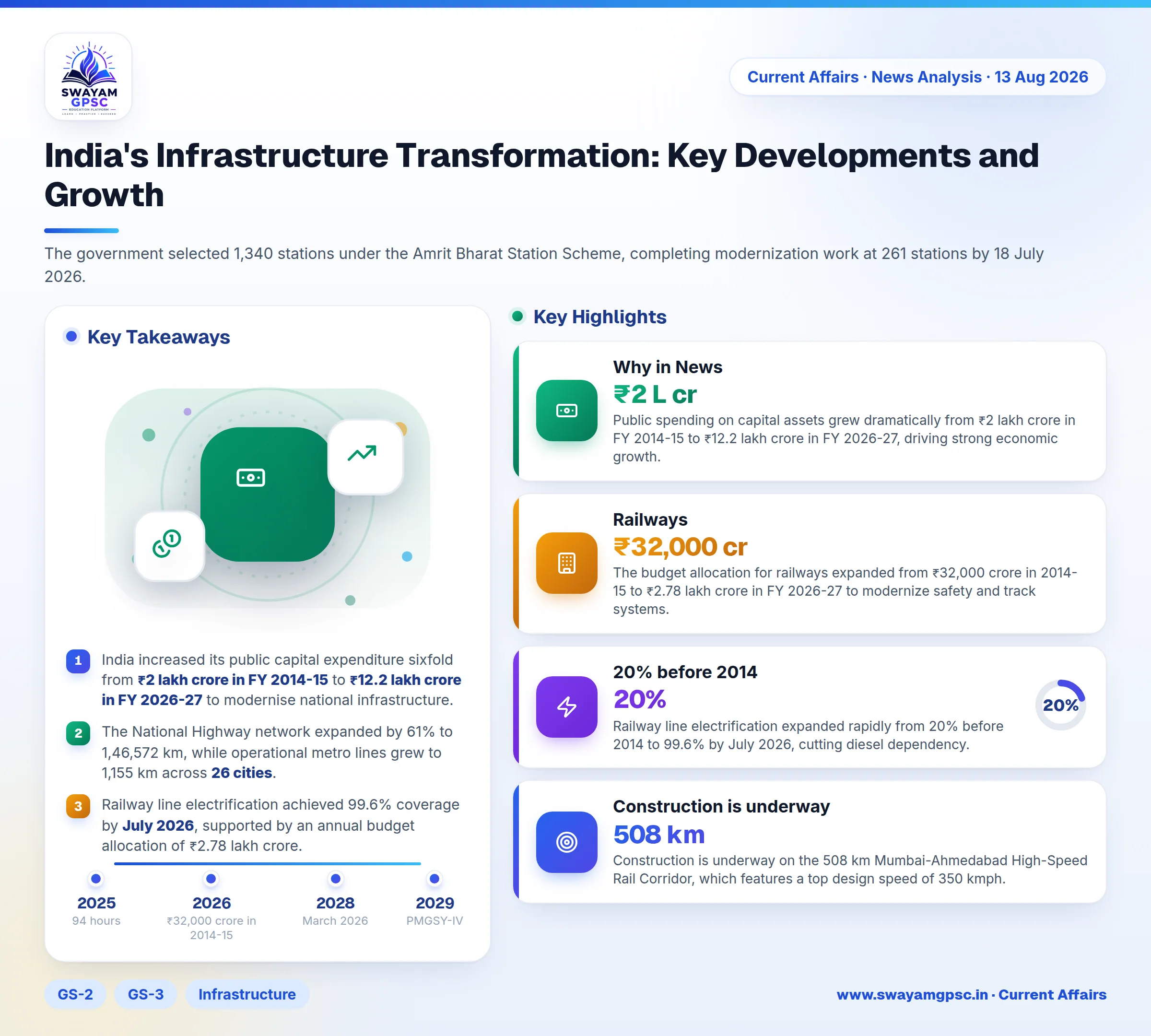
- India increased its public capital expenditure sixfold from ₹2 lakh crore in FY 2014-15 to ₹12.2 lakh crore in FY 2026-27 to modernise national infrastructure.
- The National Highway network expanded by 61% to 1,46,572 km, while operational metro lines grew to 1,155 km across 26 cities.
- Railway line electrification achieved 99.6% coverage by July 2026, supported by an annual budget allocation of ₹2.78 lakh crore.
- Tap water connections in rural households reached 15.91 crore under the Jal Jeevan Mission by August 2026.
- Under the PM GatiShakti plan, the Network Planning Group evaluated 396 projects worth ₹18.66 lakh crore for integrated multimodal logistics.
Why in News
- Over the past 12 years, India transformed its infrastructure through integrated planning across transport, logistics, housing, and water systems.
- Public spending on capital assets grew dramatically from ₹2 lakh crore in FY 2014-15 to ₹12.2 lakh crore in FY 2026-27, driving strong economic growth.
Railways
- The budget allocation for railways expanded from ₹32,000 crore in 2014-15 to ₹2.78 lakh crore in FY 2026-27 to modernize safety and track systems.
- Railway line electrification expanded rapidly from 20% before 2014 to 99.6% by July 2026, cutting diesel dependency.
- Indian Railways currently runs 162 Vande Bharat, 2 Vande Bharat Sleeper, and 72 Amrit Bharat trains for modern passenger travel.
- Authorities installed the home-grown train protection technology Kavach Version 4.0 across 2,633 route km by July 2026 to prevent train collisions.
- Construction is underway on the 508 km Mumbai-Ahmedabad High-Speed Rail Corridor, which features a top design speed of 350 kmph.
- The government selected 1,340 stations under the Amrit Bharat Station Scheme, completing modernization work at 261 stations by 18 July 2026.
- In July 2026, India introduced a 10-coach indigenously built Hydrogen Fuel Cell Trainset carrying 2,600 passengers on the Jind-Sonipat route.
Roads and Highways Connecting India
- India manages the second-biggest road system globally, spanning around 63.73 lakh km to support passenger travel and freight transport.
- The total length of National Highways grew 61%, rising from 91,287 km in FY 2013-14 to 1,46,572 km by March 2026.
- High-capacity highways with four or more lanes expanded from 18,371 km in 2014 to 45,516 km, easing traffic congestion.
- Workers built 4.11 lakh km of rural roads under PMGSY between 2014 and 2026, outpacing the 3.86 lakh km completed from 2000 to 2014.
- The government introduced PMGSY-IV in September 2024 to build all-weather roads for 25,000 isolated villages by 2029.
- Contractors finished 22,590 km of highway corridors under the Bharatmala Pariyojana by 31st March 2026.
Bridges and Tunnels: Engineering New Frontiers
- Located on the USBRL project, the 1,315-metre long Chenab Rail Bridge sits 359 metres above the river bed as the world's highest rail arch structure.
- Built in Jammu & Kashmir, the Anji Khad Bridge serves as India's premier cable-stayed railway structure across complex mountain terrain.
- The 2.08-km New Pamban Bridge in Tamil Nadu functions as India's first vertical-lift railway sea bridge with a 72.5-metre liftable span for passing ships.
- The 12-km Z-Morh Tunnel project features a 6.4-km main passage to provide safe all-weather travel between Srinagar and Sonamarg.
- Opening in 2024, the 2.32-km Sudarshan Setu cable-stayed bridge connects the Okha mainland to Beyt Dwarka in Gujarat.
- Spanning 9.02 km under Rohtang Pass, the Atal Tunnel shortens the Manali-Sarchu distance by 46 km and saves up to 5 hours of driving time.
- The 9-km Dr. Syama Prasad Mookerjee Tunnel bypasses 41 km of dangerous roads and reduces travel time between Jammu and Srinagar by roughly 2 hours.
Civil Aviation and Regional Air Access
- By 15th July 2026, the UDAN regional flight program linked 95 airports, heliports, and water aerodromes across 679 routes, assisting 1.68 crore passengers.
- The count of active operational airports in India increased from 74 in 2014 to 165 by July 2026.
- Authorities granted official approval for 25 greenfield airports after 2014 to handle increasing passenger volumes.
- Operating across 38 airports, the Digi Yatra contactless platform processed over 10 crore passenger journeys alongside 2.4 crore app downloads.
- The government sanctioned the Modified UDAN Scheme in March 2026 with a budget of ₹28,840 crore running through FY 2035-36.
- This modified initiative plans to construct 100 airports from existing airstrips and set up 200 modern helipads in hilly or remote areas.
- Financial help through Viability Gap Funding will support regional air carriers and help maintain airport facilities on low-traffic routes.
Metro and Mass Urban Transit
- India's operational urban metro network grew from 248 km in 2014 to over 1,155 km in 2026, making it the world's third largest network.
- Metro systems expanded from 5 cities in 2014 to 26 cities, carrying a daily passenger load of more than 1.15 crore people.
- In 2024, Kolkata opened India's initial underwater metro section along the Esplanade-Howrah Maidan line passing beneath the Hooghly River.
- Launching its first vessel in December 2021 and operations in April 2023, Kochi introduced India's first electric-hybrid Water Metro system.
India’s Maritime Momentum
- Cargo handling capability across major Indian sea ports nearly doubled from 873 MMTPA in 2014 to 1,728 MMTPA in 2026.
- Mean ship turn-around time at major public ports dropped from 94 hours down to 48.8 hours in 2025-26.
- Total cargo traffic handled at primary ports reached 915.17 million tonnes in FY 2025-26, up from 581 million tonnes in FY 2014-15.
- The Sagarmala Programme enhances port infrastructure, logistics connectivity, and coastal economic development.
- Declared National Waterways increased from 5 in 2014 to 111 in 2026, with 32 waterways actively operating today.
- India became the world's leading ship-recycling country in 2025, holding a 35.4% global market share and recycling 2.99 million gross tons.
- In the Container Port Performance Index 2025, Jawaharlal Nehru Port secured the 22nd position globally.
- The Bharat Maritime Insurance Pool (BMIP) began operating on 12th May 2026 with USD 1.5 billion capacity and a USD 1.4 billion (₹12,980 crore) government guarantee.
- By 29th July 2026, the BMIP framework issued 1,608 Cargo War and Hull War risk policies for domestic ships.
Strengthening Logistics and Industrial Capacity
- The PM GatiShakti National Master Plan coordinates project planning across 58 Ministries and Departments using 3,291 data layers.
- As of 11th August 2026, the Network Planning Group evaluated 396 infrastructure projects worth ₹18.66 lakh crore, sanctioning 256 of them.
- The National Logistics Policy works beside PM GatiShakti to lower freight costs and streamline supply chains across different transport modes.
- Through the PRAGATI platform, officials reviewed 382 major projects valued at over ₹85 lakh crore and cleared 2,958 administrative issues.
- The digital India Industrial Land Bank (IILB) maps more than 4,220 industrial parks to give clear details to prospective investors.
- Around 272 plug-and-play industrial parks operate currently, allowing manufacturers to start factories without long set-up delays.
- Government authorities approved 20 industrial smart cities across seven industrial corridors to boost manufacturing hubs.
- Approved in March 2026 with ₹33,660 crore, the Bharat Audyogik Vikas Yojna (BHAVYA) will set up 100 investment-ready industrial parks.
- The BHAVYA Rasayan scheme provides ₹3,030 crore from FY 2026-27 to FY 2030-31 to construct three dedicated chemical parks.
- The government sanctioned seven PM MITRA Parks with a budget allocation of ₹4,445 crore to build modern textile manufacturing clusters.
Water, Housing and Urban Development
- Tap-water coverage in rural homes increased from 3.23 crore in 2019 to 15.91 crore by 10th August 2026 under the Jal Jeevan Mission.
- Approved in March 2026, JJM 2.0 extends the rural water mission to December 2028 with a financial outlay of ₹8.69 lakh crore.
- Under PMAY-Urban, workers finished 99.25 lakh houses by 12th August 2026, with 96% of PMAY-U 2.0 allocations going to women owners.
- Out of 3.91 crore sanctioned houses under PMAY-Gramin, builders completed 3.13 crore homes, where women own nearly 75% of properties.
- The SWAMIH Fund delivered over 63,000 completed homes by June 2026, helping 2.52 lakh people move into delayed housing projects.
- Sanctioned projects under AMRUT and AMRUT 2.0 reached ₹2.79 lakh crore since 2015 to upgrade urban water and sanitation utilities.
- Under the Smart Cities Mission, cities completed 7,790 projects worth ₹1,56,257 crore by March 2026 to upgrade urban services.
Conclusion
- India's infrastructure development strategy moved beyond basic physical connectivity to building large integrated capacity across sectors.
- Large investments in transport networks, urban housing, clean water, and industrial parks strengthen long-term economic competitiveness.