India's Higher Education System Undergoes Massive Expansion Over Decade
#GS-2 #Governance & Social Justice #Education #Social Justice #Current Events #National #GS-3 #Economy #Employment #Higher Education #NEP 2020 #AISHE
Key takeaways
- India's overall higher education enrollment increased by 31.5% over ten years, growing from 3.42 crore to 4.50 crore students.
- The national Gross Enrolment Ratio (GER) reached 30.0% in 2023-24, with female GER surpassing male GER for seven consecutive years.
- Ph.D. research admissions experienced a dramatic rise of 192.9%, reaching 3.43 lakh doctoral candidates.
- Despite producing over 1.09 crore graduates annually, skill mismatches leave more than 29% of educated youth facing job search delays.
- Strategic policy targets under NEP 2020 aim to raise India's higher education Gross Enrolment Ratio to 50% by the year 2035.
Why in News
- The Ministry of Education published a ten-year performance evaluation using data from the All India Survey on Higher Education (AISHE).
- The evaluation reveals that higher education in India underwent substantial structural expansion between 2014-15 and 2023-24.
Overview of Higher Education System
- India manages the second largest tertiary education network across the world, driving the national shift toward a knowledge economy under NEP 2020.
- This academic network supports SDG 4, which aims to ensure inclusive and equal quality education for all students.
- Government initiatives over the decade transformed higher education from an exclusive system into an inclusive model focused on multidisciplinary research and social balance.
Decadal AISHE Trends and Growth
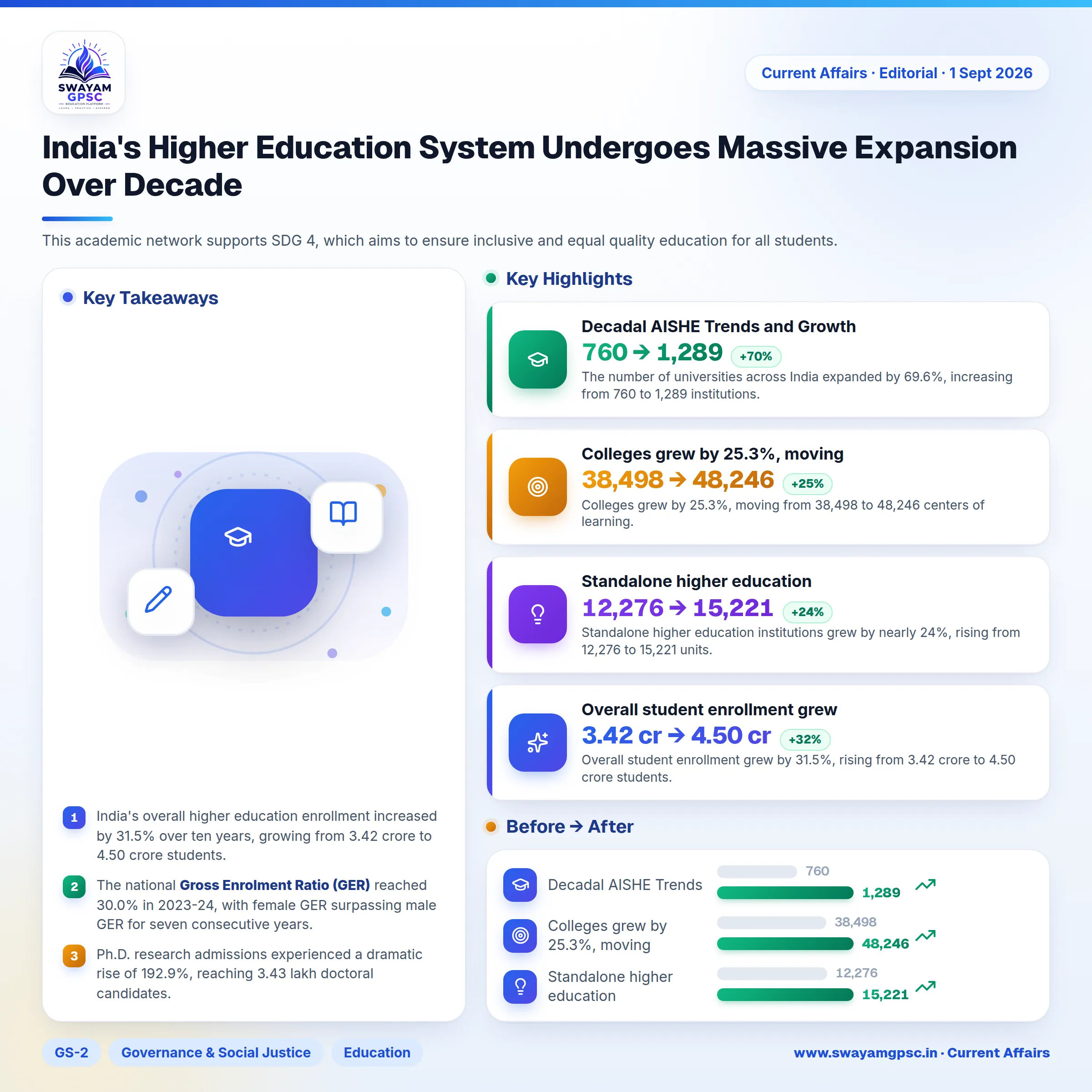
- The number of universities across India expanded by 69.6%, increasing from 760 to 1,289 institutions.
- Colleges grew by 25.3%, moving from 38,498 to 48,246 centers of learning.
- Standalone higher education institutions grew by nearly 24%, rising from 12,276 to 15,221 units.
- Overall student enrollment grew by 31.5%, rising from 3.42 crore to 4.50 crore students.
- The national Gross Enrolment Ratio (GER) rose from 23.7% in 2014-15 to 30.0% in 2023-24, aiming for 50% by 2035.
- Doctoral research admissions experienced a 192.9% surge, expanding from 1.17 lakh to 3.43 lakh Ph.D. scholars.
- Postgraduate degree enrollments grew by 50.2%, increasing from 38.53 lakh to 57.85 lakh students.
- Enrollment in integrated degree programs jumped by 301.4%, rising from 1.41 lakh to 5.69 lakh candidates.
- Female student enrollment rose by 42.2% from 1.57 crore to 2.24 crore, outpacing overall student growth rates.
- The Female Gross Enrolment Ratio hit 31.2%, remaining higher than the male ratio of 28.9% for seven straight years.
- The Gender Parity Index (GPI) improved to 1.08 overall, with Scheduled Caste GPI reaching 1.11 and Scheduled Tribe GPI reaching 1.08.
- Admissions among Other Backward Classes (OBC) grew from 32.8% to 40.1% of total enrollments, marking the highest share increase.
- The enrollment share of Scheduled Caste (SC) students rose to 15.5%, while SC GER climbed from 18.9% to 27.8%.
- The enrollment share of Scheduled Tribe (ST) students increased to 6.4%, while ST GER rose from 13.5% to 22.8%.
- Student enrollment in STEM fields reached 1.02 crore in 2023-24, showing an 11.5% decadal increase.
- The foreign student population in India grew by 37.5%, rising from 42,293 to 58,134 international scholars.
- Higher education degree completions grew by 24.1%, producing over 1.09 crore graduates every year.
Key Drivers Behind Decadal Progress
- Focused social welfare initiatives including specialized scholarships, tuition waivers, and reservation policies increased access for marginalized communities.
- Reforms under NEP 2020 such as flexible degree options and the Academic Bank of Credits (ABC) reduced institutional rigidities.
- Increased funding upgraded campus facilities, leaving over 98% of institutions with libraries, 94% with playfields, and 85% with science laboratories.
- The total teaching force grew by 17.6% to 17.32 lakh faculty members, with female teachers making up 44.9% of all educators.
Challenges
- A wide gap persists between academic curricula and industry skills, leaving over 29% of college graduates waiting longer for employment.
- Enrollment among Persons with Benchmark Disabilities (PwBD) reveals a clear gender gap, with 34,080 male students compared to 20,000 female students.
- Persistent teaching vacancies in state universities and rural colleges undermine classroom quality and student-faculty ratios.
- Advanced research infrastructure remains concentrated inside premier central institutes like IITs and IISc, leaving state colleges underfunded.
- Low international faculty recruitment and modest research citation counts hinder Indian universities in global academic rankings.
Way Forward
- Institutions in regional areas should integrate degree programs with mandatory practical apprenticeships and digital skills like artificial intelligence.
- Governments must build accessible infrastructure, specialized technology labs, and dedicated transport for female students with disabilities.
- State and central authorities should run time-bound recruitment drives to clear long-standing teacher vacancies in public universities.
- The Anusandhan National Research Foundation (ANRF) should create specific funding schemes to modernize research labs in state colleges.
- Authorities must simplify student visas, standardize housing, and expand academic exchanges under the Study in India program to recruit 100,000 foreign students.
Conclusion
- India expanded its higher education network while improving social inclusion and gender equality over the last ten years.
- Reaching the NEP 2020 target of a 50% GER by 2035 requires shifting attention from physical expansion to educational excellence and job readiness.