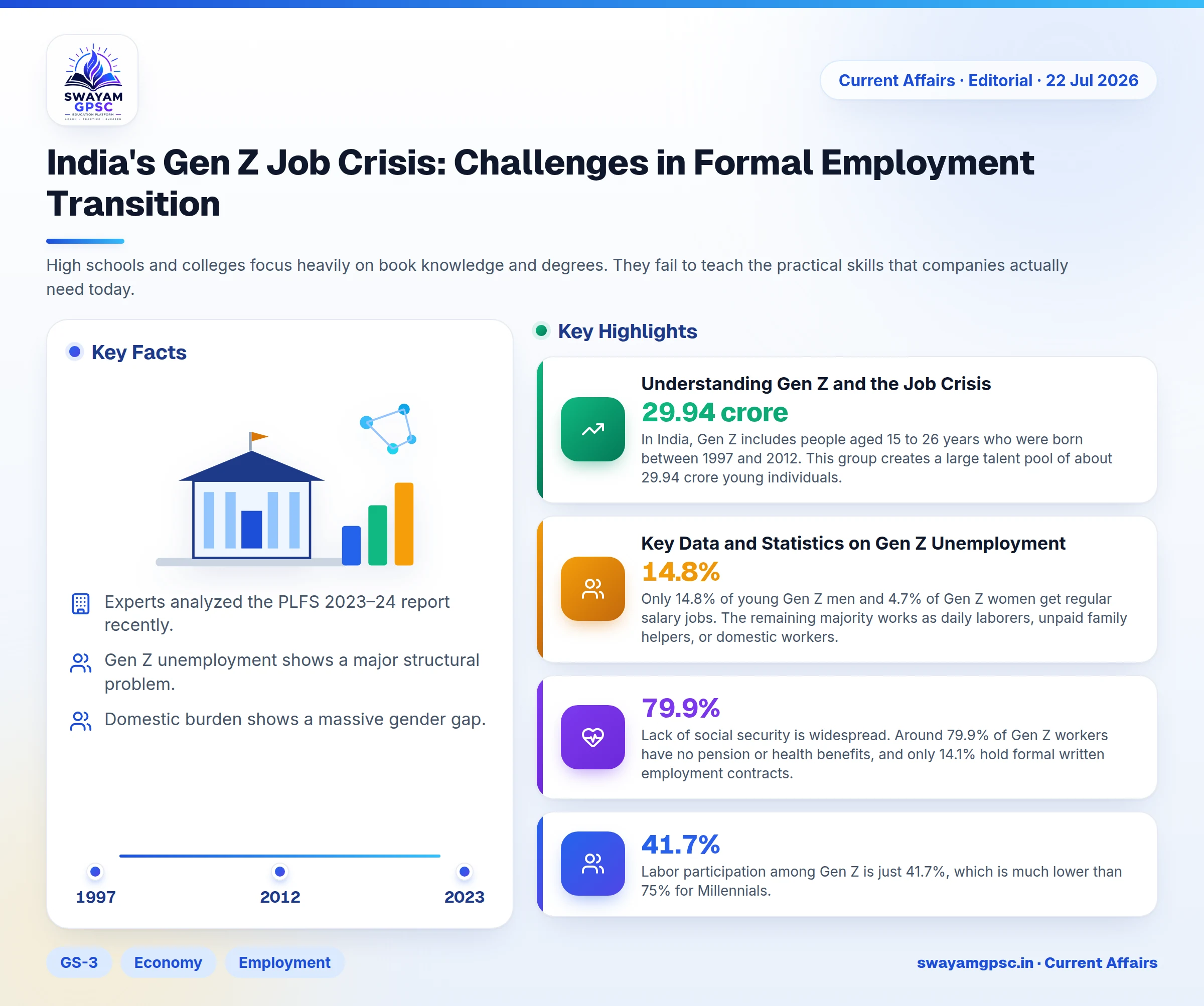
India's Gen Z Job Crisis: Challenges in Formal Employment Transition
#GS-3 #Economy #Employment #Growth #GS-2 #Indian Society #Women #Current Events #National #PLFS 2023-24 #Gen Z Unemployment #Labor Market
Why in News
- Experts analyzed the PLFS 2023–24 report recently. Their analysis shows that India's educated youth face severe difficulties in finding regular, formal jobs today.
Understanding Gen Z and the Job Crisis
- In India, Gen Z includes people aged 15 to 26 years who were born between 1997 and 2012. This group creates a large talent pool of about 29.94 crore young individuals.
- Gen Z unemployment shows a major structural problem. Young jobseekers face high jobless rates, struggle to enter the workforce after studies, and end up in low-paying or unpaid informal jobs.
Key Data and Statistics on Gen Z Unemployment
- Only 14.8% of young Gen Z men and 4.7% of Gen Z women get regular salary jobs. The remaining majority works as daily laborers, unpaid family helpers, or domestic workers.
- Lack of social security is widespread. Around 79.9% of Gen Z workers have no pension or health benefits, and only 14.1% hold formal written employment contracts.
- Labor participation among Gen Z is just 41.7%, which is much lower than 75% for Millennials. For young women, this rate drops drastically to 28% in villages and 21.1% in cities.
- Domestic burden shows a massive gender gap. About 27.1% of Gen Z women spend their time solely on unpaid housework, while only 0.32% of Gen Z men do the same.
Reasons Behind Unemployment Among Indian Gen Z
- High schools and colleges focus heavily on book knowledge and degrees. They fail to teach the practical skills that companies actually need today.
- Rapid growth in AI and automated technology is replacing traditional entry-level office jobs. Companies now require fewer entry-level workers for administrative tasks.
- Women face extra obstacles like lack of safe transport, high childcare costs, and family duties. These factors restrict educated young women from joining the paid workforce.
- Big companies and factories are shifting toward hiring short-term gig workers and contract staff. This trend reduces stable, permanent jobs that offer medical benefits and pensions.
Implications of the Gen Z Job Crisis
- Prolonged joblessness builds frustration among young people. This economic stress can trigger widespread protests and social unrest across different regions.
- Families invest heavily in higher education for their children. However, poor job prospects reduce returns on this money and put financial pressure on households.
- When educated women fail to find formal employment, they return to unpaid domestic work. This shift weakens gender equality and limits women’s financial independence.
- India risks losing the economic advantages of having a young population. Failing to employ young workers converts a demographic asset into a financial burden.
- Widespread informal work and poor salaries cut the spending power of young adults. Lower income leads to weaker consumer demand across the national market.
- Pushing educated youth into low-skill daily labor damages overall national productivity. It limits industrial growth and suppresses long-term economic innovation.
Way Forward
- Government policies must support labor-intensive sectors like textiles, construction, and food processing. These industries can quickly offer formal jobs to casual workers.
- Universities should partner with companies to create direct training pathways. Connecting degree programs with paid apprenticeships will boost hiring rates for graduates.
- Cities need safer public transport, affordable day-care units, and flexible work settings. These improvements will encourage more young women to take up paid jobs.
- State governments should launch structured urban employment schemes. These programs can provide contracts and social security to platform workers and urban youth.
Conclusion
- The main challenge for India today is creating enough high-quality formal jobs for its educated young citizens.
- Leaving nearly 80% of Gen Z workers without pension plans and having graduate unemployment over 30% harms the nation's economic progress.
- To reap the benefits of its young population, the nation must move beyond basic announcements and build strong, formal employment opportunities for Gen Z.