India's Gen Z and the Growing Unemployment Crisis
#GS-3 #GS-2 #Economy #Governance & Social Justice #Indian Society #Employment #Population #Women
Why in News
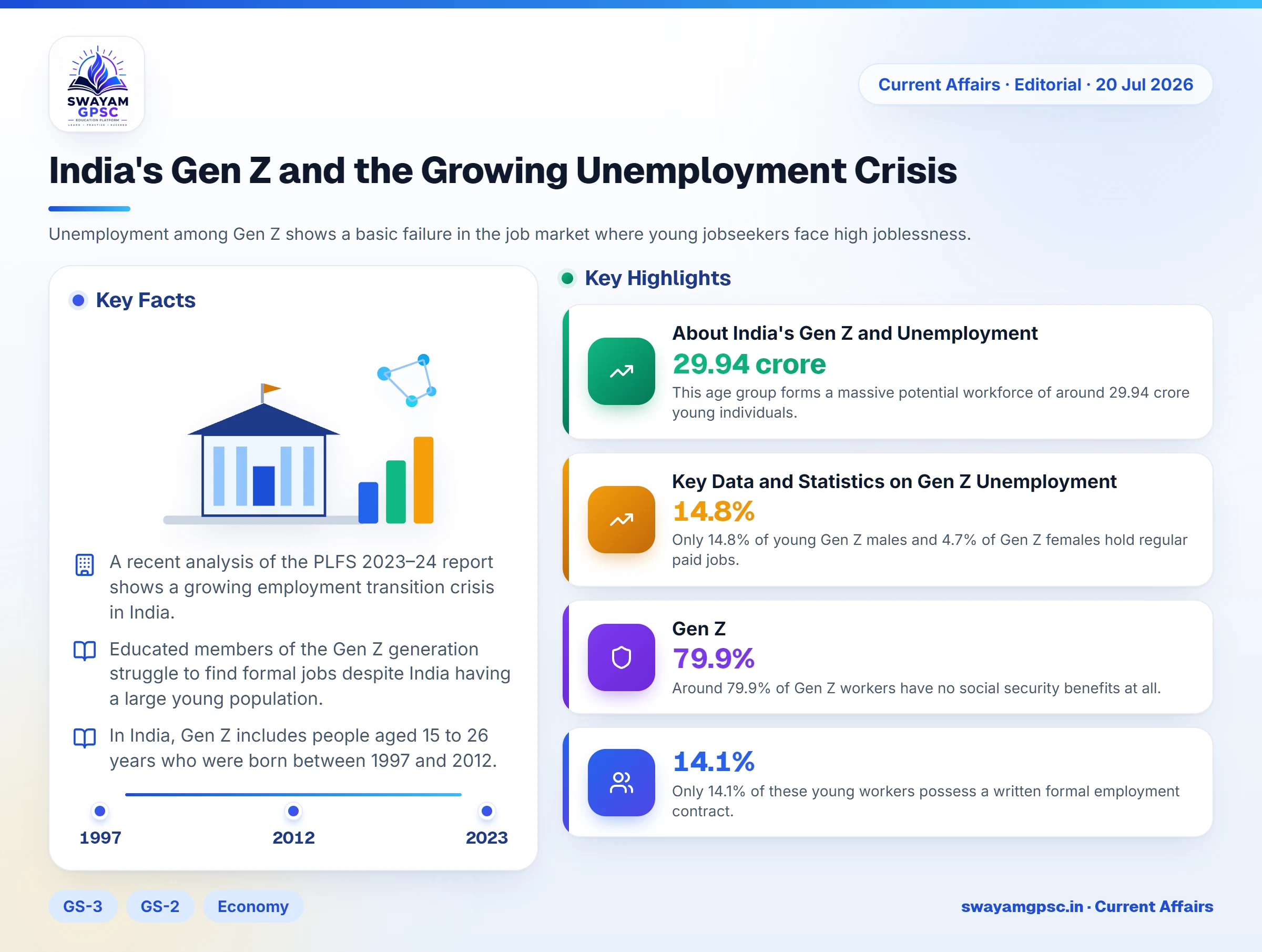
- A recent analysis of the PLFS 2023–24 report shows a growing employment transition crisis in India.
- Educated members of the Gen Z generation struggle to find formal jobs despite India having a large young population.
About India's Gen Z and Unemployment
- In India, Gen Z includes people aged 15 to 26 years who were born between 1997 and 2012.
- This age group forms a massive potential workforce of around 29.94 crore young individuals.
- Unemployment among Gen Z shows a basic failure in the job market where young jobseekers face high joblessness.
- Many young workers face long delays when moving from school to work, with many getting pushed into low-paying informal jobs or unpaid family work.
Key Data and Statistics on Gen Z Unemployment
- Only 14.8% of young Gen Z males and 4.7% of Gen Z females hold regular paid jobs.
- The remaining majority must work as daily wage earners, unpaid family workers, or do unpaid household chores.
- Around 79.9% of Gen Z workers have no social security benefits at all.
- Only 14.1% of these young workers possess a written formal employment contract.
- The labor force participation rate for Gen Z stands low at 41.7%, compared to 75% for older millennials.
- Participation drops sharply for young women, reaching 28% in rural areas and just 21.1% in urban areas.
- Around 27.1% of Gen Z women do unpaid housework full-time, while only 0.32% of young men do the same.
Reasons Behind Unemployment Among Indian Gen Z
- Colleges focus heavily on theoretical degrees rather than practical skills needed by modern companies.
- Fast adoption of AI and automation is cutting down traditional entry-level office jobs and administrative roles.
- Lack of affordable childcare, safety concerns during travel, and social expectations keep millions of educated young women out of work.
- Companies are relying more on short-term contract work and gig roles, reducing permanent jobs that offer social benefits.
Implications of Gen Z Job Crisis
- Lack of steady jobs causes high anxiety among youth, leading to frequent public protests and labor strikes.
- Families spend heavy savings on higher education, but poor job outcomes waste these investments and strain home budgets.
- High obstacles to finding regular jobs push young women back into unpaid house work, worsening gender inequality.
- Failing to provide good jobs to young people turns India's demographic dividend into a financial burden.
- Low wages and informal jobs limit the buying power of youth, slowing down consumer demand across the country.
- Pushing educated youth into low-skill casual labor lowers overall national productivity and slows innovation.
Way Forward
- Government policies should support labor-heavy industries like textiles, food processing, and construction to create formal jobs.
- Colleges must connect degree courses directly with company apprenticeships to help students move smoothly into employment.
- Cities need safer public transport, affordable childcare centers, and flexible work options to help women join the workforce.
- States should launch urban job programs that give social security and clear contracts to gig workers and city youth.
Conclusion
- India's main challenge is creating enough high-quality formal jobs for its educated young population.
- Leaving nearly 80% of young workers without social security and graduate unemployment over 30% harms economic growth.
- To benefit from its young population, India must build strong and stable formal job markets for future generations.