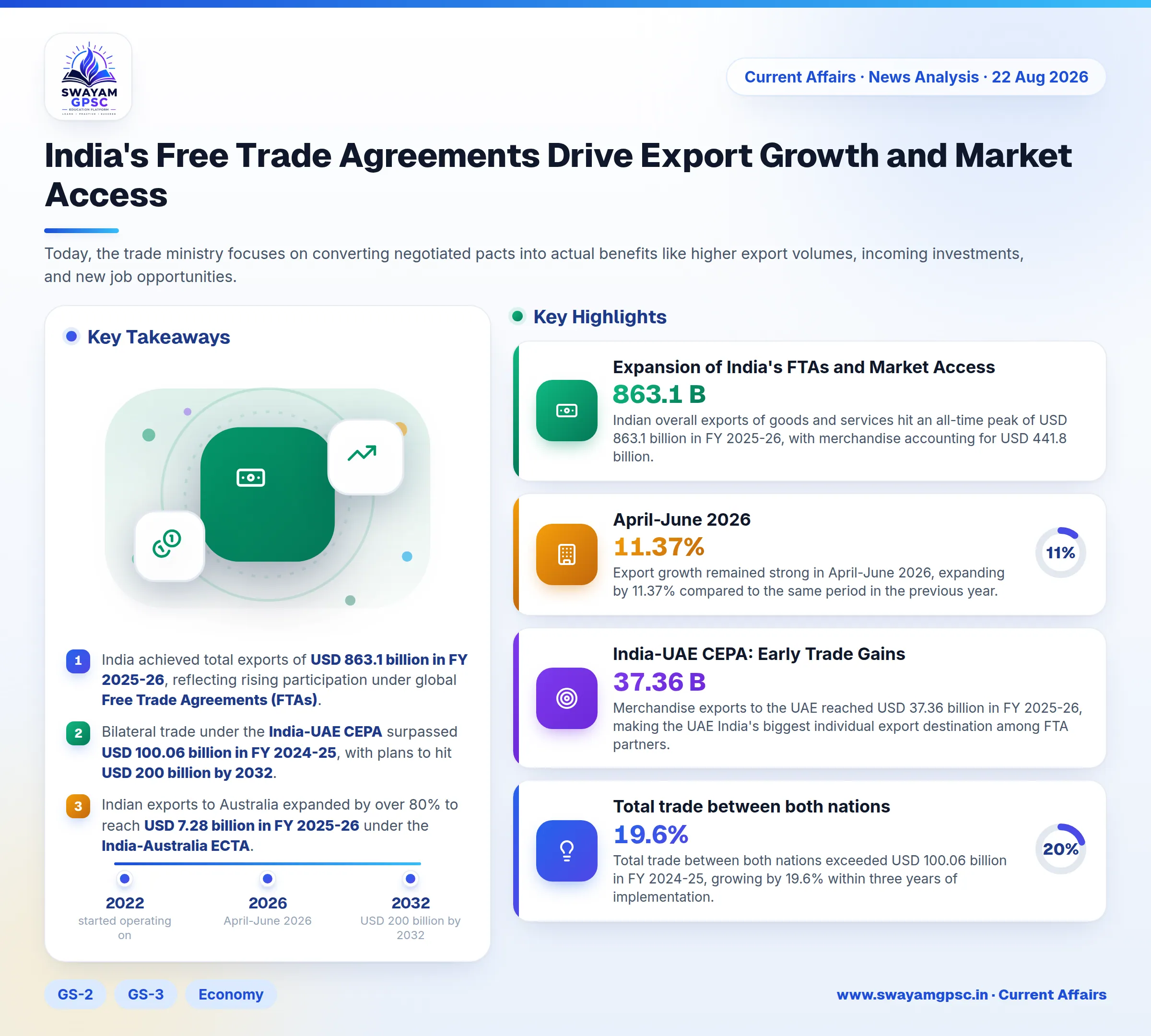
India's Free Trade Agreements Drive Export Growth and Market Access
#GS-2 #GS-3 #Economy #Current Events #Governance & Social Justice #National #International #Growth #Free Trade Agreements
Key takeaways
- India achieved total exports of USD 863.1 billion in FY 2025-26, reflecting rising participation under global Free Trade Agreements (FTAs).
- Bilateral trade under the India-UAE CEPA surpassed USD 100.06 billion in FY 2024-25, with plans to hit USD 200 billion by 2032.
- Indian exports to Australia expanded by over 80% to reach USD 7.28 billion in FY 2025-26 under the India-Australia ECTA.
- The India-UK CETA offers zero-duty access for nearly 99% of Indian goods and saves over ₹4,000 crore through a Double Contribution Convention on social security.
Why in News
- The government recently shared updates on how Indian exporters actively use Free Trade Agreements (FTAs). These agreements have already generated early export growth, increased origin certificate issuance, and expanded product range across partner countries.
Expansion of India's FTAs and Market Access
- Over the last ten years, India built a broad network of Free Trade Agreements (FTAs) with major trading nations to integrate further into global trade.
- These modern trade pacts open fresh markets for exporters, creating new channels in goods, service industries, and foreign investment.
- Today, the trade ministry focuses on converting negotiated pacts into actual benefits like higher export volumes, incoming investments, and new job opportunities.
- India balances global ambitions with domestic safety by protecting sensitive sectors and local producers through careful tariff commitments.
- Indian overall exports of goods and services hit an all-time peak of USD 863.1 billion in FY 2025-26, with merchandise accounting for USD 441.8 billion.
- Export growth remained strong in April-June 2026, expanding by 11.37% compared to the same period in the previous year.
India-UAE CEPA: Early Trade Gains
- The India-UAE Comprehensive Economic Partnership Agreement (CEPA) started operating on 1st May 2022, after negotiators completed discussions in just 88 days.
- Merchandise exports to the UAE reached USD 37.36 billion in FY 2025-26, making the UAE India's biggest individual export destination among FTA partners.
- Total trade between both nations exceeded USD 100.06 billion in FY 2024-25, growing by 19.6% within three years of implementation.
- Looking ahead, both partner nations aim to expand total bilateral trade to USD 200 billion by 2032.
India-Australia ECTA: Expanding Trade Partnership
- Enforced on 29th December 2022, the India-Australia Economic Cooperation and Trade Agreement (ECTA) marked India's first agreement with a developed nation in over ten years.
- Indian goods exports to Australia climbed from USD 4 billion in FY 2020-21 to USD 7.28 billion in FY 2025-26, reflecting an impressive growth rate of over 80%.
- While Australia initially removed import duties on 98.3% of product lines, zero-duty treatment expanded to 100% of Indian goods starting in 2026.
- Building on ECTA, both countries are negotiating a fuller Comprehensive Economic Cooperation Agreement (CECA) covering goods, services, digital commerce, and skilled mobility.
Export Facilitation through Certificates of Origin
- Exporters must prove where their products are made using a preferential Certificate of Origin (CoO) to claim zero or reduced import taxes under trade deals.
- Strong issuance numbers of origin certificates under the UAE CEPA and Australia ECTA show that Indian businesses actively claim available tax cuts.
- The digital portal e-CoO 2.0 streamlines certificate approvals online by using Aadhaar electronic signatures and QR code checks for faster processing.
- Recent agreements like the India-EFTA TEPA and India-UK CETA simplify paperwork by allowing self-declaration and exempting shipments below £1,000 from origin forms.
- Under the India-Australia ECTA, exporters can list multiple eligible goods on a single certificate, cutting down administrative paperwork.
- Small businesses use the official Trade Connect portal to explore lower tariff rates, review agreement schedules, and resolve certificate questions easily.
Expanded Market Access for Merchandise Goods
- The proposed India-UK Comprehensive Economic Trade Agreement (CETA) grants tax-free access to almost 99% of Indian export items.
- Under the India-Oman CEPA, Oman offers tariff reductions on 98% of its product categories, boosting market entries for Indian manufacturers.
- The India-EFTA Trade and Economic Partnership Agreement (TEPA) provides preferential access across 92.2% of tariff lines, covering 99.6% of Indian goods sold there.
- Through the India-Mauritius Comprehensive Economic Cooperation and Partnership Agreement (CECPA), Indian exporters receive reduced tariffs on 310 item lines.
- The India-UAE CEPA removes or lowers tariffs on 97% of UAE product lines, matching 99% of Indian merchandise sent to the Emirates.
- Indian businesses enjoy complete zero-duty entrance across 100% of tariff categories in Australia under the India-Australia ECTA.
- Upcoming pacts like the India-EU FTA plan duty benefits for 97% of tariff lines, while the India-New Zealand FTA offers zero-duty access on 100% of exports upon launch.
- Reduced import barriers help key job-creating industries such as textiles, agriculture, leather, gems, and handicrafts, allowing MSMEs to grow internationally.
- India carefully manages tariff reductions and grace periods to shield vulnerable farmers and key domestic factories from unfair foreign competition.
New Opportunities for Indian Services and Professionals
- The service sector employs nearly 30% of India's workforce and generated USD 421.3 billion in exports during FY 2025-26, making professional mobility a priority in trade pacts.
- Under the upcoming India-New Zealand FTA, up to 5,000 skilled Indian professionals can work in New Zealand for up to 3 years across sectors like IT, healthcare, and education.
- Negotiated pacts with the European Union (EU) cover 144 service sub-sectors, aiding business visas, corporate transfers, student moves, and family work permissions.
- The India-UK CETA eases movement for contractual workers and freelancers while its Double Contribution Convention will save over ₹4,000 crore by ending double social security taxes.
- The India-EFTA TEPA opens access across dozens of service sectors in Switzerland, Norway, Iceland, and Liechtenstein while creating mutual professional degree recognitions.
- With the India-Oman CEPA, short-term business visits and intra-company worker transfers become significantly easier and less restricted by visas.
- Australia opened 135 service sub-sectors to Indian firms under ECTA, granting equal market treatment across key fields like technology, healthcare, and schooling.
- Under the India-UAE CEPA, Indian professionals gain expanded access across 111 service sub-sectors covering finance, healthcare, tourism, and communications.
- The India-Mauritius CECPA provides open market entry across 115 service sub-sectors, including computer technology, telecommunications, education, and yoga instruction.
Conclusion
- India successfully shifted its trade policy from simply negotiating agreements to maximizing real benefits for small businesses and skilled workers. Expanding trade access combined with growing export statistics proves that Indian firms now use trade pacts effectively.