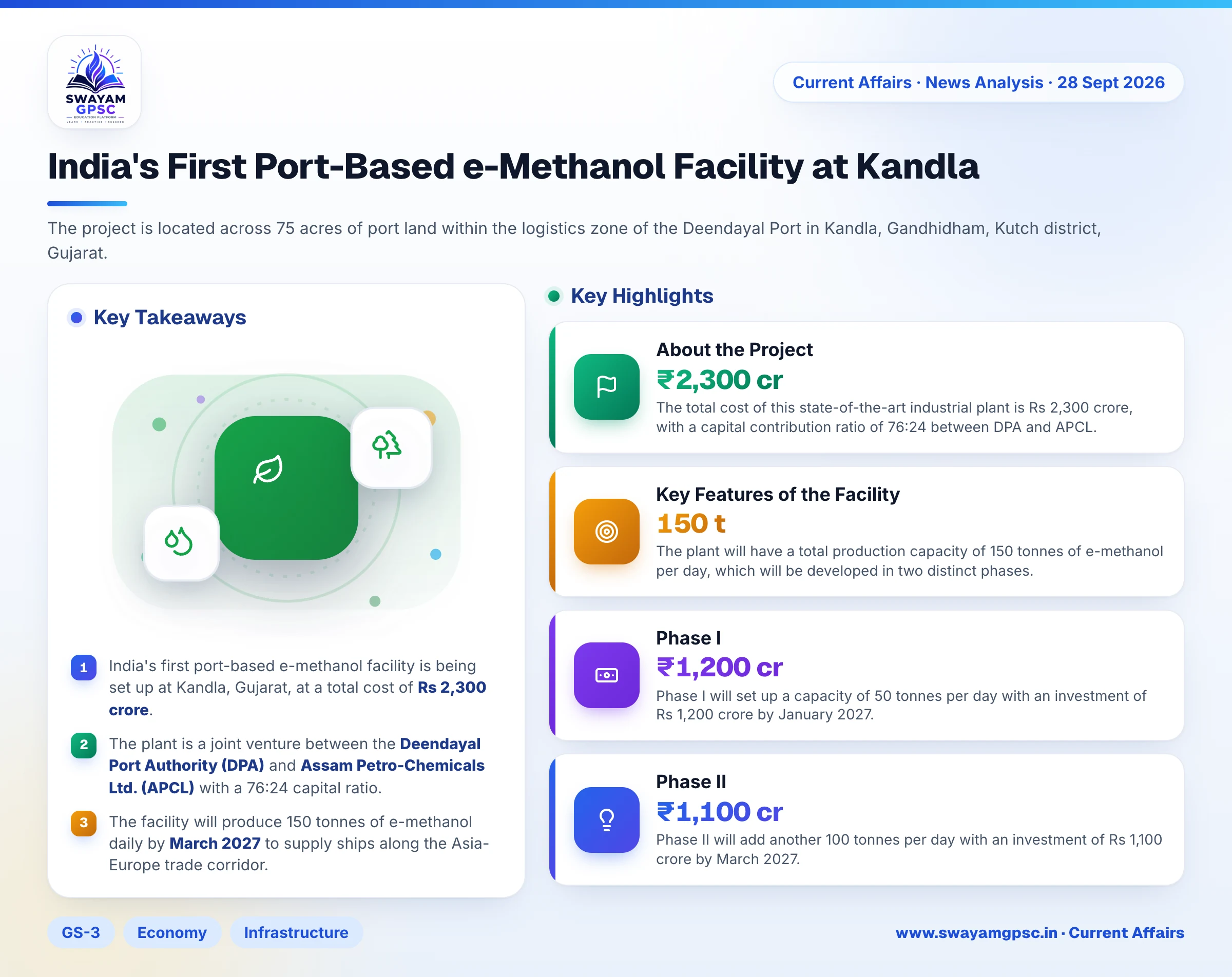
India's First Port-Based e-Methanol Facility at Kandla
#GS-3 #Economy #Infrastructure #Environment #Sustainable Development #Current Events #National #Gujarat
Key takeaways
- India's first port-based e-methanol facility is being set up at Kandla, Gujarat, at a total cost of Rs 2,300 crore.
- The plant is a joint venture between the Deendayal Port Authority (DPA) and Assam Petro-Chemicals Ltd. (APCL) with a 76:24 capital ratio.
- The facility will produce 150 tonnes of e-methanol daily by March 2027 to supply ships along the Asia-Europe trade corridor.
- The produced green fuel is expected to cost US$ 750 per tonne, which is significantly lower than the global rate of US$ 1,300 per tonne.
- This initiative aligns with India's goal to achieve Net Zero emissions by 2070 and become a top ship-owning nation by 2047.
Why in News
- India has laid the foundation stone for its first port-based e-methanol production facility at the Deendayal Port Authority (DPA) in Kandla, Gujarat.
- This project marks a major milestone in India's efforts to supply green maritime fuel to the global shipping industry.
About the Project
- The project is a joint venture between the Deendayal Port Authority (DPA) under the Ministry of Ports, Shipping and Waterways and Assam Petro-Chemicals Ltd. (APCL), a state PSU.
- The total cost of this state-of-the-art industrial plant is Rs 2,300 crore, with a capital contribution ratio of 76:24 between DPA and APCL.
- The project is located across 75 acres of port land within the logistics zone of the Deendayal Port in Kandla, Gandhidham, Kutch district, Gujarat.
- This facility will produce synthetic, carbon-neutral e-methanol by combining green hydrogen made from renewable electricity with captured biogenic carbon dioxide.
Key Features of the Facility
- The plant will have a total production capacity of 150 tonnes of e-methanol per day, which will be developed in two distinct phases.
- Phase I will set up a capacity of 50 tonnes per day with an investment of Rs 1,200 crore by January 2027.
- Phase II will add another 100 tonnes per day with an investment of Rs 1,100 crore by March 2027.
- The facility relies on dedicated renewable power, on-site desalinated water for electrolysis, and captured biogenic carbon dioxide as circular inputs.
- The plant is designed to produce green methanol at a highly competitive cost of US$ 750 per tonne, which is much lower than the current global market rate of about US$ 1,300 per tonne.
- The Deendayal Port Authority (DPA) is contributing an equity stake of Rs 567.32 crore along with 75 acres of land and dedicated pipeline and energy infrastructure.
- The project is expected to create more than 3,500 direct and indirect jobs while building a green molecules ecosystem in the region.
Significance of the Facility
- The e-methanol will be supplied to cargo vessels operating on the Asia-Europe International Trade Corridor, positioning Kandla as a key green-fuel hub on the Singapore-Rotterdam route.
- The project directly supports the International Maritime Organization's emission-reduction goals by helping global shipping fleets transition to cleaner fuels.
- It aligns with India's Net Zero 2070 goal, energy self-reliance targets, and the Make in India, Make for the World initiative.
- The venture showcases strong inter-state cooperation by linking the petrochemical expertise of Assam with the port infrastructure of Gujarat.
Wider Maritime Push
- This project is part of India's larger maritime plans, which include adding 100 ships to the merchant fleet over the next 5 years.
- India also aims to become one of the top five ship-owning nations by the year 2047 while developing major domestic shipbuilding and repair infrastructure.