India's First Plastic-Free Oil Terminal: Jawahar Dweep
#GS-3 #Economy #Infrastructure #GS-2 #Current Events #National #Mapping
Key takeaways
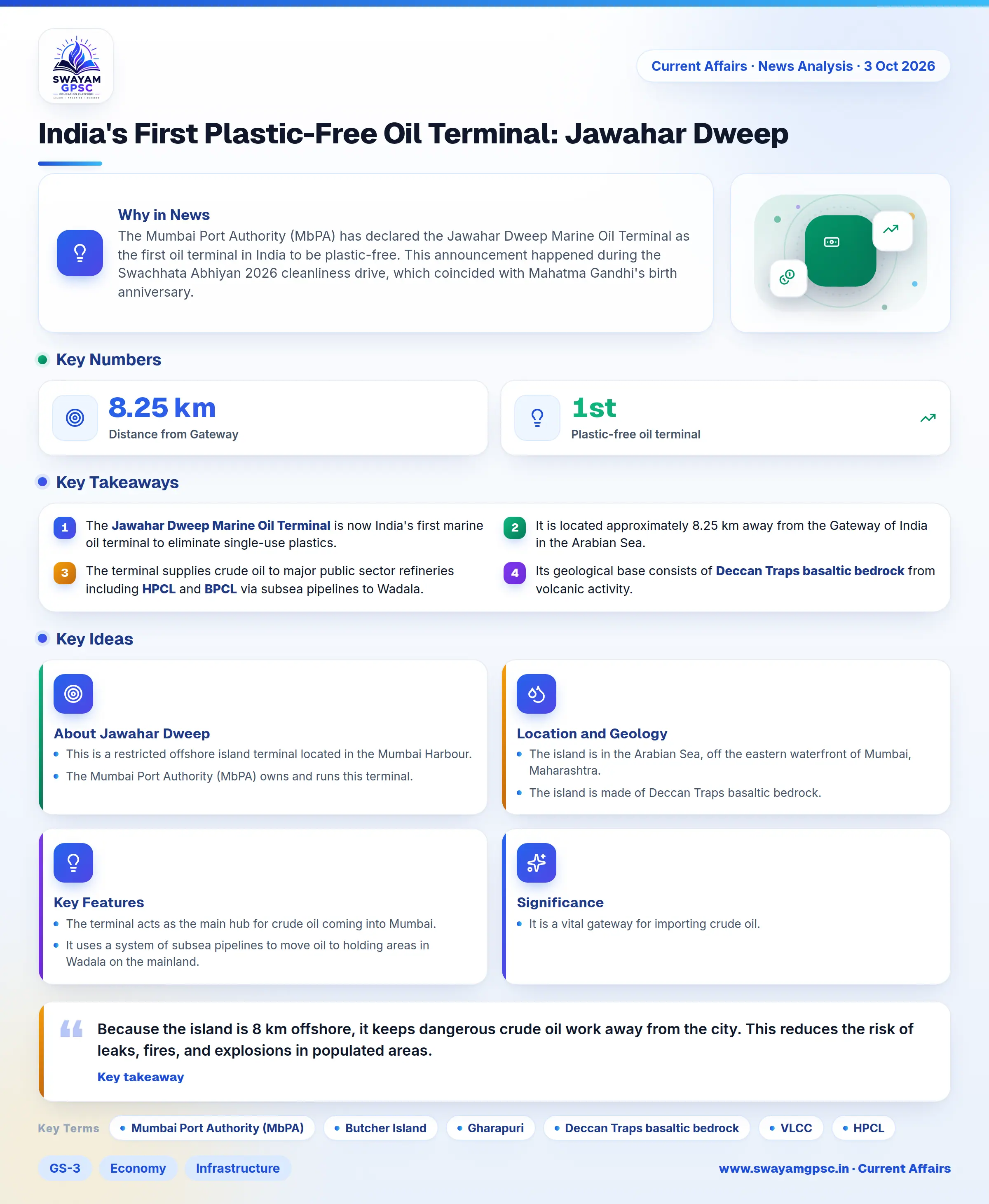
- The Jawahar Dweep Marine Oil Terminal is now India's first marine oil terminal to eliminate single-use plastics.
- It is located approximately 8.25 km away from the Gateway of India in the Arabian Sea.
- The terminal supplies crude oil to major public sector refineries including HPCL and BPCL via subsea pipelines to Wadala.
- Its geological base consists of Deccan Traps basaltic bedrock from volcanic activity.
Why in News
- The Mumbai Port Authority (MbPA) has declared the Jawahar Dweep Marine Oil Terminal as the first oil terminal in India to be plastic-free. This announcement happened during the Swachhata Abhiyan 2026 cleanliness drive, which coincided with Mahatma Gandhi's birth anniversary.
About Jawahar Dweep
- This is a restricted offshore island terminal located in the Mumbai Harbour. It was historically called Butcher Island.
- The Mumbai Port Authority (MbPA) owns and runs this terminal. Its main job is to offload, store, and manage crude oil, liquefied petroleum gas (LPG), and other petroleum products from large ocean tankers.
Location and Geology
- The island is in the Arabian Sea, off the eastern waterfront of Mumbai, Maharashtra. It sits about 8.25 km northeast of the Gateway of India and northwest of Elephanta Island (Gharapuri).
- The island is made of Deccan Traps basaltic bedrock. This rock formed during volcanic activity in the late Cretaceous and early Paleogene periods.
- It is a submerged topographic high or a remnant of a continental island. It has a hill in the center and is surrounded by mudflats and thick coastal greenery within Mumbai's harbor.
Key Features
- The terminal acts as the main hub for crude oil coming into Mumbai. It has deep-water jetties that can handle very large ships like VLCC and Suezmax tankers.
- It uses a system of subsea pipelines to move oil to holding areas in Wadala on the mainland. From there, the oil goes to public sector refineries like HPCL and BPCL.
- The area is a high-security zone with restricted access. It is covered in thick natural plants and has a central hill, which keeps it separate from civilian and commercial ferry paths.
- The island has an Oil Spill Response (OSR) Operations Center. This center uses skimmers and containment booms to stop and clean up marine pollution.
- It has set a new environmental standard as India's first marine oil terminal to stop using single-use plastics. It now uses zero-waste methods for transporting hydrocarbons.
Significance
- Because the island is 8 km offshore, it keeps dangerous crude oil work away from the city. This reduces the risk of leaks, fires, and explosions in populated areas.
- It is a vital gateway for importing crude oil. It ensures that refineries get the fuel they need to support western India's petroleum demands.