India-EU Green Shipping Corridor Launch
#GS-3 #Infrastructure #Environment #Climate Change #Current Events #International #Quick Facts For Prelims
Key takeaways
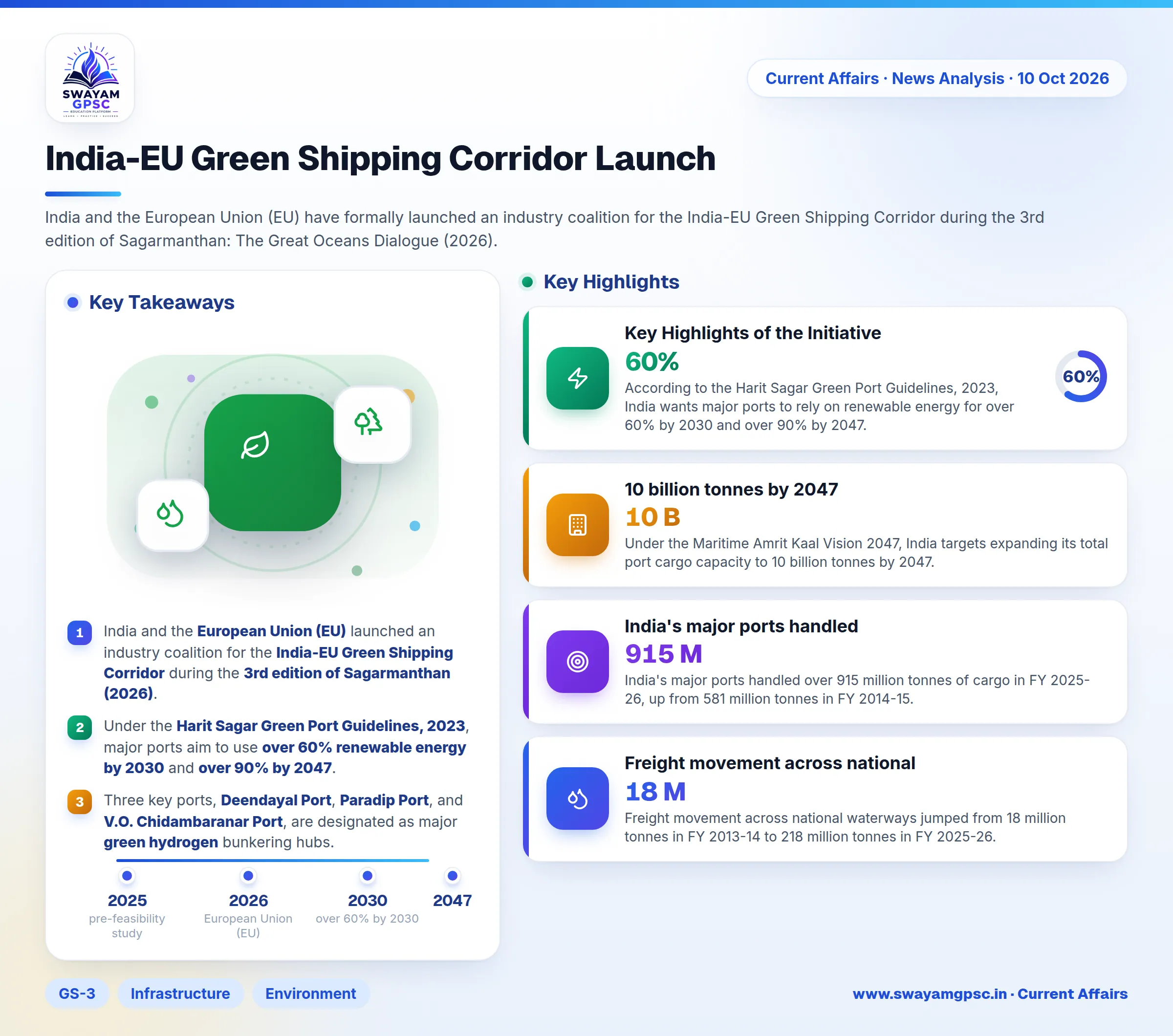
- India and the European Union (EU) launched an industry coalition for the India-EU Green Shipping Corridor during the 3rd edition of Sagarmanthan (2026).
- Under the Harit Sagar Green Port Guidelines, 2023, major ports aim to use over 60% renewable energy by 2030 and over 90% by 2047.
- Three key ports, Deendayal Port, Paradip Port, and V.O. Chidambaranar Port, are designated as major green hydrogen bunkering hubs.
- Under the Maritime Amrit Kaal Vision 2047, India aims to increase port capacity to 10 billion tonnes by 2047.
- National waterways cargo traffic grew sharply from 18 million tonnes in FY 2013-14 to 218 million tonnes in FY 2025-26.
Why in News
- India and the European Union (EU) have formally launched an industry coalition for the India-EU Green Shipping Corridor during the 3rd edition of Sagarmanthan: The Great Oceans Dialogue (2026).
- This strategic coalition aims to boost low-emission maritime fuels, attract investments, and build commercially viable green maritime routes.
- The Ministry of Ports, Shipping and Waterways (MoPSW) organised the maritime dialogue alongside the Observer Research Foundation (ORF).
Key Highlights of the Initiative
- The coalition links India's green fuel production capability with Europe's rising demand for green ammonia and methanol.
- Building on a pre-feasibility study in 2025, the 2026 industry coalition will bring in private funding and build strong public-private partnerships.
- According to the Harit Sagar Green Port Guidelines, 2023, India wants major ports to rely on renewable energy for over 60% by 2030 and over 90% by 2047.
- India is replacing old diesel harbour tugs with green tugs and turning Deendayal Port, Paradip Port, and V.O. Chidambaranar Port into green hydrogen hubs.
- India's sustainable port strategy focuses on shore-to-ship electricity, equipment electrification, and direct carbon emission cuts.
- The green shipping corridor builds resilient supply chains against global geopolitical disruptions and climate hazards while supporting an inclusive transition.
- Under the Maritime Amrit Kaal Vision 2047, India targets expanding its total port cargo capacity to 10 billion tonnes by 2047.
- India's major ports handled over 915 million tonnes of cargo in FY 2025-26, up from 581 million tonnes in FY 2014-15.
- Freight movement across national waterways jumped from 18 million tonnes in FY 2013-14 to 218 million tonnes in FY 2025-26.