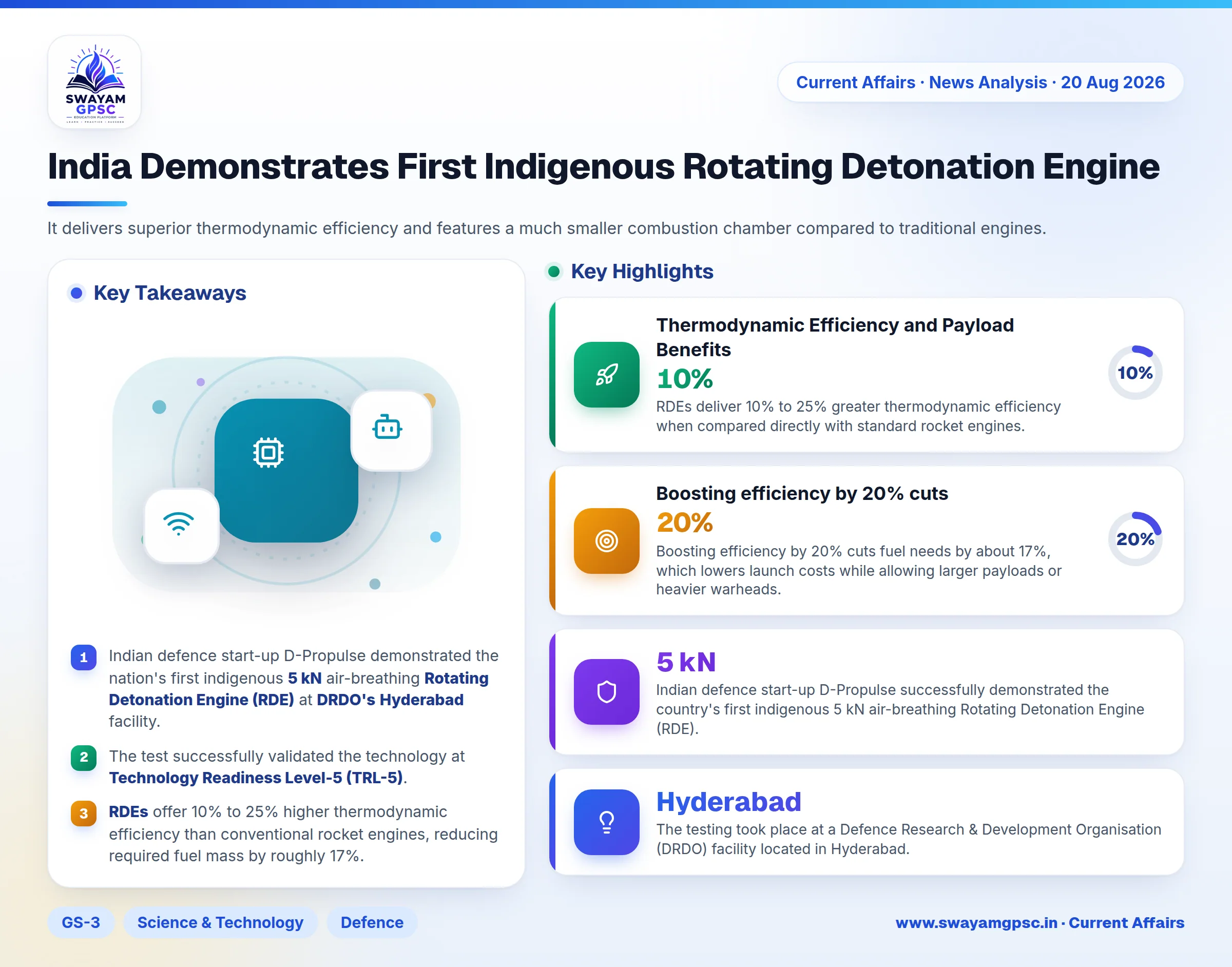
India Demonstrates First Indigenous Rotating Detonation Engine
#GS-3 #Science & Technology #Defence #Space #Current Events #National #Indigenization of Technology
Key takeaways
- Indian defence start-up D-Propulse demonstrated the nation's first indigenous 5 kN air-breathing Rotating Detonation Engine (RDE) at DRDO's Hyderabad facility.
- The test successfully validated the technology at Technology Readiness Level-5 (TRL-5).
- RDEs offer 10% to 25% higher thermodynamic efficiency than conventional rocket engines, reducing required fuel mass by roughly 17%.
- The engine structure must withstand extreme conditions including temperatures above 2,000°C and pressure ranging from 10 to 100 atmospheres.
Why in News
- Indian defence start-up D-Propulse successfully demonstrated the country's first indigenous 5 kN air-breathing Rotating Detonation Engine (RDE).
- The testing took place at a Defence Research & Development Organisation (DRDO) facility located in Hyderabad.
- The engine successfully reached Technology Readiness Level-5 (TRL-5) during this operational demonstration.
- This achievement represents a major step forward in building India's next-generation air-breathing propulsion systems locally.
Understanding Rotating Detonation Engines
- A Rotating Detonation Engine (RDE) is an advanced propulsion system that relies on continuous supersonic detonation waves.
- It delivers superior thermodynamic efficiency and features a much smaller combustion chamber compared to traditional engines.
Deflagration vs Detonation
- Traditional engines rely on deflagration, where the flame front travels at subsonic speeds under constant pressure, causing significant heat loss.
- Detonation engines operate using supersonic flame speeds, creating a high-energy shock wave at constant volume that compresses fuel instantly to generate higher thrust.
Working Mechanism of RDE
- Unlike pulsed detonation engines that burn fuel intermittently along a straight line, an RDE utilizes a ring-shaped annular combustion channel.
- Fuel and oxidizer enter continuously ahead of the shock wave, maintaining a circular wave traveling thousands of times per second for smooth thrust.
Thermodynamic Efficiency and Payload Benefits
- RDEs deliver 10% to 25% greater thermodynamic efficiency when compared directly with standard rocket engines.
- Boosting efficiency by 20% cuts fuel needs by about 17%, which lowers launch costs while allowing larger payloads or heavier warheads.
Key Strategic Applications
- RDE propulsion can power hypersonic cruise missiles like BrahMos-II, high-speed uncrewed aerial vehicles, and advanced ramjet systems.
- The technology improves the payload-to-fuel ratio for space launch vehicles and thrusters used in orbital and deep-space missions.
Engineering and Material Challenges
- RDEs demand advanced materials that endure extreme heat above 2,000°C, pressure between 10 to 100 atmospheres, and detonation speeds over 1,500 m/s.
- Engineers must achieve microsecond fuel-injection precision and deploy high-speed computing to avoid dangerous combustion instability.
Global R&D Status
- Global aerospace leaders like Lockheed Martin, GE Aerospace, Astrobotic, and SpaceWorks are currently conducting hot-fire tests for space and missile uses.