India’s Crude Oil Import Dynamics and Energy Security
#GS-3 #Economy #Mineral & Energy Resources #Infrastructure #Energy
Key takeaways
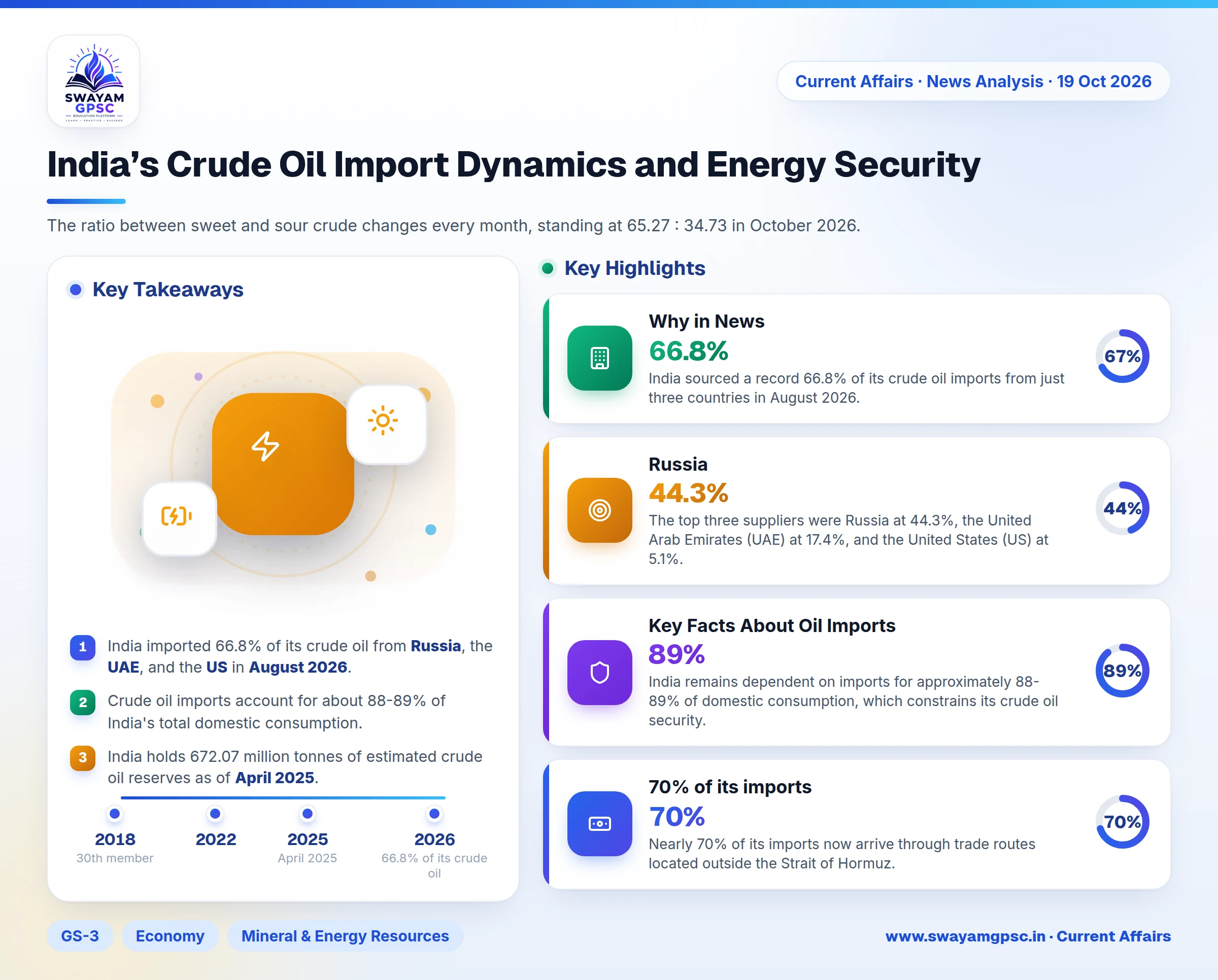
- India imported 66.8% of its crude oil from Russia, the UAE, and the US in August 2026.
- Crude oil imports account for about 88-89% of India's total domestic consumption.
- India holds 672.07 million tonnes of estimated crude oil reserves as of April 2025.
- India maintains 5.33 million tonnes of underground strategic petroleum storage capacity across Visakhapatnam, Mangaluru, and Padur.
Why in News
- India sourced a record 66.8% of its crude oil imports from just three countries in August 2026.
- The top three suppliers were Russia at 44.3%, the United Arab Emirates (UAE) at 17.4%, and the United States (US) at 5.1%.
- Russia remained the single largest supplier of crude oil to India during this period.
Key Facts About Oil Imports
- The Indian Crude Basket (ICB) represents the mix of crude oil grades imported by Indian refineries.
- It consists of sweet crude oil known as Brent Dated and sour crude oil calculated as the average of Oman and Dubai crude prices.
- The ratio between sweet and sour crude changes every month, standing at 65.27 : 34.73 in October 2026.
- India remains dependent on imports for approximately 88-89% of domestic consumption, which constrains its crude oil security.
- However, diversifying suppliers and shipping routes since 2022 has greatly strengthened India's resilience against supply shocks.
- India now purchases crude oil from roughly 40 countries, compared to only 27 nations back in 2006-07.
- Nearly 70% of its imports now arrive through trade routes located outside the Strait of Hormuz.
- This broader sourcing network lowers the danger of relying too heavily on any single transit corridor or supplier, although global price swings still affect the country.
Crude Oil Reserves in India
- As of April 2025, India possessed estimated crude oil reserves totaling 672.07 million tonnes.
- The Western Offshore holds the largest share at 31%.
- Assam accounts for 22% of the reserves, while Rajasthan holds 20%.
Current Status of Oil and Petroleum Industry
- India ranks as the world’s 4th largest oil refining country and the 7th largest exporter of refined petroleum products.
- The domestic petroleum industry has grown steadily through public-private investments, wider exploration, and policy reforms ever since the first oil well in Digboi (1867).
- India is actively promoting cleaner fuels through several key programs like the Ethanol Blending Programme targeting 20% by 2025-26, the SATAT initiative for Compressed Biogas, Strategic Petroleum Reserves, and the National Green Hydrogen Mission.
- India maintains 5.33 million tonnes of underground crude oil storage capacity located at Visakhapatnam (Andhra Pradesh), Mangaluru, and Padur (Karnataka).
- These reserves are managed by Indian Strategic Petroleum Reserves Limited (ISPRL) under the administrative control of the Ministry of Petroleum and Natural Gas.
- The government established ISPRL as a Special Purpose Vehicle in 2004.
- India also collaborates internationally with the International Energy Agency (IEA) to strengthen energy cooperation and security.
International Energy Agency
- The International Energy Agency (IEA) is an autonomous intergovernmental organization founded in 1974 during the 1973-1974 oil crisis.
- India has participated as an Association country since 2017, though it is not a full member.
- The headquarters of the organization are located in Paris, France.
- Mexico joined as the 30th member of the agency in February 2018, becoming its first Latin American member country.