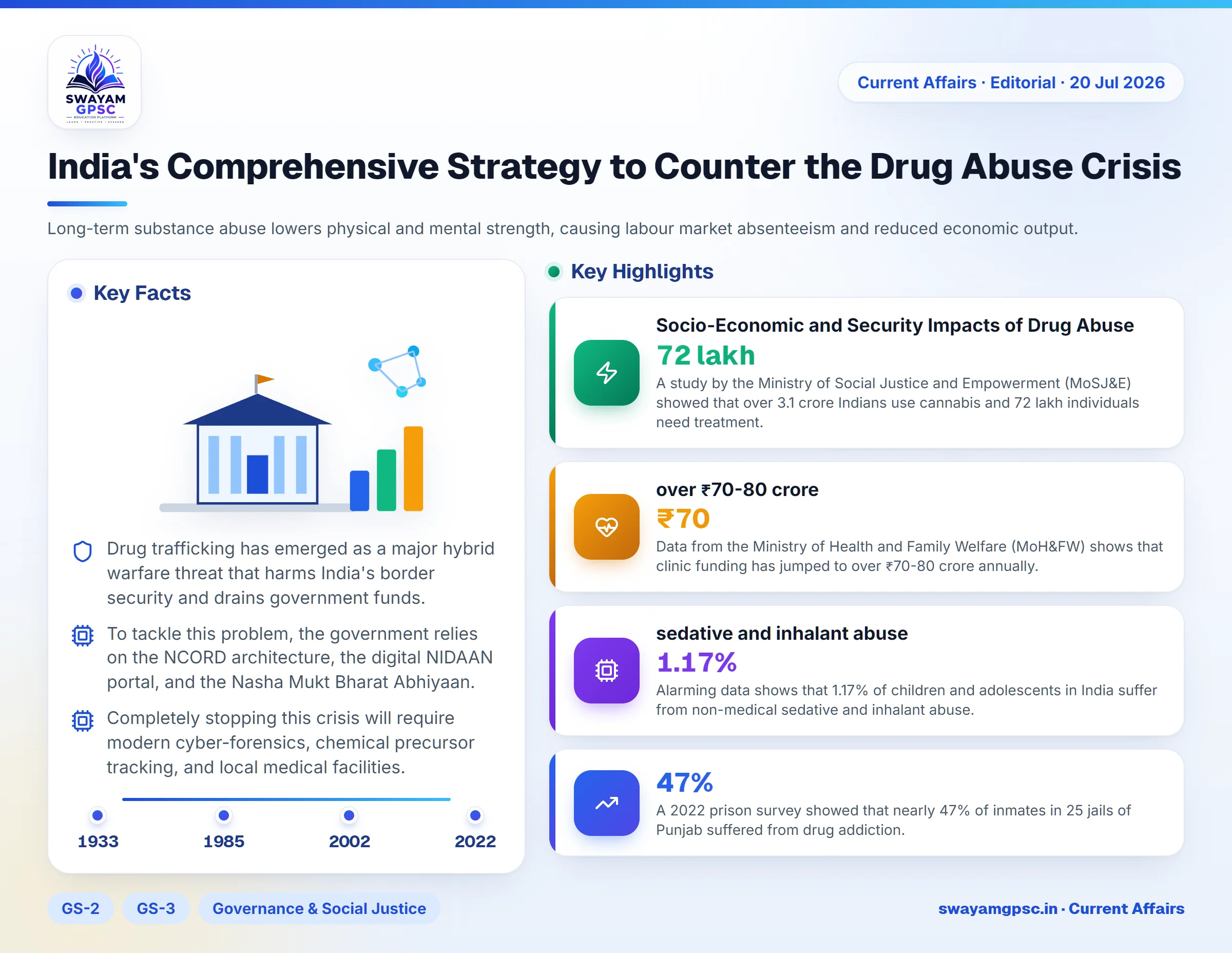
India's Comprehensive Strategy to Counter the Drug Abuse Crisis
#GS-2 #GS-3 #Governance & Social Justice #Health #Social Justice #Science & Technology #Cyber Security #Current Events #National
Why in News
- Drug trafficking has emerged as a major hybrid warfare threat that harms India's border security and drains government funds.
- To tackle this problem, the government relies on the NCORD architecture, the digital NIDAAN portal, and the Nasha Mukt Bharat Abhiyaan.
- Completely stopping this crisis will require modern cyber-forensics, chemical precursor tracking, and local medical facilities.
Socio-Economic and Security Impacts of Drug Abuse
- Long-term substance abuse lowers physical and mental strength, causing labour market absenteeism and reduced economic output.
- A study by the Ministry of Social Justice and Empowerment (MoSJ&E) showed that over 3.1 crore Indians use cannabis and 72 lakh individuals need treatment.
- In Punjab and Haryana, the spread of cheap heroin called Chitta has damaged worker productivity and strained family finances.
- Government spending shifts away from basic healthcare toward funding specialized facilities like Drug Addiction Treatment Centres (DATCs) and Drug Treatment Clinics (DTCs).
- The habit of Injecting Drug Users (IDUs) sharing needles speeds up the spread of serious blood diseases like HIV/AIDS and Hepatitis C.
- Data from the Ministry of Health and Family Welfare (MoH&FW) shows that clinic funding has jumped to over ₹70-80 crore annually.
- Drug abuse weakens community stability by causing an increase in domestic violence, petty crime, and institutional mistrust.
- Reports from the National Crime Records Bureau (NCRB) reveal that minor thefts in towns and slums are often committed to buy drugs.
- Alarming data shows that 1.17% of children and adolescents in India suffer from non-medical sedative and inhalant abuse.
- Smuggling groups funnel their large profits directly into cross-border insurgencies, creating a dangerous narco-terror connection.
- Drones sent by Pakistan-based modules routinely fly across the International Border (IB) and Line of Control (LoC) to drop synthetic drugs, weapons, and fake notes.
- Insurgent groups in Northeastern states collect illegal taxes on drug movement to purchase military weapons.
- Illegal drug money moves through money laundering and Hawala channels, creating big obstacles for the Prevention of Money Laundering Act, 2002 (PMLA).
- Joint investigations by the Enforcement Directorate (ED) and the Narcotics Control Bureau (NCB) found cartels linked to non-resident Indian (NRI) handlers in Canada, Australia, and Europe.
- Traffickers use Darknet platforms and cryptocurrency payments to hide their identity while sending parcels through standard courier services.
- Authorities have registered nearly 100 high-profile cases involving Darknet and crypto-currencies and over 1,025 cases involving commercial parcel/courier systems.
- These new technological methods forced the Ministry of Home Affairs (MHA) to create a Special Task Force on Darknet and Crypto Currency.
- Frequent arrests under the NDPS Act, 1985 create serious backlogs in Indian courts and overcrowd prisons.
- Annual arrests under the NDPS Act, 1985 have passed 1,00,000 annual arrests, slowing down the justice system.
- A 2022 prison survey showed that nearly 47% of inmates in 25 jails of Punjab suffered from drug addiction.
Government Steps to Control Drug Abuse in India
- The Ministry of Home Affairs (MHA) reorganised the Narco-Coordination Centre (NCORD) into a 4-tier institutional mechanism to improve coordination.
- This framework functions at four levels: Apex Level, Executive Level, State Level, and District Level.
- Official records show that authorities have conducted over 250 State-level and 12,400+ District-level NCORD meetings to plan joint operations.
- The new Vision Document on Drug Control (2026-2029) focuses on targeting big international networks rather than small street peddlers.
- This roadmap sets a clear target to identify and break down at least 100 major interstate and international drug cartels.
- Under the NDPS Act, 1985 and PITNDPS Act, agencies actively freeze and seize assets bought with illegal drug money.
- State police forces work with the Enforcement Directorate (ED) and National Intelligence Grid (NATGRID) to check financial records and isolate drug leaders.
- The government created the NIDAAN (National Integrated Database on Arrested Narco-Offenders) portal using data from the Inter-operable Criminal Justice System (ICJS) and E-Prisons.
- This system gives officers quick access to records of over 9.50 lakh NDPS offenders for biometric verification and tracking.
- A specialized Special Task Force on Darknet and Crypto-Currency works under the Multi-Agency Centre (MAC) to stop illegal online trading.
- The Narcotics Control Bureau (NCB) partnered with the National Forensic Sciences University (NFSU) and Rashtriya Raksha University (RRU) to develop custom tracking tools.
- The Sahyog Portal, run by the Indian Cyber Crime Coordination Centre (I4C), helps officers trace Virtual Digital Assets (VDAs) and freeze crypto wallets.
- Border forces along the Golden Crescent and Golden Triangle use anti-drone tools and thermal sensors to block nighttime air drops.
- The Narcotics Control Bureau (NCB) opened 10 new strategic field units in key locations like Ferozepur (Punjab), Sriganganagar, Aizawl, and Dimapur.
- To stop ocean routes, the Narcotics Control Bureau (NCB) conducts joint sea operations with the Indian Navy and the Indian Coast Guard.
- The Ministry of Social Justice and Empowerment (MoSJ&E) drives the Nasha Mukt Bharat Abhiyaan across thousands of schools and colleges.
- The government supports 349 Integrated Rehabilitation Centres for Addicts (IRCAs) along with local district clinics.
- Citizens can report drug sales or get free counseling using the 24x7 toll-free MANAS Helpline (1933).
Way Forward to Eliminate Drug Abuse
- State police stations should launch clear tip-off systems using WhatsApp and QR codes connected to state Anti-Narcotics Task Forces (ANTFs).
- States should build joint border checkpoints staffed by State Police, NCB, and Regional Transport Authorities (RTAs) equipped with mobile chemical kits.
- The Ministry of Communications must enforce strict Know Your Customer (KYC) rules and automated AI scans for all courier companies.
- The Ministry of Home Affairs (MHA) and National Forensic Sciences University (NFSU) should train police officers to record evidence on the e-Sakshya portal under the Bharatiya Nagarik Suraksha Sanhita, 2023 (BNSS).
- Rural primary health centers under the Ayushman Arogya Mandir network should offer basic addiction care and withdrawal treatment.
- Colleges must adopt a Drug-Free Campus framework and train student peers as Nasha Mukti Mitras to help classmates safely.
- Chemical companies must enter real-time production numbers into a digital system monitored by the Narcotics Control Bureau (NCB).
- The Ministry of Skill Development & Entrepreneurship should team up with Integrated Rehabilitation Centres for Addicts (IRCAs) to give recovering users practical job skills.
Conclusion
- Ending the threat of synthetic drugs and narco-terrorism requires combining police action with cyber forensic technology, financial checks, and strong social care.