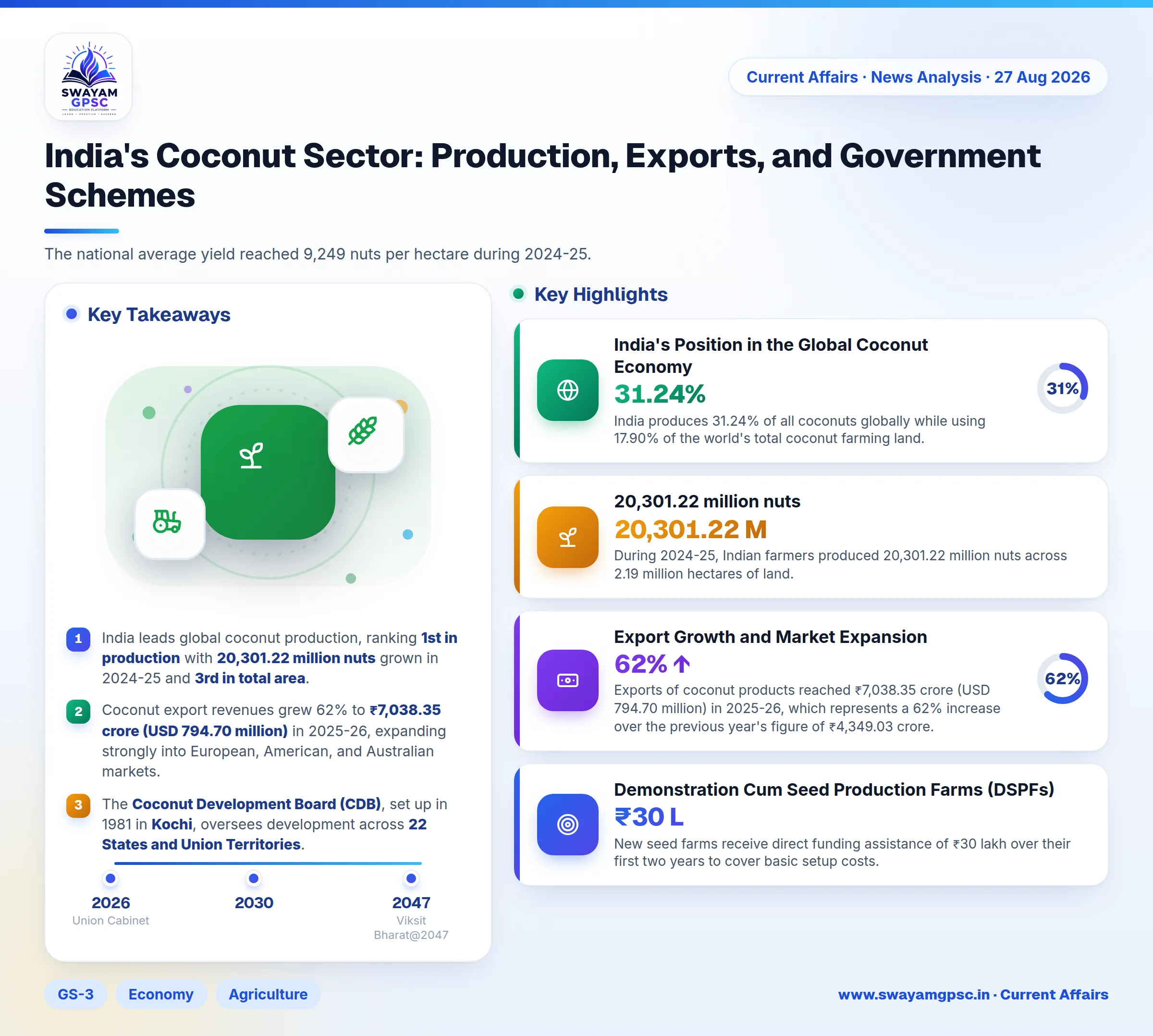
India's Coconut Sector: Production, Exports, and Government Schemes
#GS-3 #Economy #Agriculture #Food Processing #E-Technology in the Aid of Farmers #Current Events #National
Key takeaways
- India leads global coconut production, ranking 1st in production with 20,301.22 million nuts grown in 2024-25 and 3rd in total area.
- Coconut export revenues grew 62% to ₹7,038.35 crore (USD 794.70 million) in 2025-26, expanding strongly into European, American, and Australian markets.
- The Coconut Development Board (CDB), set up in 1981 in Kochi, oversees development across 22 States and Union Territories.
- The Union Budget 2026-27 introduced the Coconut Promotion Scheme alongside a ₹350 crore fund for high-value crops to rejuvenate old groves and fight pest outbreaks.
Why in News
- People often call coconut the Tree of Life because it plays a vital role in India's farming economy, rural jobs, and cultural traditions.
- The government introduced targeted measures like the Coconut Promotion Scheme in Budget 2026-27 to help farmers improve yield, increase value addition, and boost their income.
India's Position in the Global Coconut Economy
- India ranks 1st in coconut production and 3rd in total cultivation area across the world.
- India produces 31.24% of all coconuts globally while using 17.90% of the world's total coconut farming land.
- During 2024-25, Indian farmers produced 20,301.22 million nuts across 2.19 million hectares of land.
- The national average yield reached 9,249 nuts per hectare during 2024-25.
- Keralam has the largest farming area for coconut, Tamil Nadu produces the highest quantity, and Andhra Pradesh achieves the highest productivity per hectare.
- Coconut products now play a growing role in boosting India's overall agricultural export earnings.
Export Growth and Market Expansion
- Exports of coconut products reached ₹7,038.35 crore (USD 794.70 million) in 2025-26, which represents a 62% increase over the previous year's figure of ₹4,349.03 crore.
- India shifted from exporting basic items like coconut oil, copra, and shell charcoal toward high-value goods like virgin coconut oil, coconut water, coconut milk, and activated carbon.
- Indian suppliers expanded beyond traditional buyers in the Middle East to trade with countries in Europe, the Americas, and Australia.
- Key buyer nations currently include the USA, UAE, Sri Lanka, Germany, Russia, Turkey, Belgium, UK, and the Netherlands.
Coconut Development Board (CDB)
- The Coconut Development Board (CDB) started operations on 12th January 1981 under the Ministry of Agriculture and Farmers Welfare.
- The board maintains its headquarters in Kochi and supports coconut farming across 22 States and Union Territories.
- The CDB leads the overall development of the sector by supporting farm production, processing facilities, and product marketing.
- The board helps farmers increase crop yields through quality saplings, expansion into new land, farm maintenance, and pest management.
- The CDB also helps farmers earn higher incomes by promoting modern processing technology, product variety, and export opportunities.
Minimum Support Price (MSP) for Copra
- The government includes copra among the 22 mandated crops under the Minimum Support Price (MSP) system.
- The Union Cabinet raised the MSP for copra for the 2026 season to ensure that growers receive fair profit margins.
- India produces Milling Copra primarily for extracting oil after drying the kernel.
- India also produces Ball Copra, which growers dry as whole fruit for eating as dry fruit and using in religious rituals.
- The National Agricultural Cooperative Marketing Federation of India Ltd. (NAFED) and the National Cooperative Consumers' Federation (NCCF) act as central nodal agencies for copra purchases.
Production of Quality Planting Material
- The government strengthens the supply chain right at the start by making high-grade saplings easily available to growers.
- This program creates seed farms, seed gardens, nurseries, and plant certification systems to supply healthy coconut seedlings.
Demonstration Cum Seed Production Farms (DSPFs)
- The Coconut Development Board sets up Demonstration cum Seed Production Farms (DSPFs) to teach modern farming techniques and raise quality saplings.
- New seed farms receive direct funding assistance of ₹30 lakh over their first two years to cover basic setup costs.
- Starting from the third year, the board provides upkeep funds up to ₹1 lakh per hectare per year until output stabilizes, which takes about 15-20 years.
Other Support Measures for Planting Material
- The government supports Nucleus Coconut Seed Gardens to breed high-yielding coconut plant varieties.
- The initiative supports both public and private small nurseries to increase seedling supplies.
- A formal nursery accreditation and rating system guarantees that farmers receive genuine, high-quality plant stock.
- Public sector units like State Agriculture Departments, Agricultural Universities, PSUs, Krishi Vigyan Kendras (KVKs), and CDB farms receive financial grants to raise seedling output.
Expansion of Area Under Cultivation
- This initiative brings fresh land under coconut farming by offering financial grants, subsidies, and technical aid.
- Farmers receive cash assistance of ₹56,000 per hectare in two equal yearly installments to plant new coconut trees.
- To help smallholders, individual benefits apply to farms ranging from a minimum of 0.08 hectares (20 cents) up to a maximum of 2 hectares.
- During 2025-26, farmers planted new coconut palm groves across approximately 2,175 hectares of farmland.
- Targeted expansion regions included Keralam, Tamil Nadu, Karnataka, Andhra Pradesh, Odisha, West Bengal, Gujarat, Assam, and Arunachal Pradesh.
Improving Productivity in Existing Gardens
- This program helps farmers boost yield on existing lands by adopting integrated farming and coconut-based cropping systems.
- The Productivity Improvement Through Coconut-Based Cropping System (PICCS) forms the primary driver for boosting farm output.
- State Agriculture or Horticulture Departments and the Coconut Development Board implement PICCS using a cluster approach.
- The scheme offers a 100% cost subsidy of ₹42,000 per hectare in two equal annual payments, capped at 2 hectares per farmer.
- Major participating regions include Tamil Nadu, Andhra Pradesh, Keralam, Assam, Goa, and Puducherry, with Keralam receiving the largest share during 2025-26.
- The program funds community irrigation tanks and farm ponds to secure steady water supplies for palm groves.
- The initiative promotes organic farming by offering backing for organic product certification, processing, and sales.
- The government supports farm mechanization through machinery grants, modern tool demonstrations, and post-harvest equipment training.
Replanting and Rejuvenation of Coconut Gardens
- This scheme aims to raise overall farm output by replacing old, diseased, and non-bearing trees with fresh quality saplings.
- The plan restores ailing coconut gardens to health through an integrated package of modern agronomic practices.
- State agencies run this effort on a project-by-project basis to solve specific regional farming challenges.
- Farmers receive grants up to ₹54,000 per hectare spread over two years to complete replanting and tree removal work.
- Key operational steps include cutting down unproductive palms, planting quality saplings, and improving overall grove management.
Complementary Initiatives for the Sector
- The Technology Mission on Coconut (TMOC) funds research and technology uptake for pest control, processing, and product creation.
- The Kera Suraksha Insurance Scheme offers accident insurance coverage to tree climbers, harvesters, and Neera technicians working in the field.
Coconut Promotion Scheme
- The Union Budget 2026-27 announced the Coconut Promotion Scheme to fight pest outbreaks, root wilt disease, and aging plantations.
- The scheme drives higher yield by distributing quality saplings, opening new growing areas, and rejuvenating old palm stands.
- The initiative trains farmers in integrated crop health management to protect palm trees against diseases.
- The scheme supports processing facilities under a broader ₹350 crore fund dedicated to high-value agriculture like coconut, cashew, and cocoa.
- This long-term plan aims to secure farm livelihoods and position India as a top global exporter of coconut and coir by the 2030s.
Skill Development and Enterprise Creation
- The Coconut Development Board runs vocational training programs to build a skilled workforce for harvesting and processing.
- Initiatives like Kera Kaushal Kendra help rural entrepreneurs set up small processing businesses and earn higher incomes.
- During 2025-26, the board organized 414 training workshops to educate farmers on scientific growing methods and value addition.
Conclusion
- India's coconut sector brings together agriculture, rural livelihoods, and strong export growth.
- Upgrading from traditional farming to processing high-value products shows the power of focused state support.
- Continued technological support will help the coconut sector drive rural prosperity and support the vision of Viksit Bharat@2047.