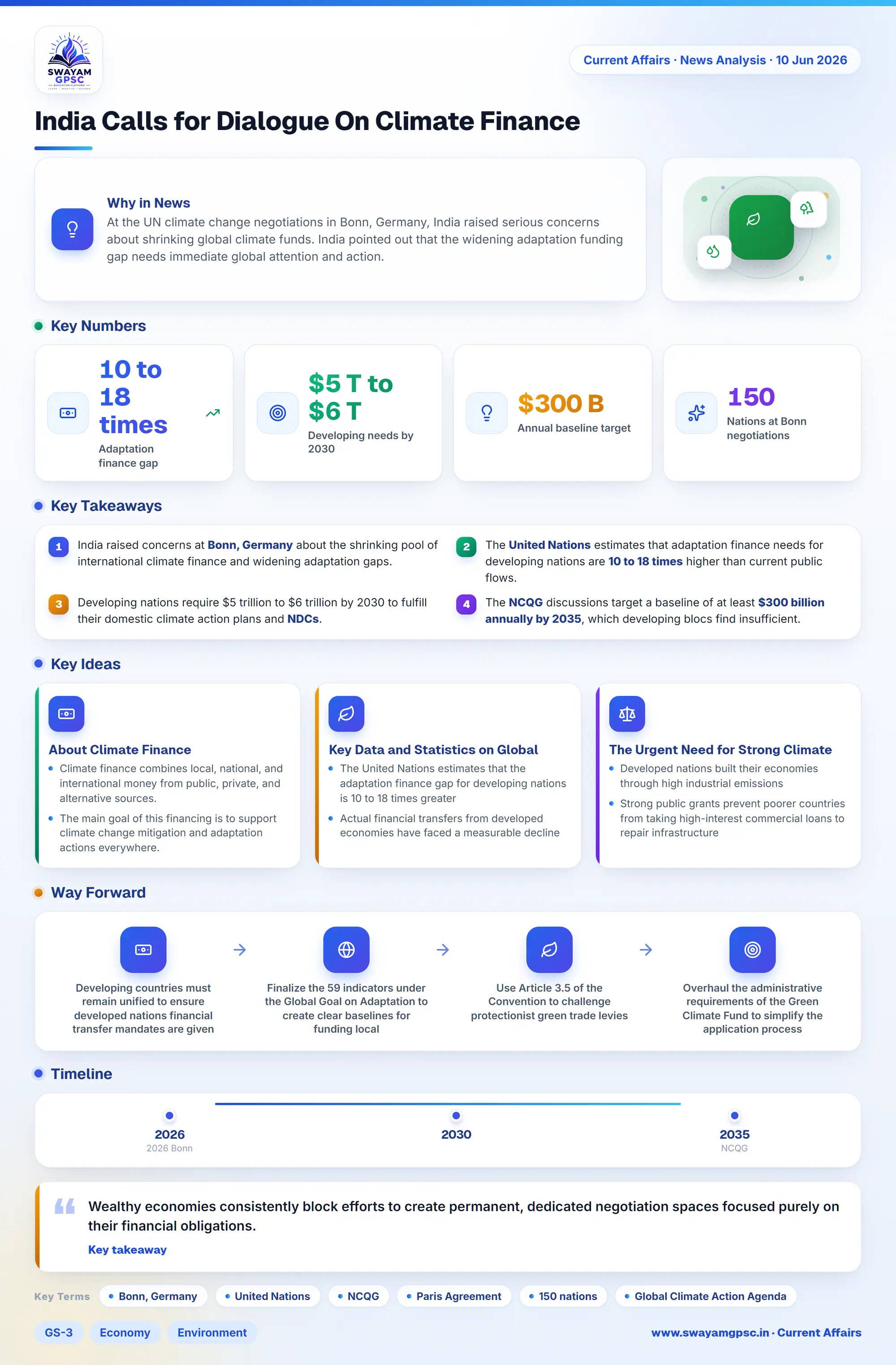
India Calls for Dialogue On Climate Finance
#GS-3 #Economy #Environment #Climate Change #Sustainable Development #Current Events #National #International
Key takeaways
- India raised concerns at Bonn, Germany about the shrinking pool of international climate finance and widening adaptation gaps.
- The United Nations estimates that adaptation finance needs for developing nations are 10 to 18 times higher than current public flows.
- Developing nations require $5 trillion to $6 trillion by 2030 to fulfill their domestic climate action plans and NDCs.
- The NCQG discussions target a baseline of at least $300 billion annually by 2035, which developing blocs find insufficient.
- The Paris Agreement under Article 9.1 mandates developed nations to provide financial support for mitigation and adaptation.
Why in News
- At the UN climate change negotiations in Bonn, Germany, India raised serious concerns about shrinking global climate funds.
- India pointed out that the widening adaptation funding gap needs immediate global attention and action.
About Climate Finance
- Climate finance combines local, national, and international money from public, private, and alternative sources.
- The main goal of this financing is to support climate change mitigation and adaptation actions everywhere.
Key Data and Statistics on Global Climate Finance
- The United Nations estimates that the adaptation finance gap for developing nations is 10 to 18 times greater than current public financial flows.
- Actual financial transfers from developed economies have faced a measurable decline, reducing available concessionary funds.
- By 2030, developing nations cumulatively require between $5 trillion to $6 trillion to implement their domestic climate action plans and NDCs**.
- The NCQG targets discussed for the post-2025 era seek a baseline commitment of at least $300 billion annually by 2035, a figure developing blocs criticize as inadequate.
The Urgent Need for Strong Climate Finance
- Developed nations built their economies through high industrial emissions, creating a moral and legal duty to fund green transitions globally.
- Strong public grants prevent poorer countries from taking high-interest commercial loans to repair infrastructure damaged by extreme weather.
- Developing economies cannot phase out traditional coal power and expand clean energy networks without significant upfront capital infusions.
- Providing dedicated resources for adaptation insulates critical agricultural and manufacturing hubs from severe climate disruptions.
Initiatives Taken So Far
- The Paris Agreement formalized Article 9.1, making it legally mandatory for developed countries to provide financial resources to assist developing nations.
- Negotiators from over 150 nations assembled at the 64th session of the Subsidiary Bodies to convert high-level pledges into binding legal texts.
- The Global Climate Action Agenda was launched by the Brazilian COP30 Presidency to move international climate goals into real-world economies over a five-year window.
- India actively unified its position with major developing coalitions, including the G77 and China, LMDCs, and the BASIC bloc.
Challenges
- Wealthy economies consistently block efforts to create permanent, dedicated negotiation spaces focused purely on their financial obligations.
- Developed trade blocs are utilizing domestic environmental rules to penalize industrial exports arriving from developing countries.
- Wealthy nations frequently try to rewrite treaties by adding strict emission targets without providing the necessary funding.
- Ongoing international conflicts frequently divert attention and financial resources away from long-term climate adaptation funds.
- Smaller groups of wealthy countries often create external treaties that ignore the developmental realities of emerging nations.
Way Forward
- Developing countries must remain unified to ensure developed nations financial transfer mandates are given primary placement at all future UNFCCC sessions.
- Finalize the 59 indicators under the Global Goal on Adaptation to create clear baselines for funding local adaptation projects.
- Use Article 3.5 of the Convention to challenge protectionist green trade levies, ensuring carbon border taxes do not penalize developing economies.
- Overhaul the administrative requirements of the Green Climate Fund to simplify the application process for vulnerable nations.
- Ensure the post-2025 NCQG framework moves away from vague pledges toward transparent, grant-equivalent public capital transfers.
Conclusion
- The 2026 Bonn climate conference highlights the urgent need to bridge the gap between high-level environmental promises and actual financial delivery.
- By firmly aligning with the G77 and BASIC blocs against unilateral trade barriers, India has reinforced the core principle of climate equity.