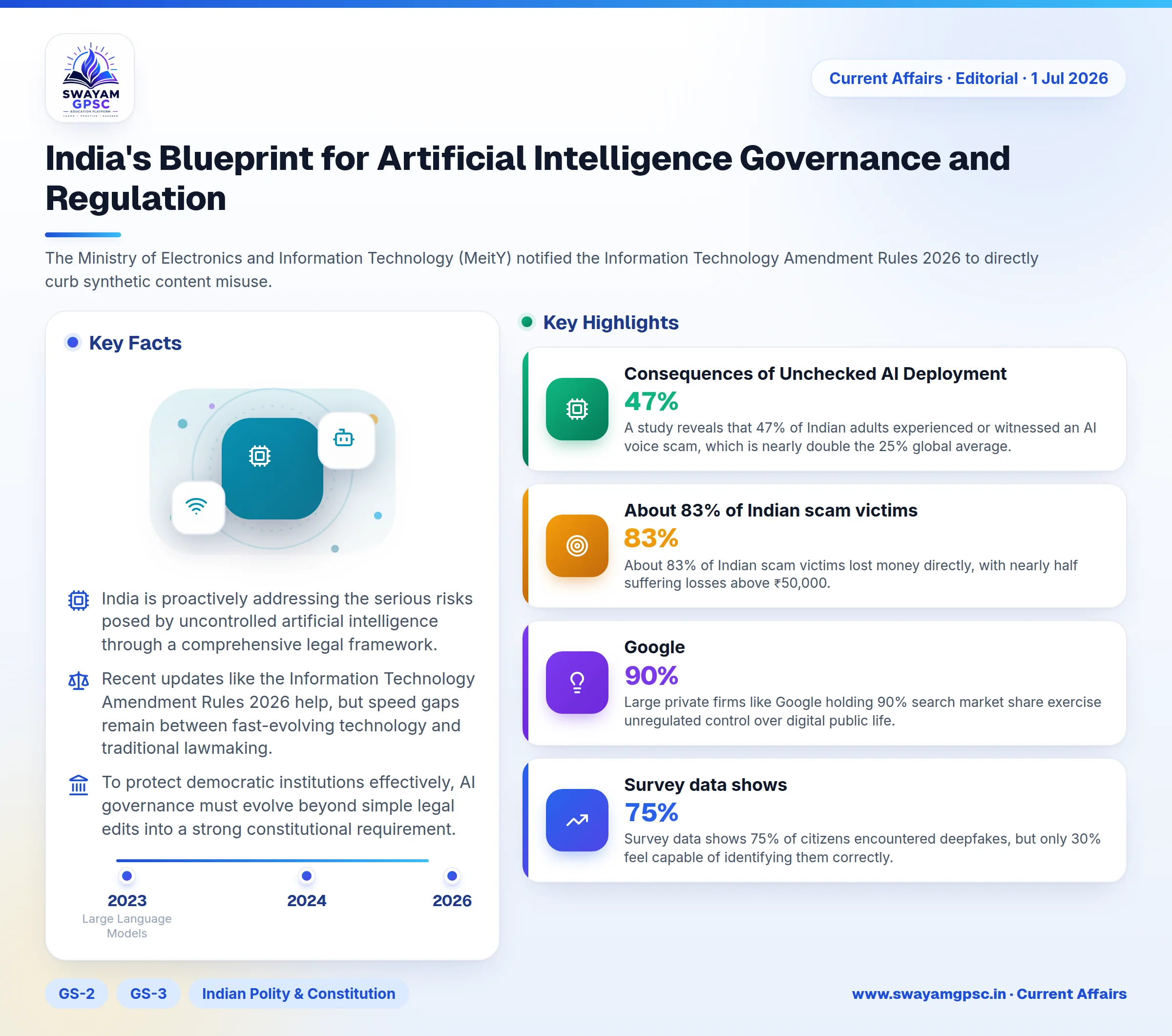
India's Blueprint for Artificial Intelligence Governance and Regulation
#GS-2 #GS-3 #Indian Polity & Constitution #Governance & Social Justice #Science & Technology #Artificial Intelligence #Government Policies & Interventions #Current Events #National
Why in News
- India is proactively addressing the serious risks posed by uncontrolled artificial intelligence through a comprehensive legal framework.
- Recent updates like the Information Technology Amendment Rules 2026 help, but speed gaps remain between fast-evolving technology and traditional lawmaking.
- To protect democratic institutions effectively, AI governance must evolve beyond simple legal edits into a strong constitutional requirement.
Current Laws and Regulations to Govern AI in India
- The Ministry of Electronics and Information Technology (MeitY) notified the Information Technology Amendment Rules 2026 to directly curb synthetic content misuse.
- This rule defines Synthetically Generated Information (SGI) as computationally created or altered media, directly targetting deepfakes and AI impersonations.
- It sets a 3-Hour Takedown Rule for platforms to delete illegal content, which drops to 2 hours for non-consensual deepfakes or explicit media.
- Platforms must insert technical provenance markers for traceability or lose their legal immunity under Safe Harbour provisions.
- The MeitY introduced the IndiaAI Mission & India AI Governance Guidelines to promote responsible tech growth based on Innovation over Restraint.
- This framework outlines 7 principles including Trust, People First, Fairness, Accountability, Understandable Design, and Sustainability.
- It establishes national bodies like the AI Governance Group (AIGG), the Technology & Policy Expert Committee (TPEC), and the AI Safety Institute (AISI).
- The Digital Personal Data Protection (DPDP) Act, 2023 limits data scraping and protects personal information used to train Large Language Models (LLMs).
- Law enforcement uses the Bharatiya Nyaya Sanhita (BNS), 2023 to prosecute criminal acts like digital impersonation, forgery, and financial fraud.
- The Supreme Court issued draft rules in 2026 allowing administrative automation in courts while banning AI from writing judicial decisions.
- Judicial officers remain personally accountable for errors caused by algorithmic failures or AI Hallucinations.
- The Reserve Bank of India (RBI) issued the FREE-AI Framework to force mandatory audits on AI models used in credit scoring and trading.
Consequences of Unchecked AI Deployment
- Generative AI enables fraudsters to bypass voice security and multi-factor authentication using realistic voice cloning.
- A study reveals that 47% of Indian adults experienced or witnessed an AI voice scam, which is nearly double the 25% global average.
- About 83% of Indian scam victims lost money directly, with nearly half suffering losses above ₹50,000.
- Cheap automated content tools build targetted misinformation streams that spread hatred across communities.
- Hostile AI content can reach targetted readers for as low as $0.07 per view, creating a massive social hazard.
- Uncontrolled data collection turns personal privacy into digital control, as seen when Cambridge Analytica harvested data from millions of users.
- Algorithms now decide crucial outcomes like loan approvals or jobs without oversight, similar to Australia's failed Robodebt scheme.
- Large private firms like Google holding 90% search market share exercise unregulated control over digital public life.
- Rapid technological progress leaves traditional laws behind, making policies like the EU Artificial Intelligence Act, 2024 quickly outdated.
- Because AI grows through mathematical discoveries, governments can regulate human behavior but cannot ban mathematical formulas.
- Deepfake videos disrupt democratic elections by confusing voters, as seen during India's 2024 general elections.
- Survey data shows 75% of citizens encountered deepfakes, but only 30% feel capable of identifying them correctly.
- Social media algorithms promote sensational content to boost clicks, trapping users in polarized echo chambers.
- Automated systems threaten early-career white-collar jobs, with 37% of entry-level tasks in India now handled by AI according to research.
Framework Required for Effective AI Regulation
- India must treat access to truthful information as part of the fundamental right to life and free expression.
- Policymakers must balance digital autonomy, platform accountability, free speech protections, public literacy, and defense against foreign cyber threats.
- Regulators should build a dynamic risk engine that stops dangerous applications while allowing safe AI tools to innovate.
- High-risk practices like real-time public biometric tracking and social scoring must face total legal bans.
- Critical applications in healthcare, banking, and courts need pre-market checks, while low-risk tools follow basic transparency norms.
- Laws must enforce Human-in-the-Loop (HITL) rules so human operators can stop automated decisions at any moment.
- AI developers must embed permanent cryptographic signatures into generated media using standards like C2PA.
- Online platforms must use automated scanners to read digital markers and take down harmful deepfakes quickly.
- Data practices during model development should match global guidelines like the NIST AI Risk Management Framework.
- Engineers must provide proof of diverse data sources to eliminate gender, racial, and social biases before launching models.
Conclusion
- Securing digital space requires elevating AI safety into a constitutional right.
- India must combine platform responsibility, digital markers, and legal protections to safeguard citizens and preserve national sovereignty.