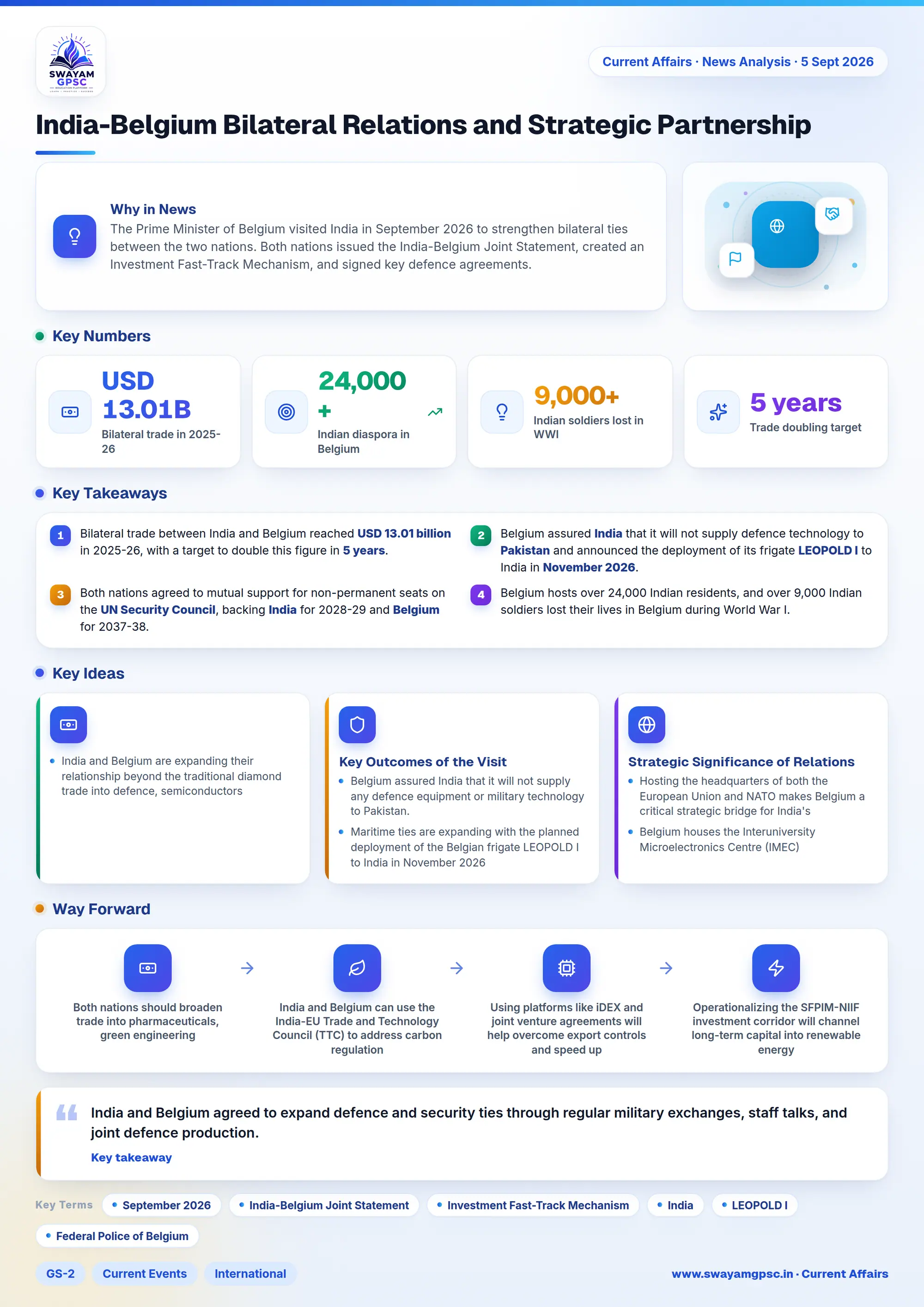
India-Belgium Bilateral Relations and Strategic Partnership
#GS-2 #Current Events #International #Government Policies & Interventions #International Treaties & Agreements #Effect of Policies & Politics of Countries on India's Interests
Key takeaways
- Bilateral trade between India and Belgium reached USD 13.01 billion in 2025-26, with a target to double this figure in 5 years.
- Belgium assured India that it will not supply defence technology to Pakistan and announced the deployment of its frigate LEOPOLD I to India in November 2026.
- Both nations agreed to mutual support for non-permanent seats on the UN Security Council, backing India for 2028-29 and Belgium for 2037-38.
- Belgium hosts over 24,000 Indian residents, and over 9,000 Indian soldiers lost their lives in Belgium during World War I.
Why in News
- The Prime Minister of Belgium visited India in September 2026 to strengthen bilateral ties between the two nations.
- Both nations issued the India-Belgium Joint Statement, created an Investment Fast-Track Mechanism, and signed key defence agreements.
Summary
- India and Belgium are expanding their relationship beyond the traditional diamond trade into defence, semiconductors, critical minerals, green hydrogen, and deep technology.
- Institutional mechanisms like the India-BLEU Joint Economic Commission and the Investment Fast-Track Mechanism support this growing partnership alongside stronger India-EU engagement.
Key Outcomes of the Visit
- India and Belgium agreed to expand defence and security ties through regular military exchanges, staff talks, and joint defence production.
- Belgium assured India that it will not supply any defence equipment or military technology to Pakistan.
- Maritime ties are expanding with the planned deployment of the Belgian frigate LEOPOLD I to India in November 2026 alongside resident Defence Attachés.
- Both nations signed a Defence Framework Agreement and an MoU between the Belgian Security and Defence Industry (BDSI) and the Society of Indian Defence Manufacturers (SIDM).
- Defence cooperation will focus on weapon systems, ammunition, radar, electro-optical sensors, command-and-control systems, and counter-drone technologies.
- The Central Bureau of Investigation (CBI) and the Federal Police of Belgium signed an MoU to boost cooperation against terrorism, organized crime, and cybercrime.
- Both governments launched an Investment Fast-Track Mechanism to resolve regulatory bottlenecks and boost two-way investment flows.
- Belgium's Federal Holding and Investment Company (SFPIM) and India's National Investment and Infrastructure Fund (NIIF) plan to build an Indo-Belgian Economic and Investment Corridor.
- Bilateral trade reached USD 13.01 billion in 2025-26, and both countries aim to double trade over the next 5 years beyond the traditional diamond sector.
- Belgium is positioning the Port of Antwerp-Bruges as a major logistics hub for Indian exports entering the European market.
- Both nations backed each other's bids for non-permanent seats on the UN Security Council, supporting India for 2028-29 and Belgium for 2037-38.
- Both leaders welcomed the completion of negotiations for the India-EU Free Trade Agreement in 2026 and endorsed the Joint India-EU Comprehensive Strategic Agenda for 2030.
- The two countries highlighted joint research at the Devasthal Optical Telescope through the Belgo-Indian Network for Astronomy and Astrophysics (BINA) and reaffirmed commitment to the BBNJ Agreement.
Strategic Significance of Relations
- Hosting the headquarters of both the European Union and NATO makes Belgium a critical strategic bridge for India's engagement with Europe.
- Belgium houses the Interuniversity Microelectronics Centre (IMEC), a global leader in microelectronics whose research can strengthen India's Semiconductor Mission.
- Belgian expertise in clean technologies like green hydrogen and offshore wind directly supports India's decarbonization targets.
- Belgium views India as a balancing power in South Asia and a strategic counterweight to China in the Indian Ocean region.
- A shift toward joint technology production aligns directly with India's Make in India vision for self-reliance.
Bilateral Relations Overview
- Belgium established diplomatic relations with India in 1947, making it one of the first European nations to recognize independent India.
- The India-BLEU Joint Economic Commission, set up in 1997, serves as the core institutional channel for bilateral economic dialogue.
- Bilateral science cooperation includes space technology, nuclear research, and the Devasthal Optical Telescope located in Uttarakhand.
- Cultural relations rest on a formal bilateral agreement signed in 1973, alongside academic exchanges between universities.
- Historical ties trace back to World War I, where over 9,000 Indian soldiers gave their lives in Flanders Fields.
- Belgium is home to over 24,000 Indian residents, and both nations are working on a Migration and Mobility Agreement to ease talent movement.
Challenges
- Heavy concentration in the diamond trade leaves supply chains vulnerable and exposes small Indian exporters to strict EU traceability rules.
- European regulations like the Carbon Border Adjustment Mechanism (CBAM) and deforestation rules add compliance costs for Indian exporters.
- Strict European export controls on dual-use technology restrict deep defence co-development between the two nations.
- Gaps in investment protection treaties and slow dispute resolution reduce investor confidence among Belgian companies.
- Research partnerships with Belgium's IMEC face challenges in moving from laboratory concepts to commercial semiconductor manufacturing.
Way Forward
- Both nations should broaden trade into pharmaceuticals, green engineering, and aerospace components to reduce diamond dependency.
- India and Belgium can use the India-EU Trade and Technology Council (TTC) to address carbon regulation and compliance issues.
- Using platforms like iDEX and joint venture agreements will help overcome export controls and speed up technology transfers.
- Operationalizing the SFPIM-NIIF investment corridor will channel long-term capital into renewable energy and port infrastructure.
- Creating commercial alliances between research institutions will help bring novel chip designs directly to market.
Conclusion
- India and Belgium are moving beyond traditional commerce toward advanced technology, defence co-production, and clean energy collaboration.
- Belgium's role as the institutional core of the European Union gives India valuable strategic leverage across the European continent.
Frequently Asked Questions
- The Investment Fast-Track Mechanism resolves regulatory hurdles to ease foreign direct investment flows between both countries.
- Belgium is strategic for India because it hosts the headquarters of both the European Union and NATO.
- New areas of economic growth include semiconductors, life sciences, green hydrogen, nuclear energy, and critical minerals.
- Collaborating with Belgium's IMEC will help India build native capacity in chip design and microelectronics packaging.
- Main challenges include diamond trade reliance, EU environmental trade barriers, export control limits, and investment policy gaps.