India Becomes Global Leader in Ship Recycling
#GS-2 #GS-3 #Economy #Infrastructure #Governance & Social Justice #Regulatory Bodies #Current Events #National #Government Policies & Interventions
Key takeaways
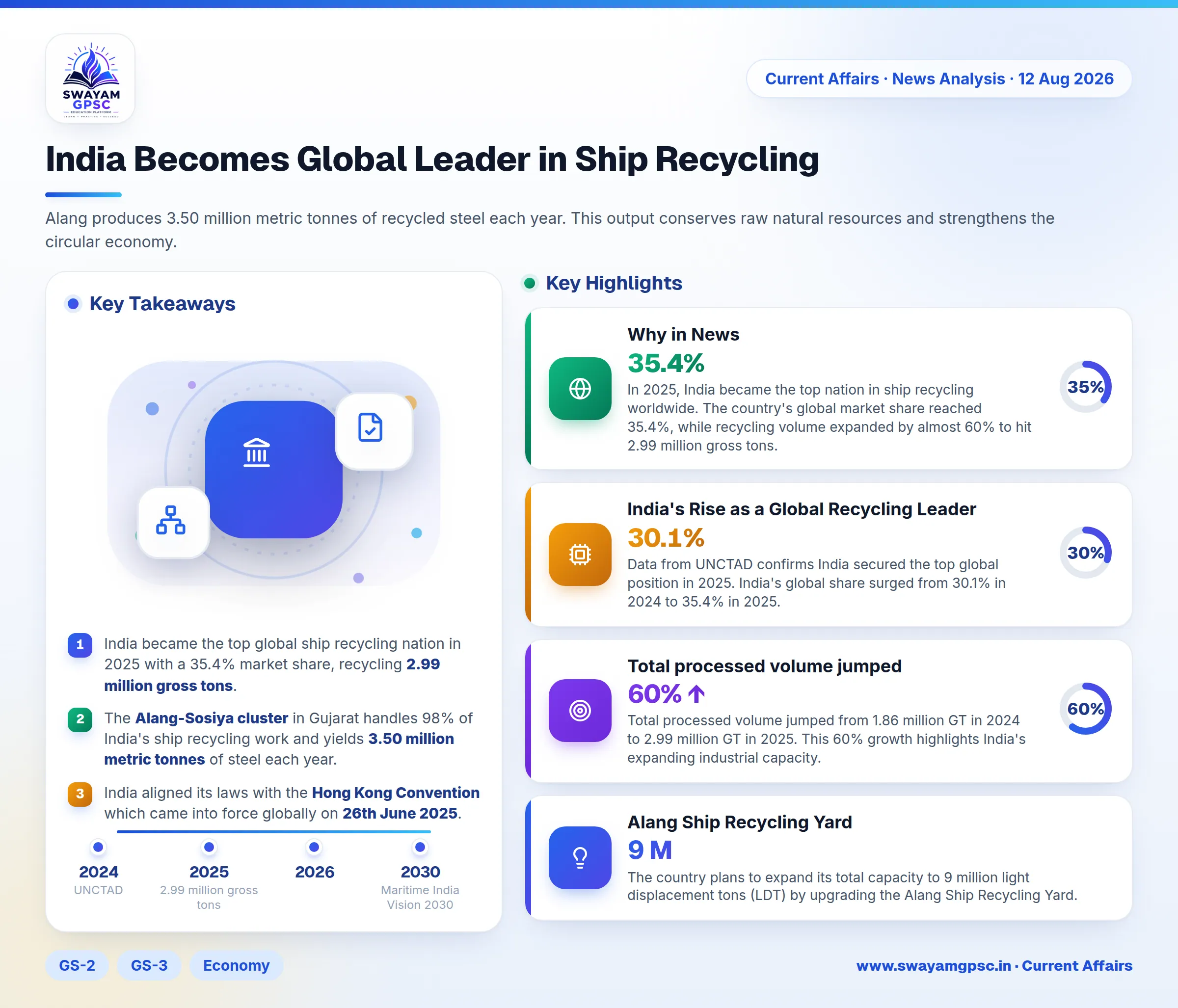
- India became the top global ship recycling nation in 2025 with a 35.4% market share, recycling 2.99 million gross tons.
- The Alang-Sosiya cluster in Gujarat handles 98% of India's ship recycling work and yields 3.50 million metric tonnes of steel each year.
- India aligned its laws with the Hong Kong Convention which came into force globally on 26th June 2025.
- Under SBFA 2.0, ship owners receive a credit note worth 40% of scrap value to help finance new Indian-built vessels.
Why in News
- In 2025, India became the top nation in ship recycling worldwide. The country's global market share reached 35.4%, while recycling volume expanded by almost 60% to hit 2.99 million gross tons.
- Systemic regulatory reforms, compliance with the Hong Kong Convention, yard upgrades, and improved environmental controls drove this massive growth.
India's Rise as a Global Recycling Leader
- Data from UNCTAD confirms India secured the top global position in 2025. India's global share surged from 30.1% in 2024 to 35.4% in 2025.
- Total processed volume jumped from 1.86 million GT in 2024 to 2.99 million GT in 2025. This 60% growth highlights India's expanding industrial capacity.
- India reached its Maritime India Vision 2030 goal 5 years ahead of schedule by becoming the world leader in ship recycling.
- The country plans to expand its total capacity to 9 million light displacement tons (LDT) by upgrading the Alang Ship Recycling Yard.
- The Alang-Sosiya yard cluster in Gujarat handles 98% of India's ship recycling work and holds an annual processing limit of 6 million GT.
- Alang produces 3.50 million metric tonnes of recycled steel each year. This output conserves raw natural resources and strengthens the circular economy.
- The Alang-Sosiya ecosystem relies on certified yards, steel re-rolling units, waste treatment facilities, and connected industrial infrastructure.
- The Safety Training and Labour Welfare Institute at Alang has trained over 1.5 lakh workers in hazardous waste management and safety rules.
- India also operates ship breaking yards at Amar Iron Udyog in Kolkata and SILK in Kerala.
- Indian yards now feature concrete plots, drainage systems, specialized cranes, safe chemical storage, and licensed waste treatment links.
Legal and Institutional Architecture
- The Ship Recycling Act, 2019 sets the legal baseline for all domestic dismantling activity and designates the Directorate General of Shipping as the National Authority.
- The Ship Recycling Rules, 2021 set procedures for facility approvals, vessel recycling plans, hazardous waste management, and worker protection standards.
- The Ship Recycling Regulations, 2026 add specific operational rules to enforce uniform environmental standards across all domestic yards.
Alignment with the Hong Kong Convention
- The Hong Kong International Convention serves as the main international standard for ship safety and green recycling, taking legal effect on 26th June 2025.
- India updated its domestic laws and rules to match the Hong Kong Convention rules across all domestic breaking yards.
- The central government provided Rs 53.5 crore to help 115 recycling facilities upgrade their technology and meet global benchmarks.
- Inspectors are reviewing 35 Alang yards for European Union approval. The Shree Ram Vessel Scrap and Y. S. Investments yards were added to the draft 16th European List.
Inventory of Hazardous Materials
- The Inventory of Hazardous Materials (IHM) lists all dangerous substances onboard a ship before recycling. This list ensures full safety and transparent risk management.
Ship Breaking Credit Note Scheme
- The government created the Ship-breaking Credit Note Scheme under SBFA 2.0 to encourage vessel owners to recycle ships at approved Indian yards.
- When an owner scraps a vessel in India, they receive a credit note worth 40% of the scrap steel value.
- Ship owners can use this credit note to cover up to 5% of the cost of building a new ship at an Indian shipyard.
Case Study of Ex-INS Viraat
- The Ex-INS Viraat served the Royal Navy for 27 years and the Indian Navy for 30 years before decommissioning in March 2017.
- The aircraft carrier arrived at Alang, Gujarat in September 2020 for dismantling, proving India's capacity to handle massive naval vessels.
- During its active lifetime, the warship recorded over 22,622 flying hours, spent 2,252 days at sea, and traveled 5.88 lakh nautical miles.
- Dismantling this warship demonstrated India's ability to extract high-value steel under modern safety and environmental protocols.
- The project generated jobs, created raw materials, and showcased India's modern recycling standards to international buyers.
Way Forward and Conclusion
- India's modern ship recycling industry strengthens resource security, creates jobs, and advances sustainable green manufacturing under Maritime India Vision 2030.
- To maintain global leadership, India must continue investing in clean technology, worker safety, and international safety certifications.