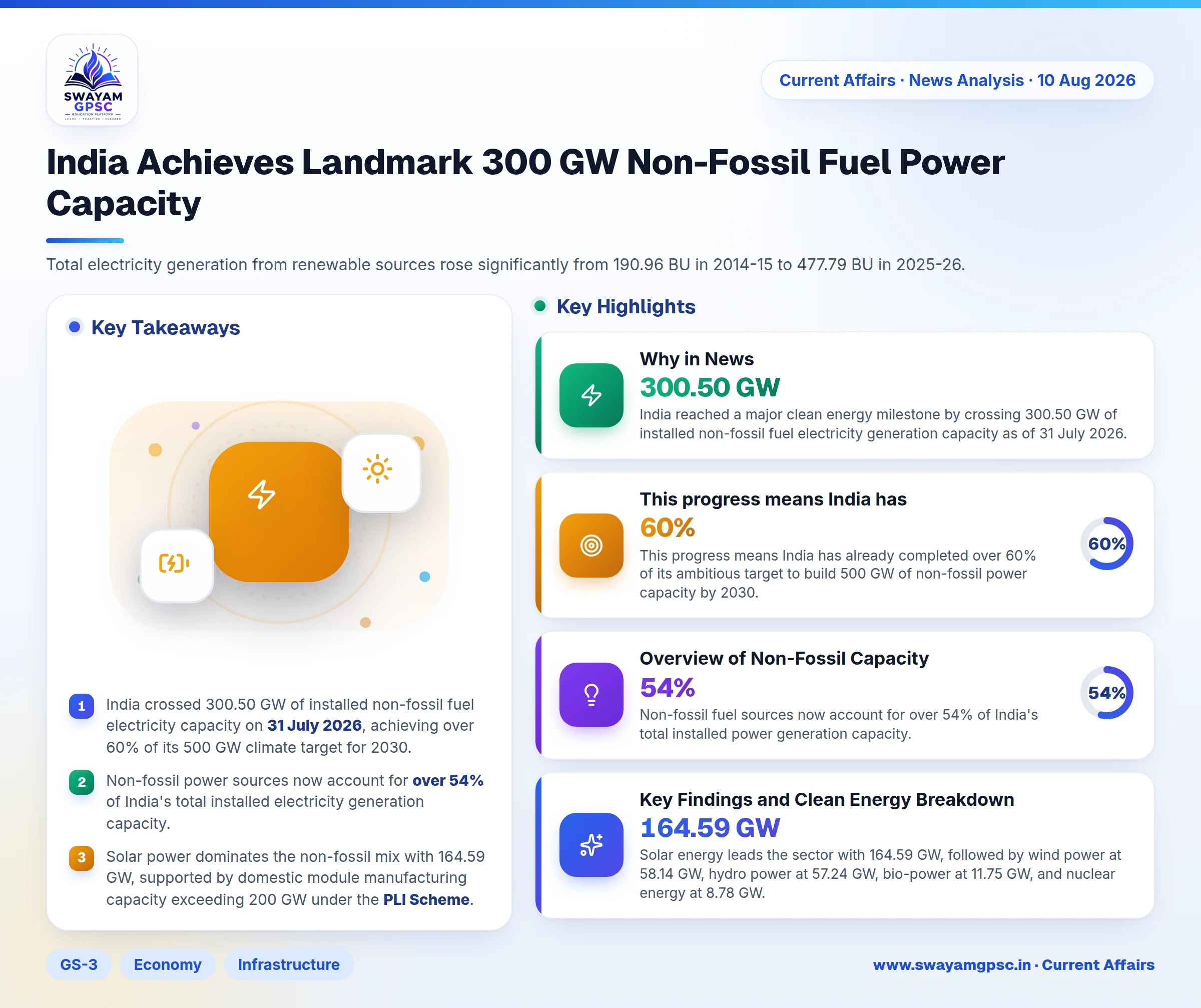
India Achieves Landmark 300 GW Non-Fossil Fuel Power Capacity
#GS-3 #Economy #Infrastructure #Environment #Climate Change #Energy #GS-2 #Current Events #National #Renewable Energy
Key takeaways
- India crossed 300.50 GW of installed non-fossil fuel electricity capacity on 31 July 2026, achieving over 60% of its 500 GW climate target for 2030.
- Non-fossil power sources now account for over 54% of India's total installed electricity generation capacity.
- Solar power dominates the non-fossil mix with 164.59 GW, supported by domestic module manufacturing capacity exceeding 200 GW under the PLI Scheme.
- India achieved a record annual non-fossil capacity addition of 55.29 GW in 2025-26, driving renewable electricity generation to 477.79 BU.
Why in News
- India reached a major clean energy milestone by crossing 300.50 GW of installed non-fossil fuel electricity generation capacity as of 31 July 2026.
- This progress means India has already completed over 60% of its ambitious target to build 500 GW of non-fossil power capacity by 2030.
Overview of Non-Fossil Capacity
- Non-fossil fuel sources now account for over 54% of India's total installed power generation capacity.
- This milestone reflects rapid expansion across solar, wind, hydro, bio-power, and nuclear energy sectors.
Key Findings and Clean Energy Breakdown
- India achieved an installed non-fossil capacity of 300.50 GW by 31 July 2026.
- Solar energy leads the sector with 164.59 GW, followed by wind power at 58.14 GW, hydro power at 57.24 GW, bio-power at 11.75 GW, and nuclear energy at 8.78 GW.
- The country added a record 55.29 GW of non-fossil capacity during 2025-26, which includes 44.6 GW from solar and 6 GW from wind.
- Total electricity generation from renewable sources rose significantly from 190.96 BU in 2014-15 to 477.79 BU in 2025-26.
- Domestic solar PV module manufacturing capacity under the ALMM list crossed 200 GW, boosted by financial support from the PLI Scheme.
Significance
- This achievement moves India closer to meeting its target under the Paris Agreement to reach 500 GW of non-fossil capacity by 2030.
- It reduces reliance on imported fossil fuels, making the national energy supply more secure and self-reliant under the Aatmanirbhar Bharat vision.
- It drives green industrial growth by expanding clean technology manufacturing, supporting the National Green Hydrogen Mission, and creating new jobs.