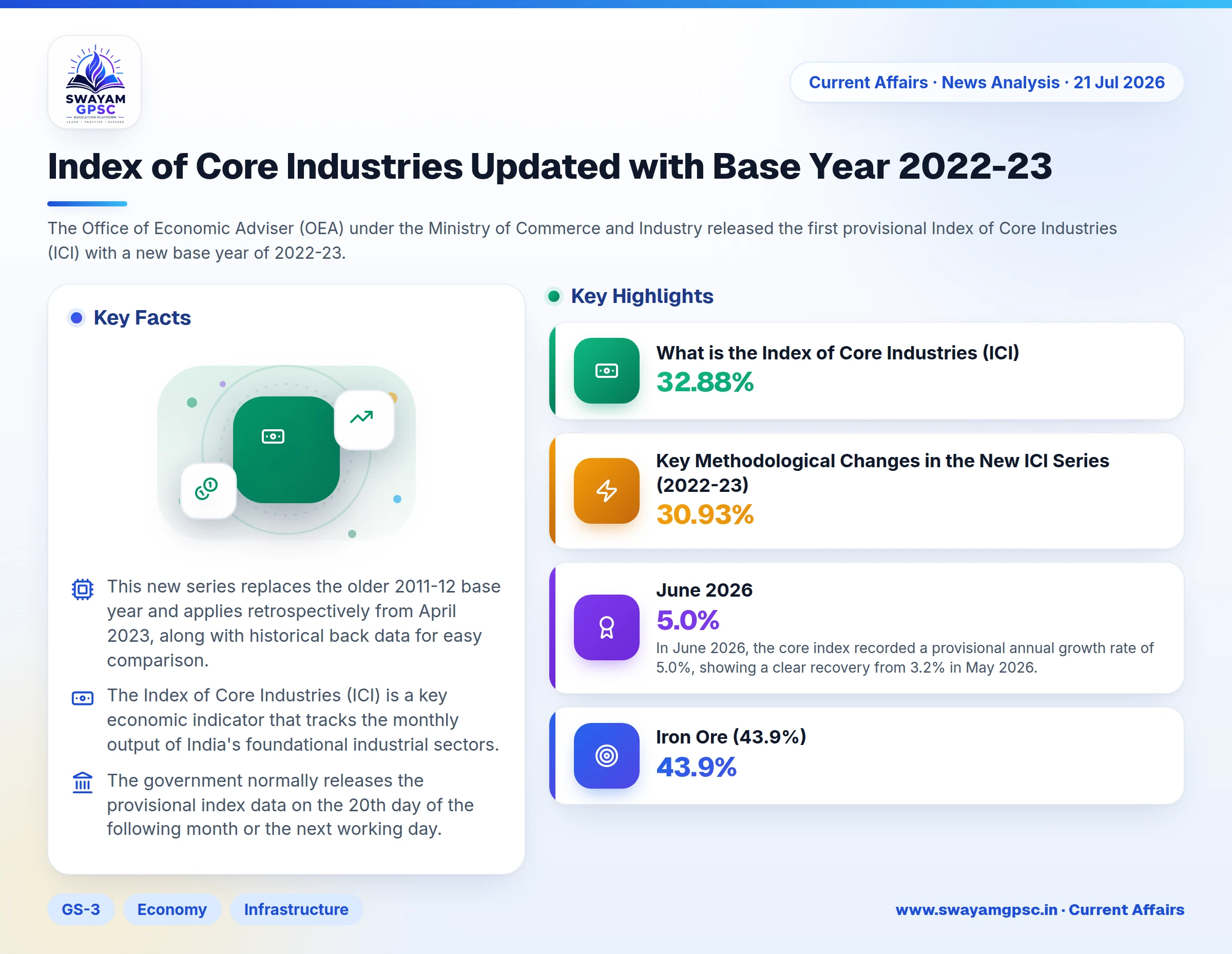
Index of Core Industries Updated with Base Year 2022-23
#GS-3 #Economy #Infrastructure #Government Policies & Interventions #Industrial Policy #Current Events #National
Why in News
- The Office of Economic Adviser (OEA) under the Ministry of Commerce and Industry released the first provisional Index of Core Industries (ICI) with a new base year of 2022-23.
- This new series replaces the older 2011-12 base year and applies retrospectively from April 2023, along with historical back data for easy comparison.
What is the Index of Core Industries (ICI)
- The Index of Core Industries (ICI) is a key economic indicator that tracks the monthly output of India's foundational industrial sectors.
- The government normally releases the provisional index data on the 20th day of the following month or the next working day.
- These core sectors form the structural backbone of the economy, and their total weight in the Index of Industrial Production (IIP) is now 32.88% under the new series, down from 40.27% in the 2011-12 series.
Key Methodological Changes in the New ICI Series (2022-23)
- The government expanded the list of core sectors from eight to nine by adding Iron Ore, recognizing its crucial role in steel production and overall industrial growth.
- As a result, the core list now covers Coal, Crude Oil, Natural Gas, Refinery Products, Fertilizers, Steel, Cement, Electricity, and Iron Ore.
- The calculation for the steel sector now uses Gross Production Data instead of net data, bringing it in line with the updated Index of Industrial Production (IIP).
- To avoid counting the same production twice, the index includes only Raw Coal while excluding Coal Middling and Washed Coal.
- Sector weights were recalculated using the 2022-23 base year, where Electricity holds the highest weight at 30.93%, followed by Refinery Products (22.57%), Steel (17.58%), Crude Oil (7.43%), Coal (5.59%), Iron Ore (4.90%), Cement (4.41%), Natural Gas (3.84%), and Fertilizers (2.73%).
- To compare past numbers with new ones accurately, officials established a linking factor using the ratio of geometric means between the old and new series.
- The official linking factor for the overall index stands at 1.47.
- In June 2026, the core index recorded a provisional annual growth rate of 5.0%, showing a clear recovery from 3.2% in May 2026.
- Sectors like Iron Ore (43.9%), Electricity (9.8%), Cement (9.8%), Steel (4.6%), and Coal (1.4%) grew positively, whereas Natural Gas, Crude Oil, Refinery Products, and Fertilizers shrank.
- Strong performance in Iron Ore and Electricity acted as the primary growth engine for the overall index in recent months.
- Between April and June 2026, cumulative core growth reached 3.6%, which is significantly higher than the 1.0% recorded during the same period in the previous year.
Difference between ICI and IIP
- While the Index of Core Industries (ICI) focuses specifically on foundational infrastructure sectors, the Index of Industrial Production (IIP) tracks short-term changes across the entire industrial landscape.
- The Office of Economic Adviser (OEA) under the Ministry of Commerce and Industry compiles the ICI, whereas the National Statistical Office (NSO) under MoSPI prepares the IIP.
- In terms of coverage, the ICI tracks 9 Core Industries, while the IIP covers three broad sectors: Manufacturing, Mining, and Electricity.
- The ICI acts as a leading subset of the IIP, offering an early signal of broader industrial momentum.
- Policymakers use the ICI to pinpoint supply bottlenecks in key sectors, while the Reserve Bank of India (RBI) relies on the IIP to design monetary and fiscal policy.
Frequently Asked Questions (FAQs)
- The Index of Core Industries (ICI) is a monthly report by the Office of Economic Adviser (OEA) that tracks nine key infrastructure industries accounting for 32.88% of the Index of Industrial Production (IIP).
- The main updates in the 2022-23 series include adding Iron Ore, switching to gross steel data, dropping processed coal items, updating sector weights, and setting a 1.47 linking factor.
- The index matters because it serves as an early indicator of economic activity, helping leaders monitor infrastructure health and fix supply chain bottlenecks.
- The core index measures only 9 key infrastructure sectors, serving as an early subset, whereas the Index of Industrial Production (IIP) measures complete industrial output across manufacturing, mining, and power.
- Updating base years is necessary so that economic data accurately reflects modern industrial patterns, improved calculation methods, and updated production weights.