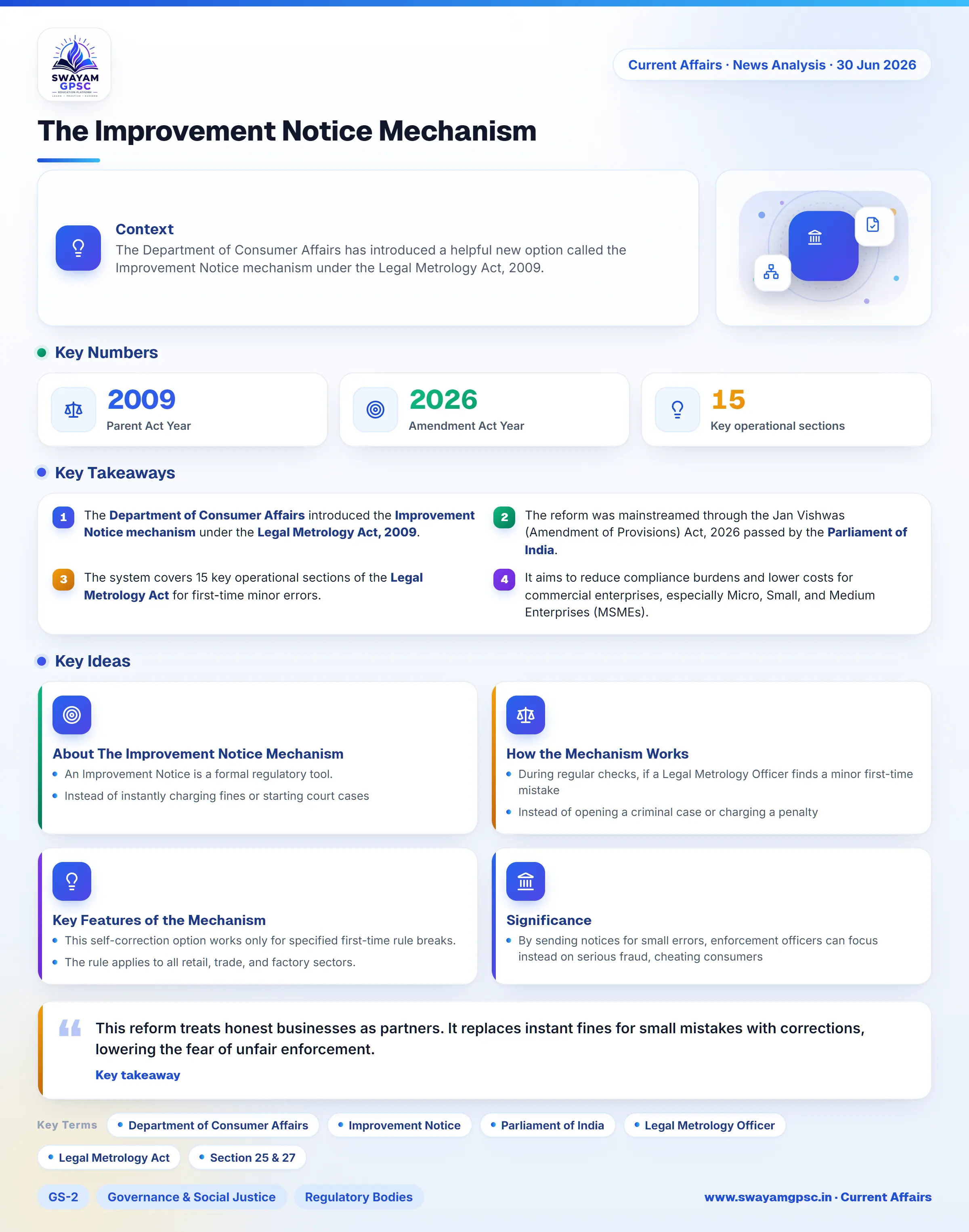
The Improvement Notice Mechanism
#GS-2 #Governance & Social Justice #Regulatory Bodies #Good Governance #Economy #Infrastructure
Key takeaways
- The Department of Consumer Affairs introduced the Improvement Notice mechanism under the Legal Metrology Act, 2009.
- The reform was mainstreamed through the Jan Vishwas (Amendment of Provisions) Act, 2026 passed by the Parliament of India.
- The system covers 15 key operational sections of the Legal Metrology Act for first-time minor errors.
- It aims to reduce compliance burdens and lower costs for commercial enterprises, especially Micro, Small, and Medium Enterprises (MSMEs).
Context
- The Department of Consumer Affairs has introduced a helpful new option called the Improvement Notice mechanism under the Legal Metrology Act, 2009.
About The Improvement Notice Mechanism
- An Improvement Notice is a formal regulatory tool. Field officers issue it when a business makes an accidental procedural error.
- Instead of instantly charging fines or starting court cases, the authority gives a formal warning and a reasonable deadline to fix the problem.
- This reform was passed by the Parliament of India. It was brought in through the Jan Vishwas (Amendment of Provisions) Act, 2026, which updated parts of the original Legal Metrology Act, 2009.
- The main goal is to reduce compliance pressure, lower operating costs, and bring clarity for commercial businesses, especially Micro, Small, and Medium Enterprises (MSMEs).
- Another aim is to stop unnecessary court cases caused by small paperwork or typing errors so courts can work more efficiently.
How the Mechanism Works
- During regular checks, if a Legal Metrology Officer finds a minor first-time mistake, they record it under this system.
- Instead of opening a criminal case or charging a penalty, the officer gives a formal Improvement Notice pointing out the exact error.
- The notice gives a reasonable, legally approved deadline for the business to fix the technical mistake.
- If the business fixes the issue within this time, the case is closed with zero penalties. If they fail or repeat the mistake, strict legal action starts automatically.
Key Features of the Mechanism
- This self-correction option works only for specified first-time rule breaks. Repeat mistakes skip the warning stage and face direct fines under the Act.
- The rule applies to all retail, trade, and factory sectors. It directly helps manufacturers, packers, importers, dealers, repairers, and traders.
- The system covers 15 key operational sections of the Legal Metrology Act.
- Section 25 & 27 cover using, making, or selling non-standard weights and measures.
- Section 31 & 41 deal with not showing documents or giving wrong statutory reports.
- Section 32 covers failing to get early model approvals for measuring equipment.
- Section 36(1) handles minor size or weight mismatches in packaged goods.
- Section 46 deals with doing repairs or changes without local registration.
- If the business corrects the logged issue within the given timeframe, officials close the file with no fine or court record.
Significance
- This reform treats honest businesses as partners. It replaces instant fines for small mistakes with corrections, lowering the fear of unfair enforcement.
- By sending notices for small errors, enforcement officers can focus instead on serious fraud, cheating consumers, and major weight fraud.