Implementing One Nation One Election Framework in India
#GS-2 #Indian Polity & Constitution #Constitution #Parliament #Executive #Constitutional Bodies #Good Governance #National
Why in News
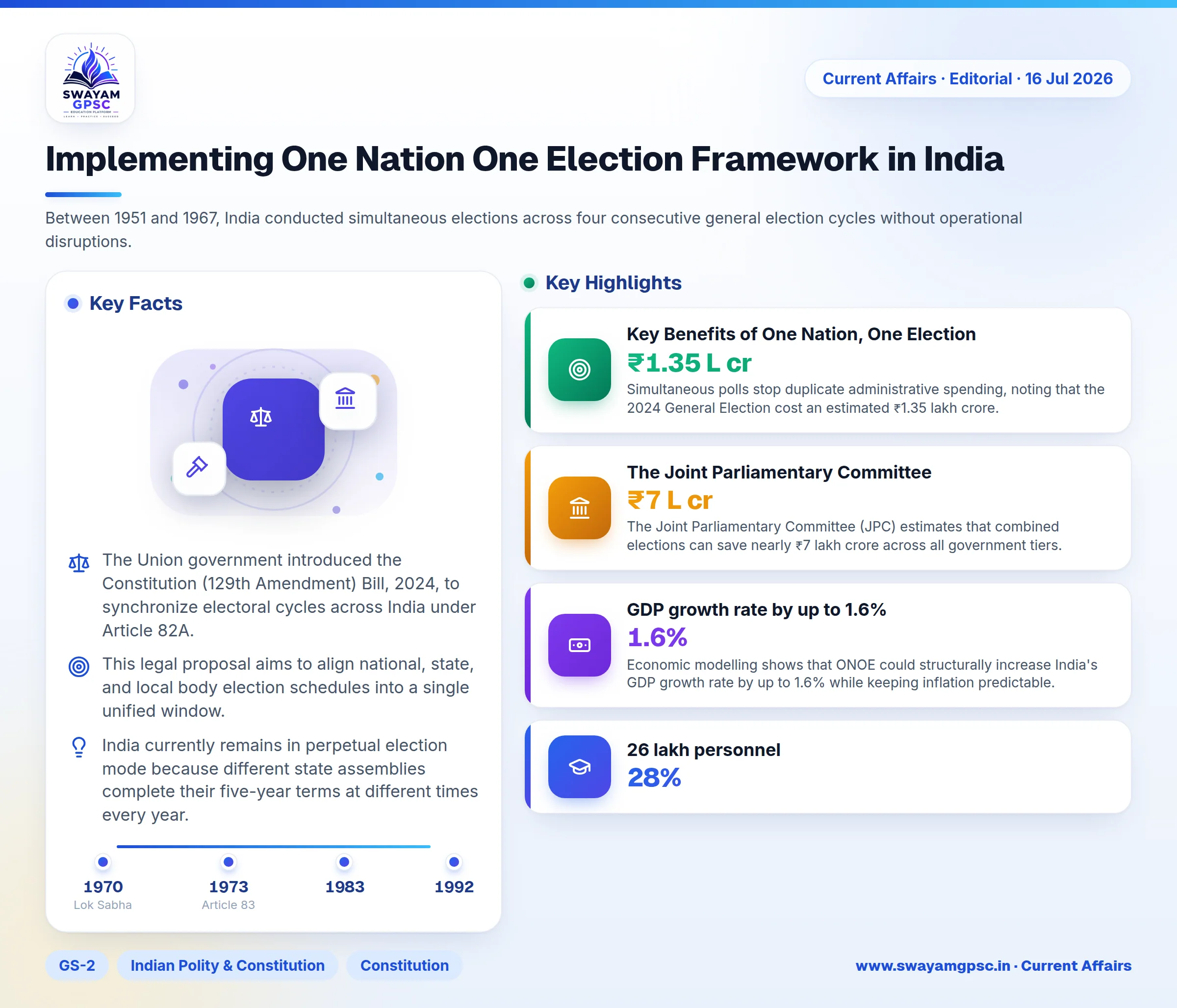
- The Union government introduced the Constitution (129th Amendment) Bill, 2024, to synchronize electoral cycles across India under Article 82A.
- This legal proposal aims to align national, state, and local body election schedules into a single unified window.
- Supporters highlight major advantages like reduced fiscal deficits and efficient security force management, while critics raise serious concerns about the basic structure doctrine.
What is One Nation, One Election?
- One Nation, One Election (ONOE) is a structural proposal to hold simultaneous polls for the Lok Sabha, all State Legislative Assemblies, and local bodies like municipalities and panchayats.
- India currently remains in perpetual election mode because different state assemblies complete their five-year terms at different times every year.
- Between 1951 and 1967, India conducted simultaneous elections across four consecutive general election cycles without operational disruptions.
- Premature dissolutions of multiple state legislative assemblies during 1968 and 1969 disrupted this natural electoral synchrony.
- The early dissolution of the 4th Lok Sabha in 1970 fractured the national election timeline completely.
- The Election Commission of India (ECI) recommended returning to simultaneous elections in its 1983 annual report to control public spending.
- Justice BP Jeevan Reddy headed the 170th Law Commission Report in 1999, which strongly advocated for synchronized elections.
- The 2015 Parliamentary Standing Committee noted that simultaneous elections would eliminate governance paralysis caused by the Model Code of Conduct.
- The 2017 NITI Aayog Discussion Paper outlined a phased strategy to synchronize elections with minimal legal conflict.
- The 2018 Law Commission Draft proposed legal amendments and a constructive vote of no-confidence to manage unstable assemblies.
- The Kovind Committee (2023-2024) recommended aligning Lok Sabha and state assembly elections first, followed by local body polls within 100 days.
- Accepting these panel recommendations led to the drafting of the Constitution (129th Amendment) Bill, 2024.
129th Constitutional Amendment Bill, 2024
- The Bill defines simultaneous elections as general elections conducted together for the Lok Sabha and all State Legislative Assemblies.
- Under proposed Article 82A, the President will notify an appointed date to adjust or shorten new state assembly terms to match the Lok Sabha tenure.
- Under proposed amendments to Article 83 and Article 172, mid-term elections will take place only for the unexpired term of the five-year cycle.
- The Election Commission of India (ECI) receives discretionary power to defer a state election during local emergencies while keeping its term aligned with Parliament.
- The Bill excludes municipal and panchayat elections for now to avoid requiring immediate ratification by half of the State Legislatures.
Union Territories Laws (Amendment) Bill, 2024
- This companion Bill extends simultaneous election rules to Union Territories with legislatures, specifically Delhi, Puducherry, and Jammu and Kashmir.
- It legally binds these assembly terms to the national Lok Sabha cycle and applies the unexpired term rule during premature dissolutions.
Key Benefits of One Nation, One Election
- Simultaneous polls stop duplicate administrative spending, noting that the 2024 General Election cost an estimated ₹1.35 lakh crore.
- The Joint Parliamentary Committee (JPC) estimates that combined elections can save nearly ₹7 lakh crore across all government tiers.
- Confining the Model Code of Conduct freeze to a single window every five years prevents routine governance delays that currently last 4 to 6 months annually in big states.
- Economic modelling shows that ONOE could structurally increase India's GDP growth rate by up to 1.6% while keeping inflation predictable.
- Conducting elections together frees public officials from frequent polling duties, improving long-term public service delivery.
- According to an Economic Advisory Council to the Prime Minister (EAC-PM) paper, ONOE reduces polling staff needs by 28%, saving 26 lakh personnel and 1.04 crore personnel-days for schools.
- A single election schedule prevents continuous shifting of Central Armed Police Forces (CAPF) units like CRPF and BSF, avoiding severe force fatigue.
- Single-block elections cut down continuous political fundraising, making it easier for the ECI to monitor unaccounted black money.
- Combined elections eliminate voter fatigue and help migrant workers return home just once to cast ballots for all governance tiers.
Challenges
- Mandatory truncations of elected assemblies conflict with Article 83 and Article 172, risking violations of the basic structure doctrine established in the Kesavananda Bharati case, 1973.
- Adopting a constructive vote of no-confidence could weaken executive accountability and allow minority governments to retain power without real legislative support.
- Opponents note that India's high growth era of 8% to 9% (2003-2011) occurred during staggered elections, unlike the 3.5% Hindu rate of growth during the simultaneous era of 1952-1967.
- Official election spending accounts for under 0.1% of the budget, while total political spending exceeded ₹1,00,000 crore in 2024, which ONOE cannot eradicate.
- During the Delhi conclave in July 2026, experts warned that national election waves could submerge regional issues like agrarian distress in Vidarbha or coastal issues in Kerala.
- Dominant national campaigns threaten democratic decentralization under the 73rd and 74th Constitutional Amendment Acts, 1992, by overshadowing local issues.
- Mid-term dissolutions resulting in assemblies serving under 1 year would cause severe governance paralysis and frequent policy shifts.
- Official ECI estimates require buying 46.75 lakh Ballot Units, 33.63 lakh Control Units, and 36.62 lakh VVPATs, costing ₹10,000 crore every 15 years for replacements.
- Holding nationwide polling on a single day creates a massive deficit of trained CAPF personnel, threatening election security in sensitive regions.
Way Forward
- The Joint Parliamentary Committee (JPC) must build political consensus among regional parties, especially since aligning local bodies requires approval from half of the State Legislatures.
- The government must legally codify remainder terms in the Constitution (129th Amendment) Bill, 2024, limiting mid-term assemblies strictly to the original five-year cycle.
- State Assembly rules should adopt a constructive vote of no-confidence, requiring opposition parties to name a successor before removing a Chief Minister.
- The ECI should build a unified Common Electoral Roll so citizens can use a single Electoral Photo Identity Card (EPIC) across all elections.
- The Ministry of Home Affairs needs a comprehensive CAPF deployment strategy, utilizing dedicated railway corridors and trained state police.
- Parliament must introduce strict campaign finance caps and fair media airtime allocation to protect regional parties.
- The Ministry of Finance must issue advance capital funding to Bharat Electronics Limited (BEL) and Electronics Corporation of India Limited (ECIL) to manufacture required EVMs over 3 to 4 years.
Conclusion
- Moving to ONOE offers structural advantages in administrative efficiency and fiscal savings for India.
- However, long-term success requires upholding the basic structure doctrine, respecting federalism, and building broad inter-state political consensus.