How Land Pooling Solves Land Acquisition Woes
#GS-2 #Economy #Infrastructure #Governance & Social Justice #Good Governance #Poverty
Key takeaways
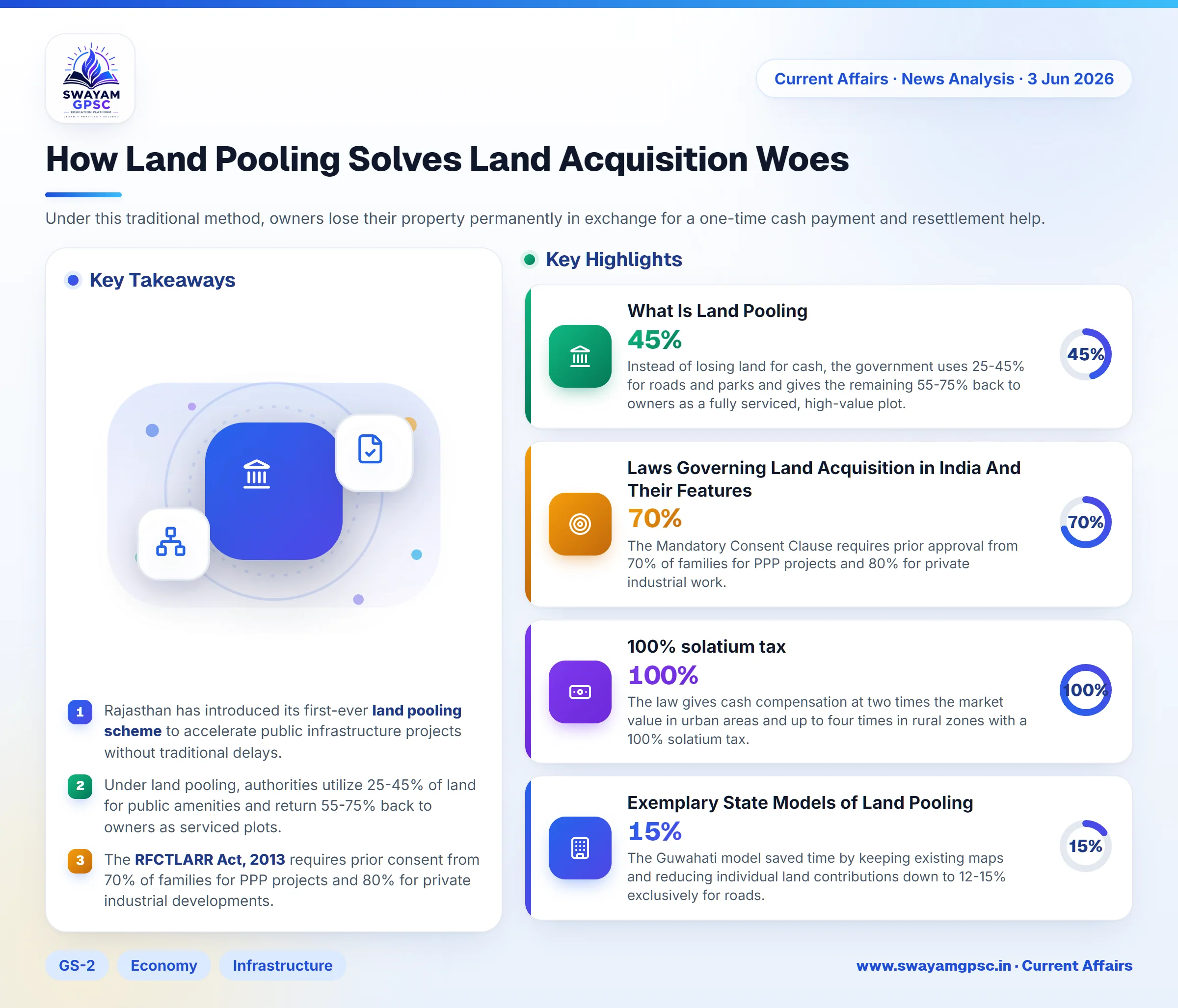
- Rajasthan has introduced its first-ever land pooling scheme to accelerate public infrastructure projects without traditional delays.
- Under land pooling, authorities utilize 25-45% of land for public amenities and return 55-75% back to owners as serviced plots.
- The RFCTLARR Act, 2013 requires prior consent from 70% of families for PPP projects and 80% for private industrial developments.
- The Gujarat Town Planning Scheme (TPS) Paradigm has successfully developed over 1,000 sq. km across major urban centers.
Why in News
- Rajasthan has officially launched its first-ever land pooling scheme to simplify getting land for public development projects like roads.
- This new step helps the government build infrastructure faster without facing the usual delays of old methods.
What Is Land Acquisition
- Land acquisition is a legal process where the government takes over private land for public welfare or industrial growth.
- Under this traditional method, owners lose their property permanently in exchange for a one-time cash payment and resettlement help.
What Is Land Pooling
- Land pooling is a cooperative public model where landowners voluntarily join their adjacent plots and hand them over to authorities for planned development.
- Instead of losing land for cash, the government uses 25-45% for roads and parks and gives the remaining 55-75% back to owners as a fully serviced, high-value plot.
Laws Governing Land Acquisition in India And Their Features
- The main law for this is The Right to Fair Compensation and Transparency in Land Acquisition, Rehabilitation and Resettlement (RFCTLARR) Act, 2013.
- The Mandatory Consent Clause requires prior approval from 70% of families for PPP projects and 80% for private industrial work.
- The Compulsory Social Impact Assessment (SIA) checks the exact disruption an infrastructure project causes to local livelihoods before starting.
- The law gives cash compensation at two times the market value in urban areas and up to four times in rural zones with a 100% solatium tax.
- Statutory R&R Rights give legal livelihood support, housing, or annuity packages to landless agricultural workers and dependent artisans.
- The law protects multi-crop fertile land by restricting acquisitions to preserve long-term food security except in strict exceptional cases.
Issues Associated with Land Acquisitions in India
- Strict welfare rules have vastly increased baseline infrastructure project costs, making large compulsory acquisitions economically unviable.
- Complex approval workflows cause massive execution gaps and stall crucial blueprint goals for many years.
- Compulsory evictions break apart long-standing community networks and force rural populations out of their ancestral homes.
- Mismatches between local realities and official records push communities to file lawsuits, creating massive court backlogs.
Exemplary State Models of Land Pooling
- The Gujarat Town Planning Scheme (TPS) Paradigm under the Gujarat Town Planning and Urban Development Act, 1976 has developed over 1,000 sq. km across major cities like Ahmedabad and Surat.
- The Guwahati model saved time by keeping existing maps and reducing individual land contributions down to 12-15% exclusively for roads.
How Land Pooling Resolves the Crisis of Land Acquisition
- The model replaces forced government takeovers with a cooperative layout, avoiding social friction and legal blockades.
- Authorities do not need massive cash reserves initially because development costs are recovered from landowners over time.
- Landowners keep 60-75% of their original space locally, staying connected to their traditional social circles.
- A farmer hands over raw land and receives a valuable, well-shaped plot fully connected to modern electricity, water, and roads.
Way Forward
- States must update and match land ownership records digitally via drone surveys before launching schemes to avoid data errors.
- Build trust by setting clear minimum and maximum limits on land contributions so landowners know what they get back.
- Expand the model to include small business spaces within new plots to protect the livelihoods of tenant workers.
- Update outdated urban planning laws to give local municipal teams the financial and legal power needed to execute schemes independently.
- Pay yearly financial allowances to smallholders while their plots are developed to support household expenses.