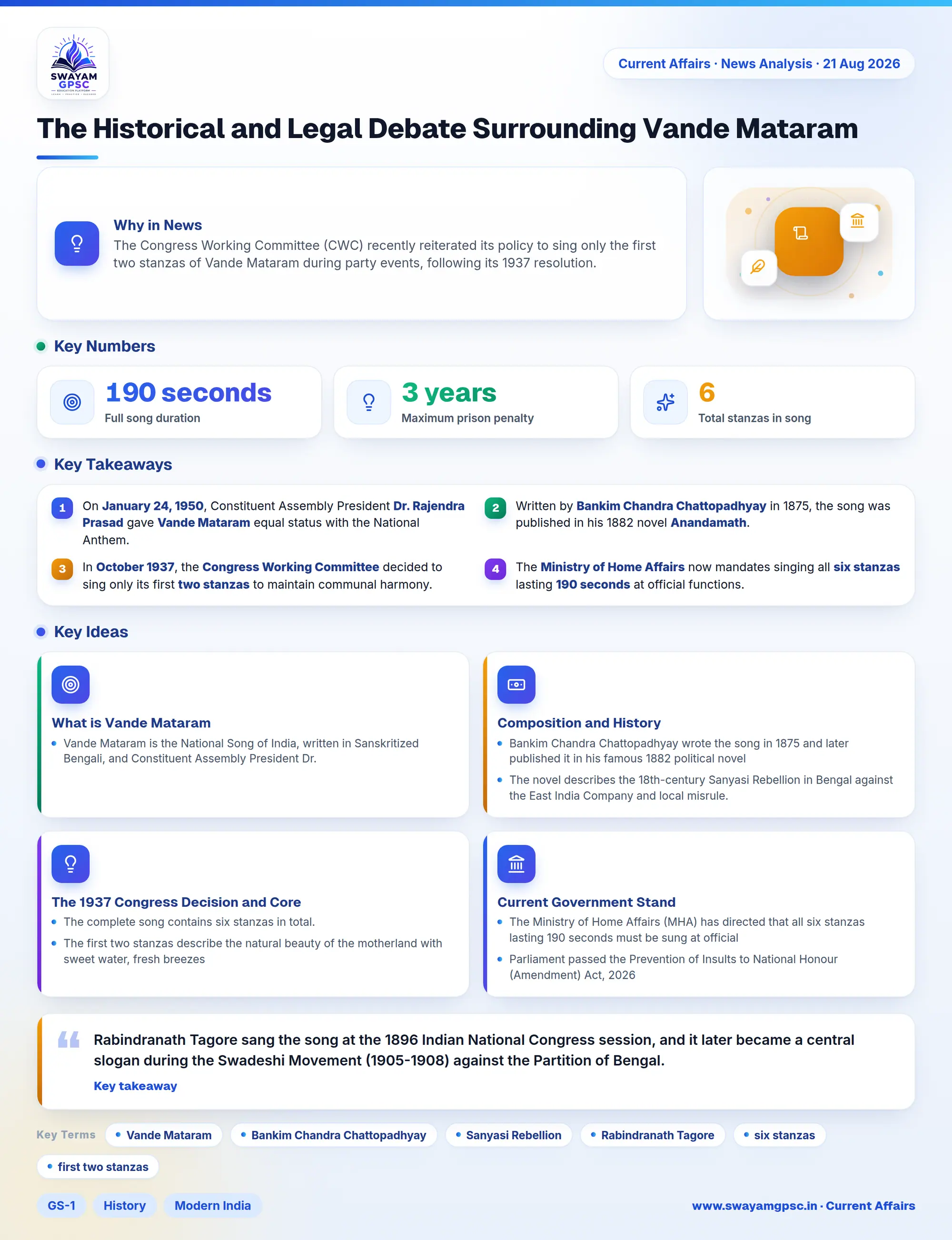
The Historical and Legal Debate Surrounding Vande Mataram
#GS-1 #History #Modern India #Freedom Struggle #Culture #Heritage #GS-2 #Indian Polity & Constitution #Constitution #Current Events #National #Vande Mataram
Key takeaways
- On January 24, 1950, Constituent Assembly President Dr. Rajendra Prasad gave Vande Mataram equal status with the National Anthem.
- Written by Bankim Chandra Chattopadhyay in 1875, the song was published in his 1882 novel Anandamath.
- In October 1937, the Congress Working Committee decided to sing only its first two stanzas to maintain communal harmony.
- The Ministry of Home Affairs now mandates singing all six stanzas lasting 190 seconds at official functions.
- Under the Prevention of Insults to National Honour (Amendment) Act, 2026, intentional disruption of the song carries up to 3 years of imprisonment.
Why in News
- The Congress Working Committee (CWC) recently reiterated its policy to sing only the first two stanzas of Vande Mataram during party events, following its 1937 resolution.
What is Vande Mataram
- Vande Mataram is the National Song of India, written in Sanskritized Bengali, and Constituent Assembly President Dr. Rajendra Prasad declared on January 24, 1950 that it holds equal status with the National Anthem Jana Gana Mana.
Composition and History
- Bankim Chandra Chattopadhyay wrote the song in 1875 and later published it in his famous 1882 political novel Anandamath.
- The novel describes the 18th-century Sanyasi Rebellion in Bengal against the East India Company and local misrule.
- Rabindranath Tagore sang the song at the 1896 Indian National Congress session, and it later became a central slogan during the Swadeshi Movement (1905-1908) against the Partition of Bengal.
The 1937 Congress Decision and Core Controversy
- The complete song contains six stanzas in total.
- The first two stanzas describe the natural beauty of the motherland with sweet water, fresh breezes, and green fields without religious references.
- The remaining four stanzas use Hindu religious symbols, portraying the motherland with swords and linking her to goddesses Durga, Lakshmi, and Saraswati.
- When Subhas Chandra Bose and Jawaharlal Nehru sought advice, Rabindranath Tagore suggested using only the first part to keep the song universal and avoid hurting Muslim sentiments.
- In October 1937, the CWC decided to sing only the first two stanzas at national events to protect religious unity.
- Mahatma Gandhi supported this balanced approach, stating that no one should be forced to sing lines containing religious elements if they object.
Current Government Stand
- The Ministry of Home Affairs (MHA) has directed that all six stanzas lasting 190 seconds must be sung at official ceremonies while the audience stands at attention.
- Parliament passed the Prevention of Insults to National Honour (Amendment) Act, 2026, amending Section 3 of the 1971 Act to punish intentional disruption of Vande Mataram with up to 3 years in prison.