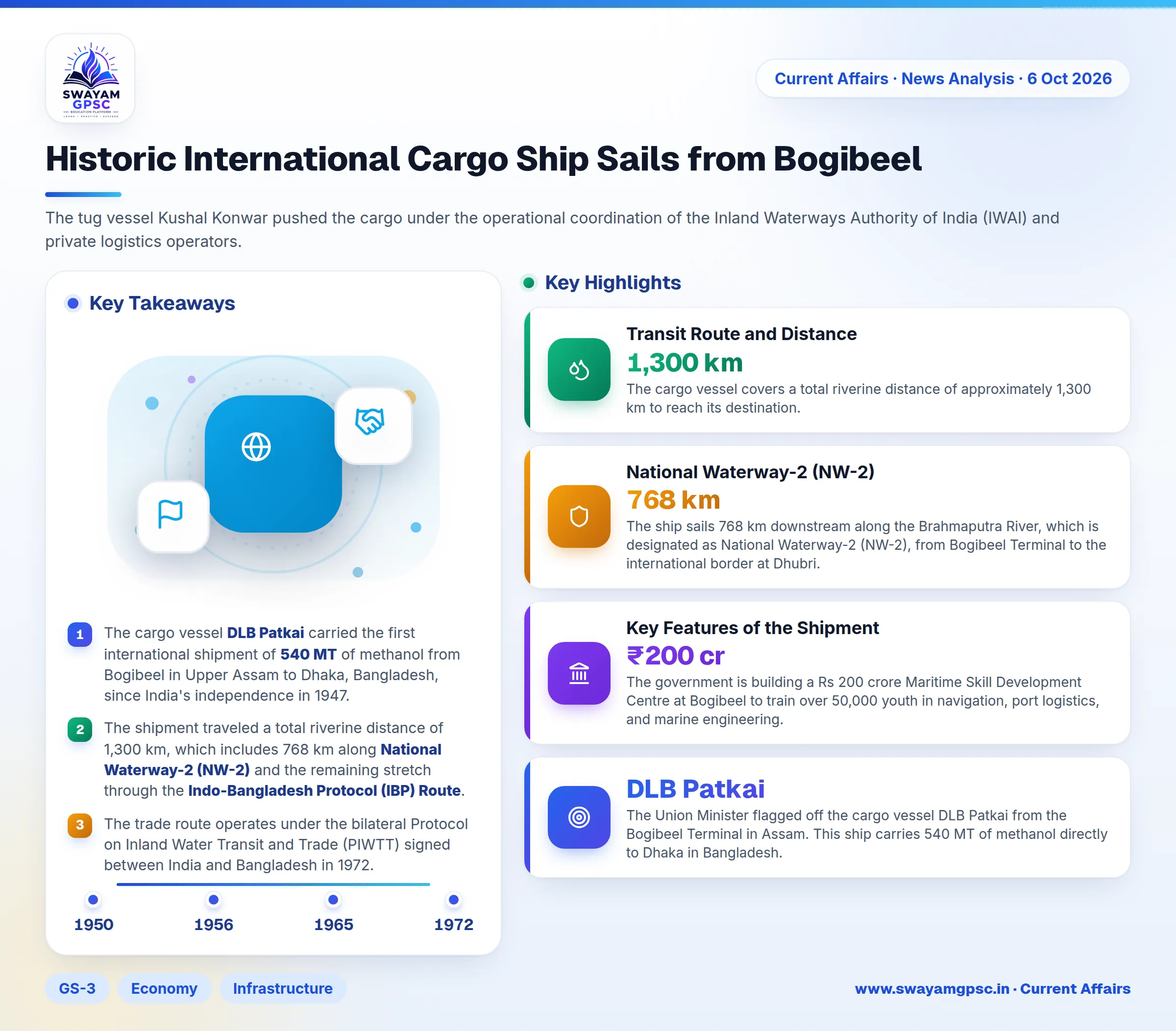
Historic International Cargo Ship Sails from Bogibeel
#GS-3 #Economy #Infrastructure #Current Events #National #International #Inland Waterways #India-Bangladesh Relations
Key takeaways
- The cargo vessel DLB Patkai carried the first international shipment of 540 MT of methanol from Bogibeel in Upper Assam to Dhaka, Bangladesh, since India's independence in 1947.
- The shipment traveled a total riverine distance of 1,300 km, which includes 768 km along National Waterway-2 (NW-2) and the remaining stretch through the Indo-Bangladesh Protocol (IBP) Route.
- The trade route operates under the bilateral Protocol on Inland Water Transit and Trade (PIWTT) signed between India and Bangladesh in 1972.
- The government announced a Rs 200 crore Maritime Skill Development Centre at Bogibeel to train more than 50,000 youth in shipping and port logistics.
Why in News
- The Union Minister flagged off the cargo vessel DLB Patkai from the Bogibeel Terminal in Assam. This ship carries 540 MT of methanol directly to Dhaka in Bangladesh.
- This event marks a major milestone because it is the first international cargo shipment from Upper Assam since India gained independence in 1947.
About the Shipment
- This historic cross-border shipment transports bulk industrial petrochemicals through inland waterways. It carries methanol directly from eastern Assam to Bangladesh using domestic and bilateral protocol routes.
Entities Involved
- The state-owned enterprise Assam Petro-Chemicals Limited (APCL) produced the methanol at its plant in Namrup, Dibrugarh.
- The tug vessel Kushal Konwar pushed the cargo under the operational coordination of the Inland Waterways Authority of India (IWAI) and private logistics operators.
- The Ministry of Ports, Shipping and Waterways (MoPSW) managed the operations in coordination with the Government of Assam and Bangladesh inland port authorities.
Transit Route and Distance
- The cargo vessel covers a total riverine distance of approximately 1,300 km to reach its destination.
- The ship sails 768 km downstream along the Brahmaputra River, which is designated as National Waterway-2 (NW-2), from Bogibeel Terminal to the international border at Dhubri.
- After crossing the border, the vessel enters Bangladesh and travels along the Indo-Bangladesh Protocol (IBP) Route to reach the Inland Container Depot at Pangaon Port in Narayanganj near Dhaka.
Historical Background of River Trade
- During the colonial era between 1856 and 1947, Dibrugarh served as one of the busiest riverine ports in eastern India.
- Regular government steamer links started connecting Dibrugarh to Kolkata by 1856.
- The opening of the Dibru-Sadiya Railway in 1882 turned Dibrugarh ghat into a multimodal terminal that dispatched daily shipments of Assam tea, crude petroleum, coal, and timber.
Disruptions and Decline
- The 1947 Partition of India cut off direct domestic river connectivity between Assam and Kolkata by placing East Pakistan in between.
- The Great Assam-Tibet Earthquake of 1950 shifted the Brahmaputra riverbed and caused heavy siltation. This led to the closure of the Dibrugarh river ghat on October 15, 1956.
- The 1965 Indo-Pak War caused the indefinite suspension of all cross-border river transit and trade routes between the regions.
Revival Milestones
- India and Bangladesh signed the Protocol on Inland Water Transit and Trade (PIWTT) in 1972 to restore water trade.
- The central government officially declared the 891-km stretch of the Brahmaputra from Sadiya to Dhubri as National Waterway-2 (NW-2) in 1988.
- The government set up permanent Land Customs and Immigration check posts at Bogibeel and Dhubri to help start international operations.
Key Features of the Shipment
- This maiden export of 540 MT of domestically produced methanol proves that the Brahmaputra river can successfully transport bulk chemical cargo.
- The shipment utilizes the upgraded Bogibeel Inland Water Transport Terminal, which now has modern customs, immigration, and berthing facilities.
- The cargo operates under the Protocol on Inland Water Transit and Trade (PIWTT), which helps extend trade routes deep into Upper Assam.
- The government is building a Rs 200 crore Maritime Skill Development Centre at Bogibeel to train over 50,000 youth in navigation, port logistics, and marine engineering.