Gulf of Aden: Strategic Location and Maritime Challenges
#GS-1 #GS-3 #Geography #Physical Geography #Current Events #International #Mapping
Key takeaways
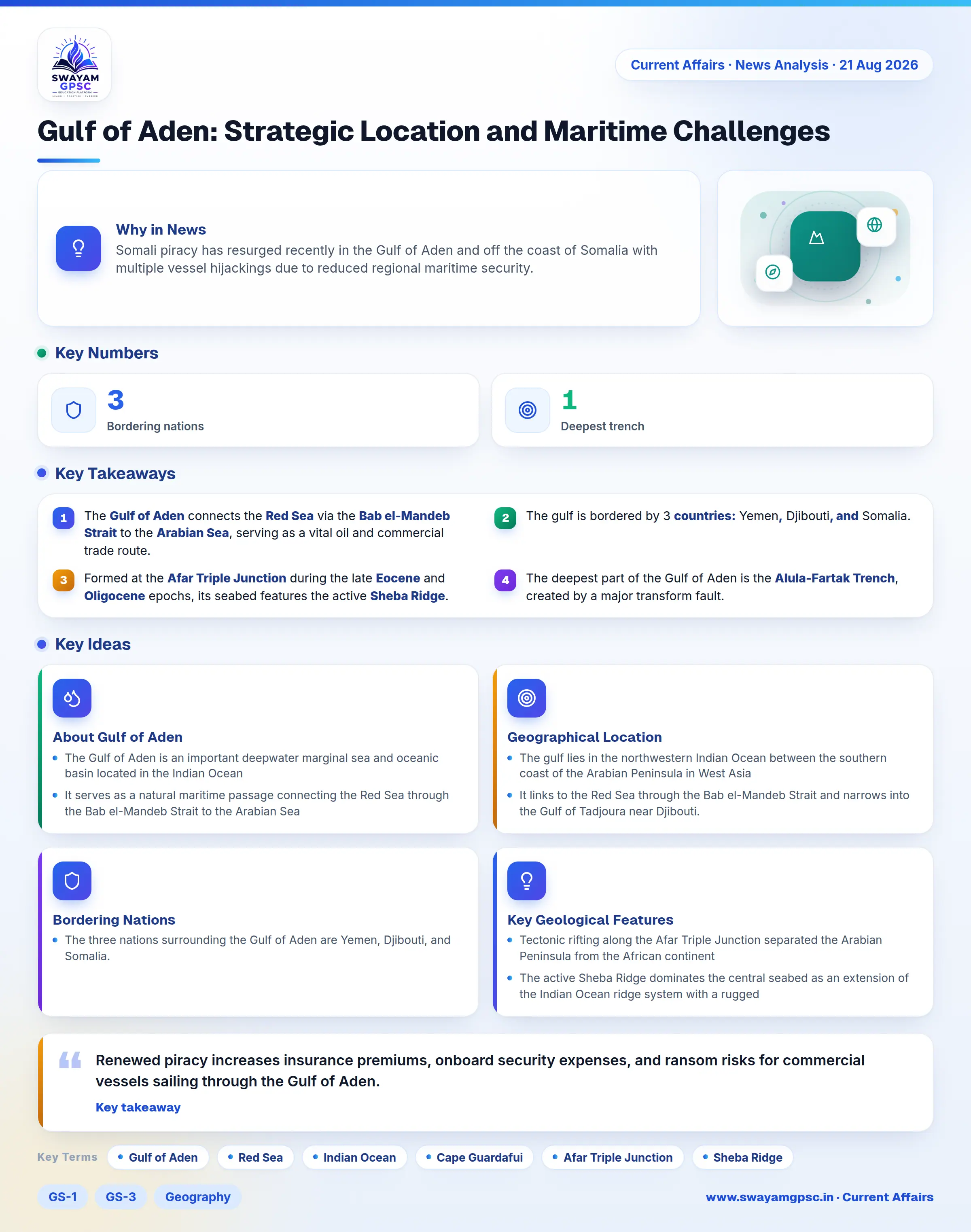
- The Gulf of Aden connects the Red Sea via the Bab el-Mandeb Strait to the Arabian Sea, serving as a vital oil and commercial trade route.
- The gulf is bordered by 3 countries: Yemen, Djibouti, and Somalia.
- Formed at the Afar Triple Junction during the late Eocene and Oligocene epochs, its seabed features the active Sheba Ridge.
- The deepest part of the Gulf of Aden is the Alula-Fartak Trench, created by a major transform fault.
- Resurgent Somali piracy forces commercial ships to divert around the Cape of Good Hope, escalating shipping costs and delays.
Why in News
- Somali piracy has resurged recently in the Gulf of Aden and off the coast of Somalia with multiple vessel hijackings due to reduced regional maritime security.
About Gulf of Aden
- The Gulf of Aden is an important deepwater marginal sea and oceanic basin located in the Indian Ocean, named after the historic seaport of Aden in southern Yemen.
- It serves as a natural maritime passage connecting the Red Sea through the Bab el-Mandeb Strait to the Arabian Sea and the broader Indian Ocean.
- This sea corridor is one of the busiest routes in the world for global commercial trade and hydrocarbon shipping.
Geographical Location
- The gulf lies in the northwestern Indian Ocean between the southern coast of the Arabian Peninsula in West Asia and the Horn of Africa in East Africa.
- It links to the Red Sea through the Bab el-Mandeb Strait and narrows into the Gulf of Tadjoura near Djibouti.
- Its geographical boundary stretches from the meridian of Cape Guardafui in Somalia to the continental shelf near the Socotra Archipelago in Yemen and the Kuria Muria Islands in Oman.
Bordering Nations
- The three nations surrounding the Gulf of Aden are Yemen, Djibouti, and Somalia.
Key Geological Features
- Tectonic rifting along the Afar Triple Junction separated the Arabian Peninsula from the African continent during the late Eocene and Oligocene epochs to form this gulf.
- The active Sheba Ridge dominates the central seabed as an extension of the Indian Ocean ridge system with a rugged central valley crossed by transform faults.
- The largest transform fault along this ridge forms the Alula-Fartak Trench, which marks the deepest point of the Gulf of Aden.
- Surface water flowing through the Bab el-Mandeb Strait balances heavy evaporation in the Red Sea, while seasonal monsoon upwelling brings nutrient-rich waters that support plankton, fisheries, and sea turtles.
Implications of Resurgent Piracy
- Renewed piracy increases insurance premiums, onboard security expenses, and ransom risks for commercial vessels sailing through the Gulf of Aden.
- Emerging ties between pirates and regional militant groups may increase illegal arms smuggling and lead to more complex maritime attacks.
- Growing security threats force ships to bypass the region and reroute around the Cape of Good Hope, causing longer transit times, higher fuel costs, and global supply chain delays.