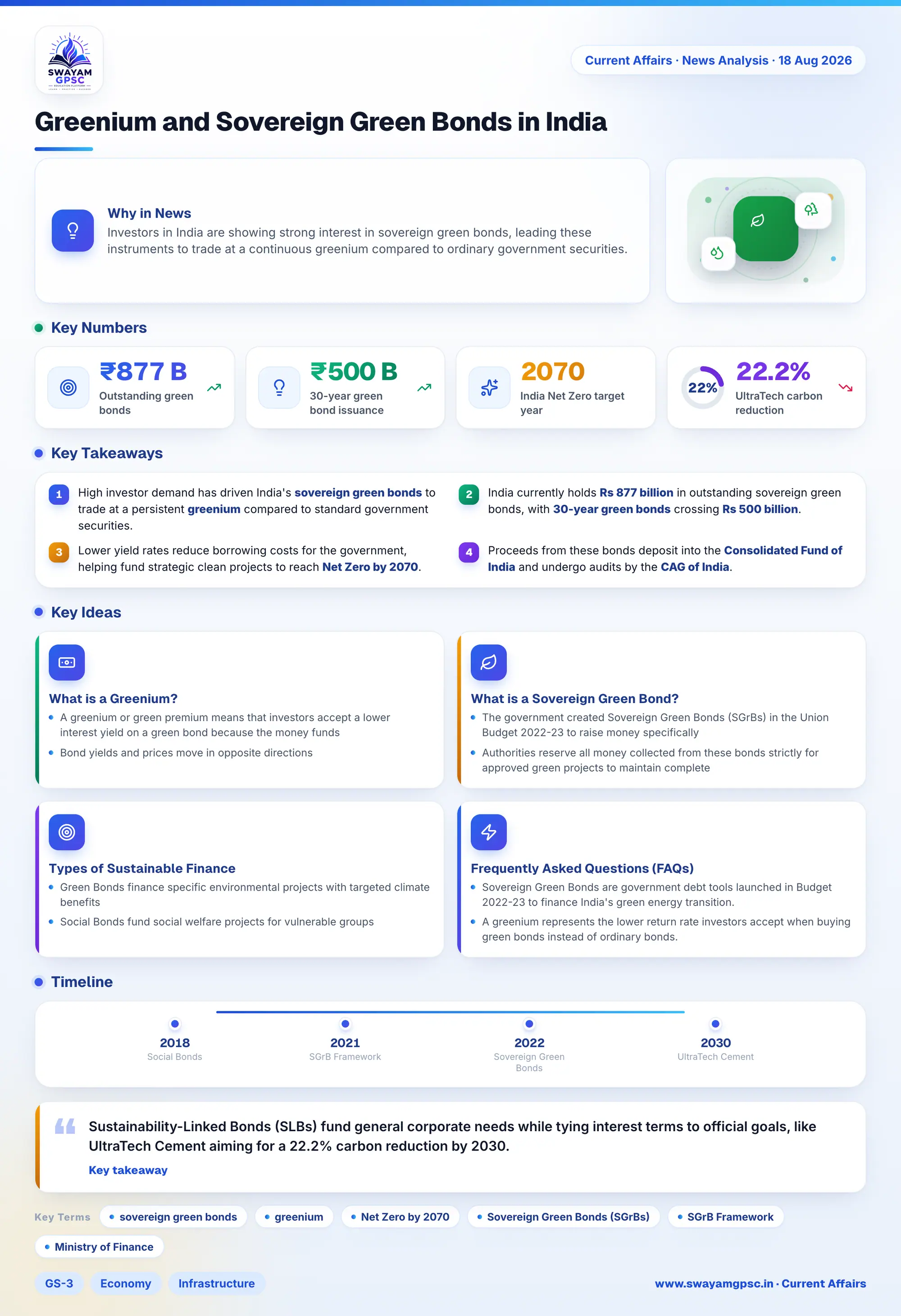
Greenium and Sovereign Green Bonds in India
#GS-3 #Economy #Infrastructure #Environment #Sustainable Development #Current Events #National #Capital Market #Mobilization of Resources #Sovereign Green Bonds #Greenium
Key takeaways
- High investor demand has driven India's sovereign green bonds to trade at a persistent greenium compared to standard government securities.
- India currently holds Rs 877 billion in outstanding sovereign green bonds, with 30-year green bonds crossing Rs 500 billion.
- Lower yield rates reduce borrowing costs for the government, helping fund strategic clean projects to reach Net Zero by 2070.
- Proceeds from these bonds deposit into the Consolidated Fund of India and undergo audits by the CAG of India.
Why in News
- Investors in India are showing strong interest in sovereign green bonds, leading these instruments to trade at a continuous greenium compared to ordinary government securities.
- During the first half of FY27, the average greenium reached its highest point since India started issuing sovereign green bonds in FY2022-23, showing that the market can handle more green bond issues in the coming months.
What is a Greenium?
- A greenium or green premium means that investors accept a lower interest yield on a green bond because the money funds environmentally friendly projects.
- Bond yields and prices move in opposite directions, so a lower yield proves that investors are willing to pay a higher market price for sustainable investments.
- This lower yield reduces total borrowing costs for the government, making it cheaper to fund large clean energy and electric transport projects needed for Net Zero by 2070.
- A steady greenium shows that India's green finance market is growing stronger and investors trust the national rules for Environmental, Social and Governance (ESG) projects.
What is a Sovereign Green Bond?
- The government created Sovereign Green Bonds (SGrBs) in the Union Budget 2022-23 to raise money specifically for projects that help India move toward a low-carbon economy.
- Authorities reserve all money collected from these bonds strictly for approved green projects to maintain complete transparency.
- India designed its SGrB Framework around the ICMA Green Bond Principles (2021) to ensure international credibility.
- Investors buy these bonds through a uniform price auction, trade them in secondary markets, and use them for repo transactions.
- Banks can also count these bonds toward their required Statutory Liquidity Ratio (SLR) quota.
- The Ministry of Finance introduced India's first formal Sovereign Green Bond Framework in 2022 to guide project selection.
- Environmental rating agency CICERO from Norway rated the framework as Medium Green with Good Governance.
- Proceeds go into the Consolidated Fund of India and the Public Debt Management Cell tracks them using a dedicated Green Register.
- The Green Finance Working Committee (GFWC), led by the Chief Economic Adviser, picks and reviews eligible projects.
- The Comptroller and Auditor General (CAG) of India audits how the government spends these funds.
- India currently has Rs 877 billion in active green bonds, with 30-year green bonds crossing Rs 500 billion.
- Although early auctions faced cancellations due to low demand at low interest rates, investor interest has bounced back strongly for long-term options.
- Insurance companies need long-term financial products like these bonds to balance their long-term payouts.
- Giving green bonds infrastructure status allows institutional investors greater freedom to assign funds to them.
- These long-duration instruments fit the Asset-Liability Management (ALM) needs of pension funds and insurance firms, driving steady demand for 30-year bonds.
Types of Sustainable Finance Instruments
- Green Bonds finance specific environmental projects with targeted climate benefits, such as India's Sovereign Green Bonds (SGrBs).
- Social Bonds fund social welfare projects for vulnerable groups, such as the Educate Girls Development Impact Bond (DIB) run in Rajasthan from 2015 to 2018.
- Sustainability Bonds blend both environmental and social targets, similar to Mexico's BONDESG bonds linked to UN SDGs.
- Sustainability-Linked Bonds (SLBs) fund general corporate needs while tying interest terms to official goals, like UltraTech Cement aiming for a 22.2% carbon reduction by 2030.
Frequently Asked Questions (FAQs)
- Sovereign Green Bonds are government debt tools launched in Budget 2022-23 to finance India's green energy transition.
- A greenium represents the lower return rate investors accept when buying green bonds instead of ordinary bonds.
- The government framework lists nine categories for funding, including renewable energy, clean transport, and climate adaptation.
- Long-term 30-year green bonds attract institutional investors because they match long-term payout obligations under Asset-Liability Management (ALM) rules.
- Money raised goes directly into the Consolidated Fund of India and is audited by the CAG of India.