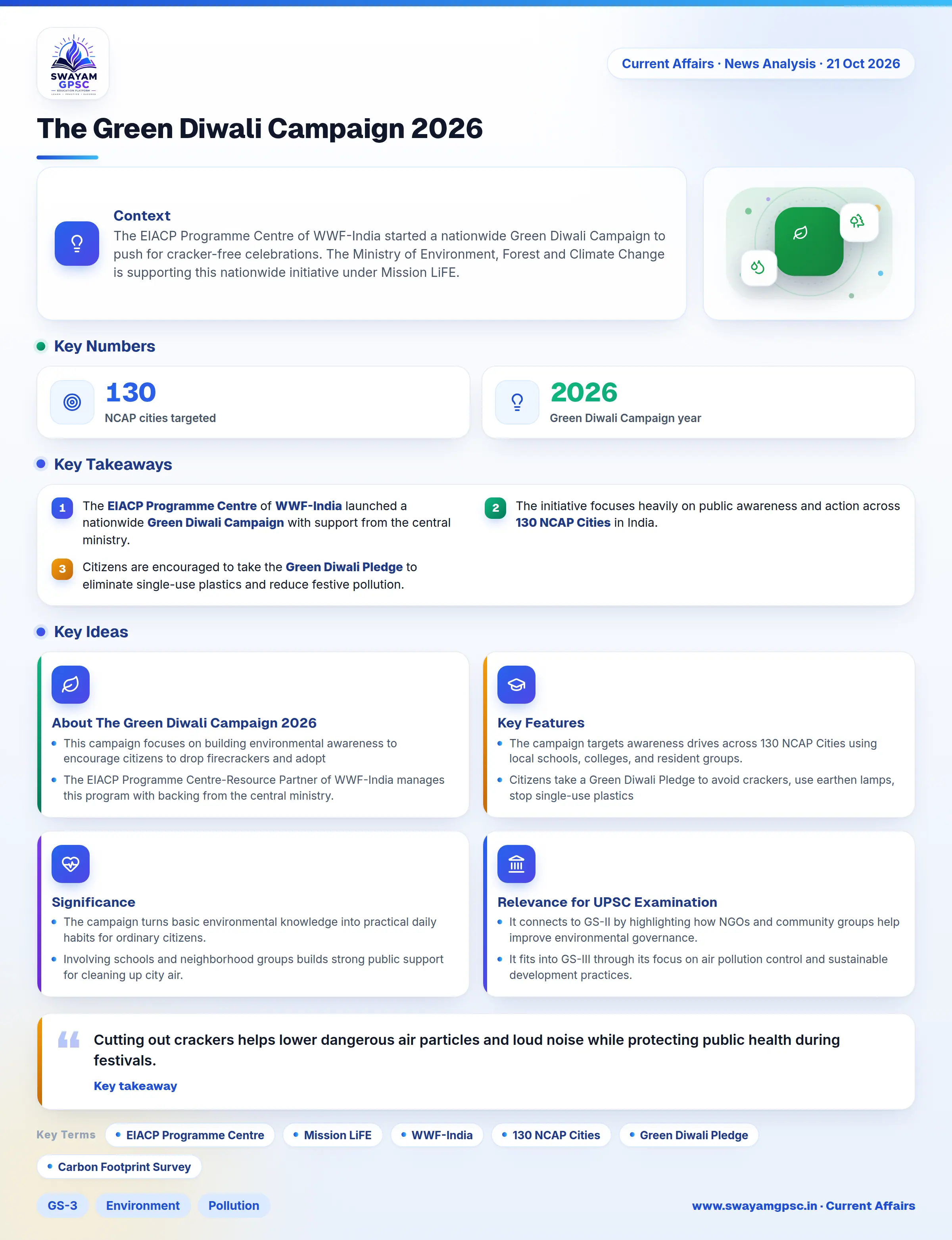
The Green Diwali Campaign 2026
#GS-3 #Environment #Pollution #Sustainable Development #GS-2 #Governance & Social Justice #GS-4 #Ethics #Current Events #National #Economy
Key takeaways
- The EIACP Programme Centre of WWF-India launched a nationwide Green Diwali Campaign with support from the central ministry.
- The initiative focuses heavily on public awareness and action across 130 NCAP Cities in India.
- Citizens are encouraged to take the Green Diwali Pledge to eliminate single-use plastics and reduce festive pollution.
Context
- The EIACP Programme Centre of WWF-India started a nationwide Green Diwali Campaign to push for cracker-free celebrations.
- The Ministry of Environment, Forest and Climate Change is supporting this nationwide initiative under Mission LiFE.
About The Green Diwali Campaign 2026
- This campaign focuses on building environmental awareness to encourage citizens to drop firecrackers and adopt eco-friendly habits.
- The EIACP Programme Centre-Resource Partner of WWF-India manages this program with backing from the central ministry.
- The main goal is to cut down festival pollution and promote sustainable lifestyles linked to Mission LiFE.
Key Features
- The campaign targets awareness drives across 130 NCAP Cities using local schools, colleges, and resident groups.
- Citizens take a Green Diwali Pledge to avoid crackers, use earthen lamps, stop single-use plastics, and buy local goods.
- People can use the Carbon Footprint Survey by WWF-India to check their personal environmental impact.
- Local communities and schools organize rallies and upload geo-tagged photos to earn official recognition.
Significance
- Cutting out crackers helps lower dangerous air particles and loud noise while protecting public health during festivals.
- The campaign turns basic environmental knowledge into practical daily habits for ordinary citizens.
- Involving schools and neighborhood groups builds strong public support for cleaning up city air.
Relevance for UPSC Examination
- It connects to GS-II by highlighting how NGOs and community groups help improve environmental governance.
- It fits into GS-III through its focus on air pollution control and sustainable development practices.
- It relates to GS-IV by stressing personal ethics and moral duties toward ecological protection.