GRAP Stage I Implementation in Delhi-NCR
#GS-3 #Environment #Pollution #Current Events #National
Key takeaways
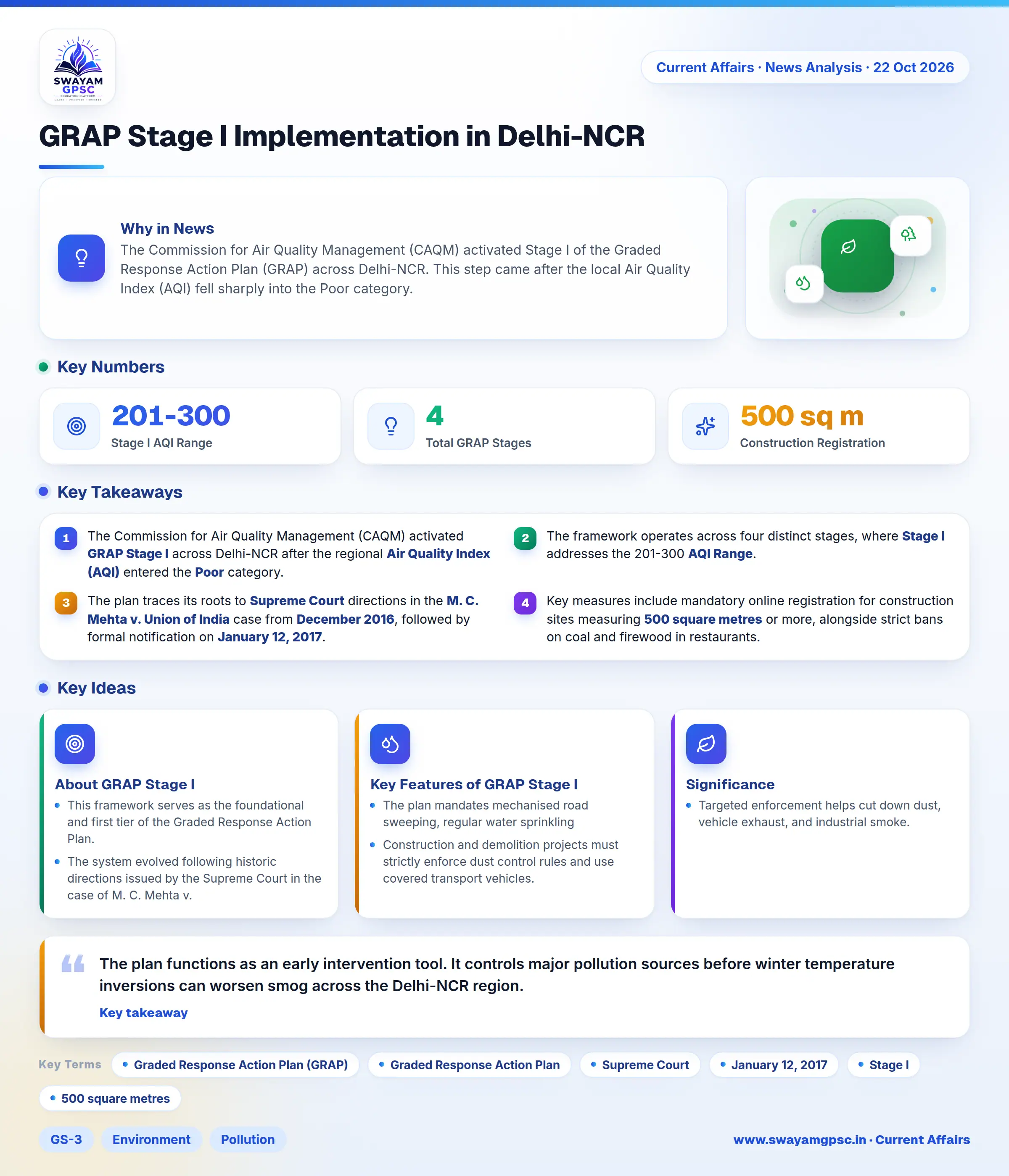
- The Commission for Air Quality Management (CAQM) activated GRAP Stage I across Delhi-NCR after the regional Air Quality Index (AQI) entered the Poor category.
- The framework operates across four distinct stages, where Stage I addresses the 201-300 AQI Range.
- The plan traces its roots to Supreme Court directions in the M. C. Mehta v. Union of India case from December 2016, followed by formal notification on January 12, 2017.
- Key measures include mandatory online registration for construction sites measuring 500 square metres or more, alongside strict bans on coal and firewood in restaurants.
Why in News
- The Commission for Air Quality Management (CAQM) activated Stage I of the Graded Response Action Plan (GRAP) across Delhi-NCR. This step came after the local Air Quality Index (AQI) fell sharply into the Poor category.
About GRAP Stage I
- This framework serves as the foundational and first tier of the Graded Response Action Plan. It acts as an automatic emergency response system across the National Capital Region whenever air quality drops into the Poor range (201 to 300).
- The system evolved following historic directions issued by the Supreme Court in the case of M. C. Mehta v. Union of India in December 2016.
- The Ministry of Environment, Forest and Climate Change (MoEFCC) formally notified the plan on January 12, 2017. Initially, the Environment Pollution (Prevention and Control) Authority (EPCA) received the responsibility for its enforcement.
- The response framework contains four distinct stages. Stage I covers the Poor category with an AQI Range of 201-300, Stage II covers the Very Poor category with an AQI Range of 301-400, Stage III covers the Severe category with an AQI Range of 401-450, and Stage IV covers the Severe+ category with an AQI Range of Above 450.
- The framework provides a structured institutional reaction to rising pollution levels. It introduces progressively stricter control measures as the Air Quality Index (AQI) climbs higher.
- The Commission for Air Quality Management (CAQM) oversees the implementation of these measures. It works alongside pollution control boards, municipal bodies, transport departments, and traffic police.
Key Features of GRAP Stage I
- The plan mandates mechanised road sweeping, regular water sprinkling, and the deployment of anti-smog guns at construction sites to control dust. Collected road dust must also undergo scientific disposal.
- Construction and demolition projects must strictly enforce dust control rules and use covered transport vehicles. Projects covering 500 square metres or more need mandatory online registration.
- Authorities step up Pollution Under Control (PUC) checks and improve traffic management. They penalize polluting vehicles, restrict non-compliant buses, and divert trucks that do not have local destinations.
- Open burning of biomass and municipal waste is strictly prohibited. Authorities monitor landfills more closely and impose environmental penalties according to National Green Tribunal (NGT) guidelines.
- Industries must switch to approved clean fuels and follow emission standards while facing restrictions on diesel generators. Restaurants are also banned from using coal and firewood in their tandoors.
Significance
- The plan functions as an early intervention tool. It controls major pollution sources before winter temperature inversions can worsen smog across the Delhi-NCR region.
- Targeted enforcement helps cut down dust, vehicle exhaust, and industrial smoke. It achieves this without resorting to widespread construction bans, school closures, or heavy economic disruptions.