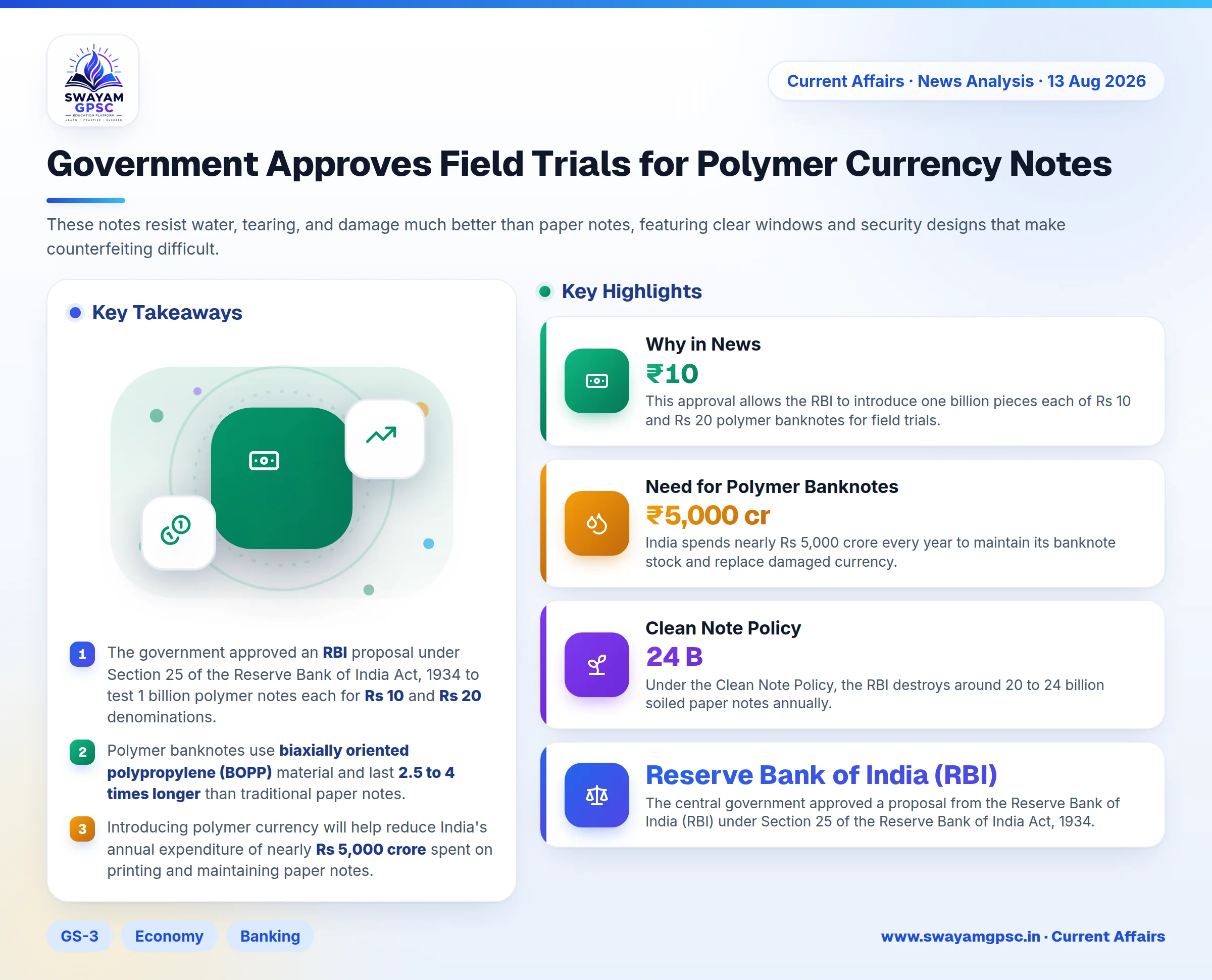
Government Approves Field Trials for Polymer Currency Notes
#GS-3 #Economy #Banking #Fiscal Policy #Current Events #National
Key takeaways
- The government approved an RBI proposal under Section 25 of the Reserve Bank of India Act, 1934 to test 1 billion polymer notes each for Rs 10 and Rs 20 denominations.
- Polymer banknotes use biaxially oriented polypropylene (BOPP) material and last 2.5 to 4 times longer than traditional paper notes.
- Introducing polymer currency will help reduce India's annual expenditure of nearly Rs 5,000 crore spent on printing and maintaining paper notes.
- The RBI currently destroys around 20 to 24 billion soiled paper banknotes every year under its Clean Note Policy.
Why in News
- The central government approved a proposal from the Reserve Bank of India (RBI) under Section 25 of the Reserve Bank of India Act, 1934.
- This approval allows the RBI to introduce one billion pieces each of Rs 10 and Rs 20 polymer banknotes for field trials.
Details of Field Trials
- The government will issue polymer notes alongside existing paper notes rather than immediately replacing them.
- Initial field trials will assess the cost, durability, security, environmental impact, and suitability of polymer notes for India's weather conditions before starting regular production.
Features of Polymer Banknotes
- Manufacturers make polymer banknotes from biaxially oriented polypropylene (BOPP) instead of traditional cotton-pulp paper.
- These notes resist water, tearing, and damage much better than paper notes, featuring clear windows and security designs that make counterfeiting difficult.
- Studies indicate that polymer banknotes last 2.5 to 4 times longer than standard paper currency.
Need for Polymer Banknotes
- India spends nearly Rs 5,000 crore every year to maintain its banknote stock and replace damaged currency.
- Under the Clean Note Policy, the RBI destroys around 20 to 24 billion soiled paper notes annually.
- Lower-value notes like Rs 10 and Rs 20 spoil quickly due to continuous public handling, making polymer notes ideal for lowering long-term replacement costs.