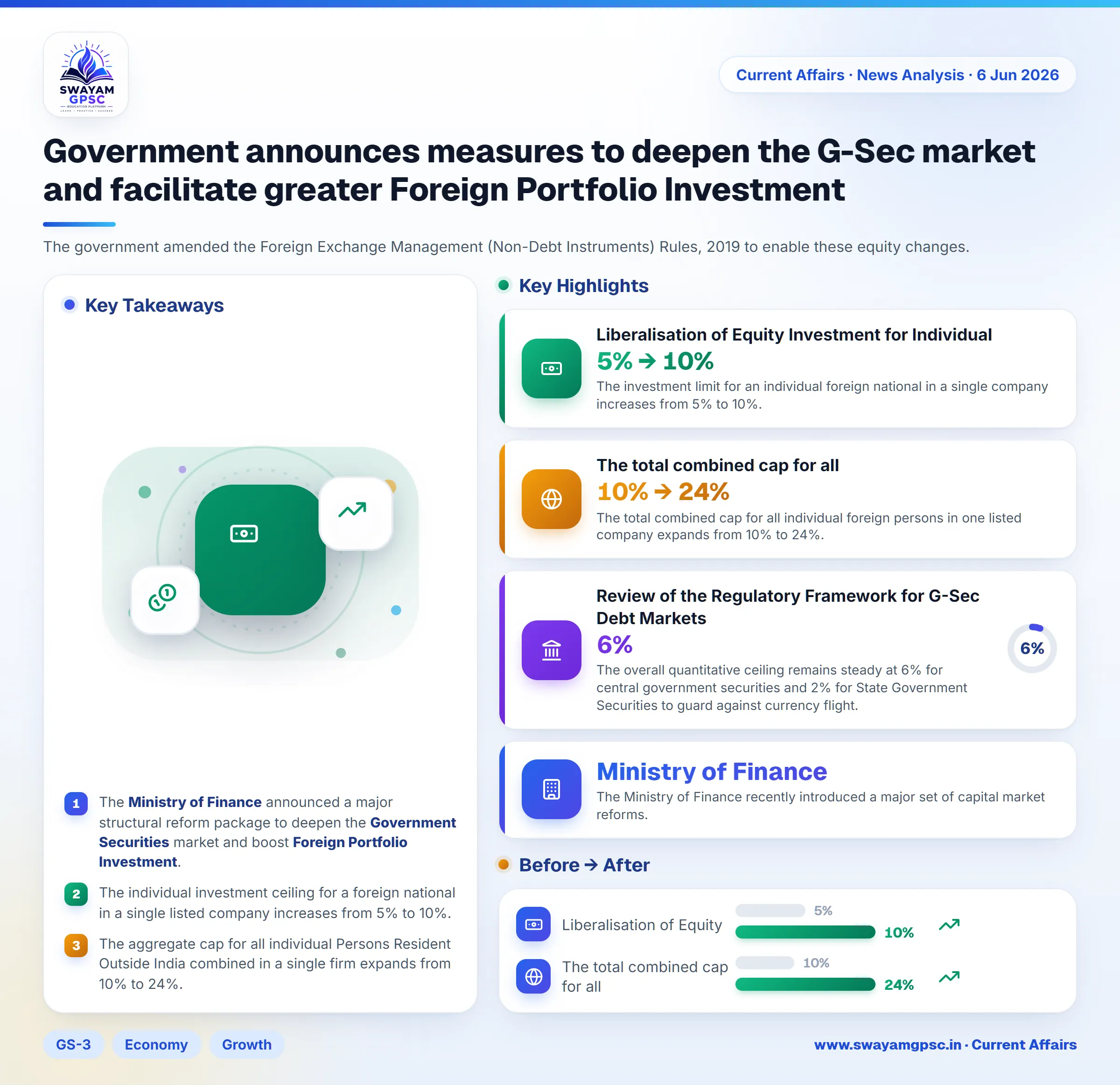
Government announces measures to deepen the G-Sec market and facilitate greater Foreign Portfolio Investment
#GS-3 #Economy #Growth #Banking #Infrastructure #Current Events #National
Key takeaways
- The Ministry of Finance announced a major structural reform package to deepen the Government Securities market and boost Foreign Portfolio Investment.
- The individual investment ceiling for a foreign national in a single listed company increases from 5% to 10%.
- The aggregate cap for all individual Persons Resident Outside India combined in a single firm expands from 10% to 24%.
- Government Securities investments by foreign portfolio investors enjoy a complete income tax exemption starting from April 1, 2026.
Why in News
- The Ministry of Finance recently introduced a major set of capital market reforms. These changes aim to expand the Government Securities market and bring in more Foreign Portfolio Investment for equities.
About the Reform Package
- This policy is a large macroeconomic reform package. It opens up India stock and sovereign debt markets to global investors.
- The primary goal is to make India a top global destination for stable and long-term foreign money.
- These changes aim to simplify market access and lower compliance rules. They also help build a smooth long-term yield curve and boost national foreign exchange inflows.
Liberalisation of Equity Investment for Individual Foreigners
- The government amended the *Foreign Exchange Management (Non-Debt Instruments) Rules, 2019* to enable these equity changes.
- Individual Persons Resident Outside India can now invest directly in listed Indian equities through the Portfolio Investment Scheme.
- Previously, this fast track was available only to Non-Resident Indians and Overseas Citizens of India.
- The investment limit for an individual foreign national in a single company increases from 5% to 10%.
- The total combined cap for all individual foreign persons in one listed company expands from 10% to 24%.
- New investors will use the digital onboarding pipelines of Non-Resident Indians and Overseas Citizens of India for quick setup without extra verification layers.
Review of the Regulatory Framework for G-Sec Debt Markets
- Authorities are completely overhauling institutional debt-purchasing guidelines to unlock the long-term sovereign bond market.
- The government expanded the Fully Accessible Route to include ultra-long-term 15, 30, and 40-year new G-Sec issuances along with Sovereign Green Bonds.
- The administration removed operational boundaries for foreign investors working under the General Route.
- The central bank and finance ministry permanently scrapped the short term investment limit, the concentration limit, and the security-wise limit for bond dealers.
- The overall quantitative ceiling remains steady at 6% for central government securities and 2% for State Government Securities to guard against currency flight.
- The separate investment sub-buckets are now merged into a single pool to give fund managers complete portfolio flexibility.
Total Income Tax Exemption on G-Sec Investments
- The government introduced a zero-tax regime for foreign institutional money locked in Indian sovereign debt papers.
- Foreign portfolio investors receive a complete tax exemption on any interest earned or capital gains generated from Government Securities.
- This tax exemption applies to all earnings made on or after April 1, 2026.
- Authorities extended this same tax exemption to the Bank for International Settlements to secure high-tier international liquid reserves.
- This tax change places Indian bond yields on equal footing with advanced Western and Asian debt markets.