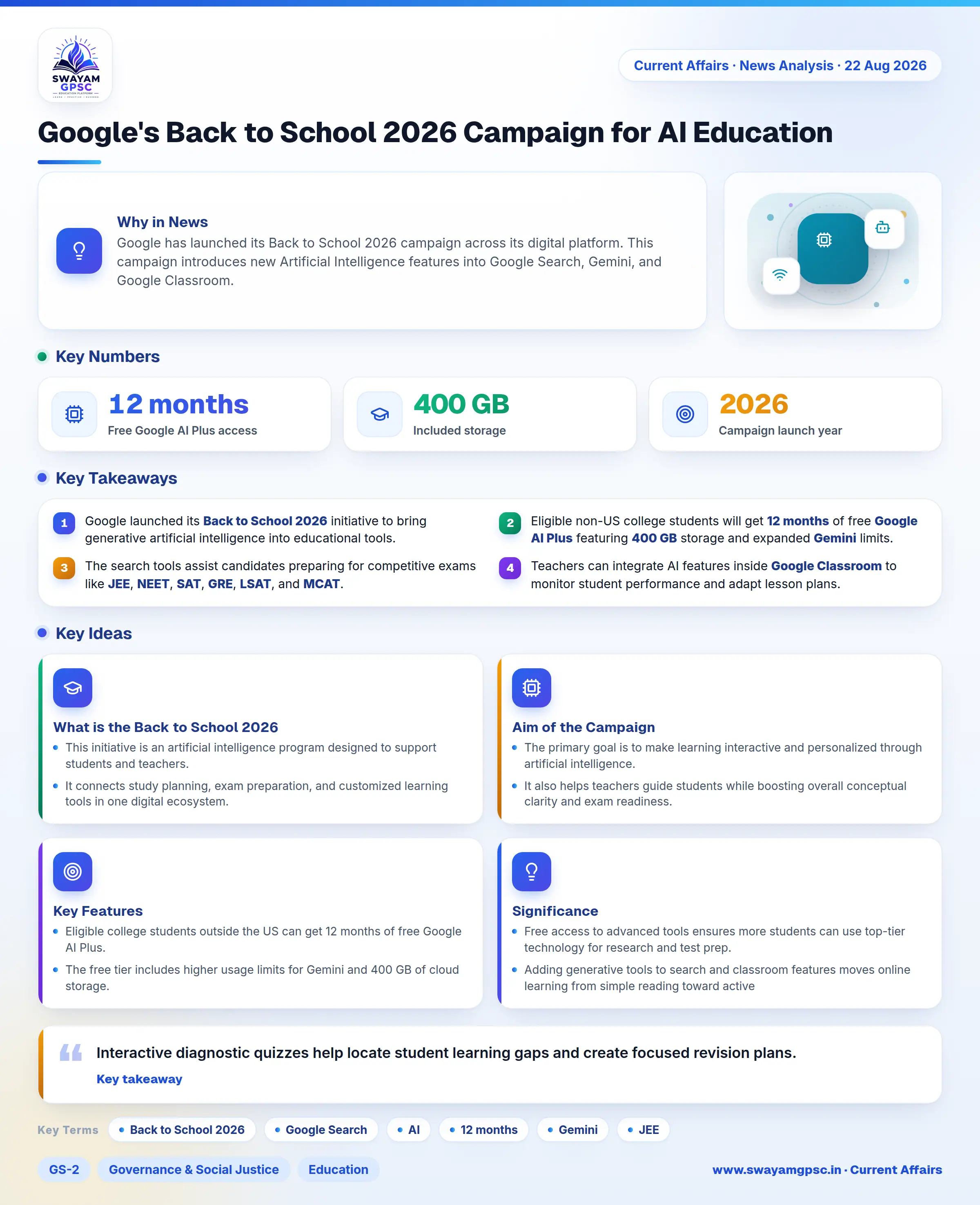
Google's Back to School 2026 Campaign for AI Education
#GS-2 #Governance & Social Justice #Education #GS-3 #Science & Technology #Artificial Intelligence #Google Back to School 2026 #Gemini AI #Google AI Plus #Google Classroom #EdTech
Key takeaways
- Google launched its Back to School 2026 initiative to bring generative artificial intelligence into educational tools.
- Eligible non-US college students will get 12 months of free Google AI Plus featuring 400 GB storage and expanded Gemini limits.
- The search tools assist candidates preparing for competitive exams like JEE, NEET, SAT, GRE, LSAT, and MCAT.
- Teachers can integrate AI features inside Google Classroom to monitor student performance and adapt lesson plans.
Why in News
- Google has launched its Back to School 2026 campaign across its digital platform.
- This campaign introduces new Artificial Intelligence features into Google Search, Gemini, and Google Classroom.
What is the Back to School 2026 Campaign
- This initiative is an artificial intelligence program designed to support students and teachers.
- It connects study planning, exam preparation, and customized learning tools in one digital ecosystem.
Aim of the Campaign
- The primary goal is to make learning interactive and personalized through artificial intelligence.
- It also helps teachers guide students while boosting overall conceptual clarity and exam readiness.
Key Features
- Eligible college students outside the US can get 12 months of free Google AI Plus.
- The free tier includes higher usage limits for Gemini and 400 GB of cloud storage.
- Google Search can now generate practice quizzes, interactive visuals, and step-by-step guides for hard concepts.
- The search tools directly support students preparing for major competitive exams like JEE, NEET, SAT, GRE, LSAT, and MCAT.
- The Gemini Student Hub offers a clear space where students can organize their schoolwork and build personalized study plans.
- Teachers using Google Classroom can adapt artificial intelligence tools to fit their syllabus and track student progress.
Significance
- Interactive diagnostic quizzes help locate student learning gaps and create focused revision plans.
- Free access to advanced tools ensures more students can use top-tier technology for research and test prep.
- Adding generative tools to search and classroom features moves online learning from simple reading toward active practice.
Relevance for GPSC Syllabus
- This topic relates to GS Paper II under governance and social sector policies for education.
- It connects to GS Paper III regarding developments in Artificial Intelligence and information technology.
- It offers strong essay points on technology as a tool for social improvement and modern learning.