Gnani Artha: India's Indigenous Sovereign AI Stack
#GS-3 #Science & Technology #Artificial Intelligence #ICT #GS-2 #Current Events #National #Gnani Artha #GNANI AI #Data Sovereignty
Key takeaways
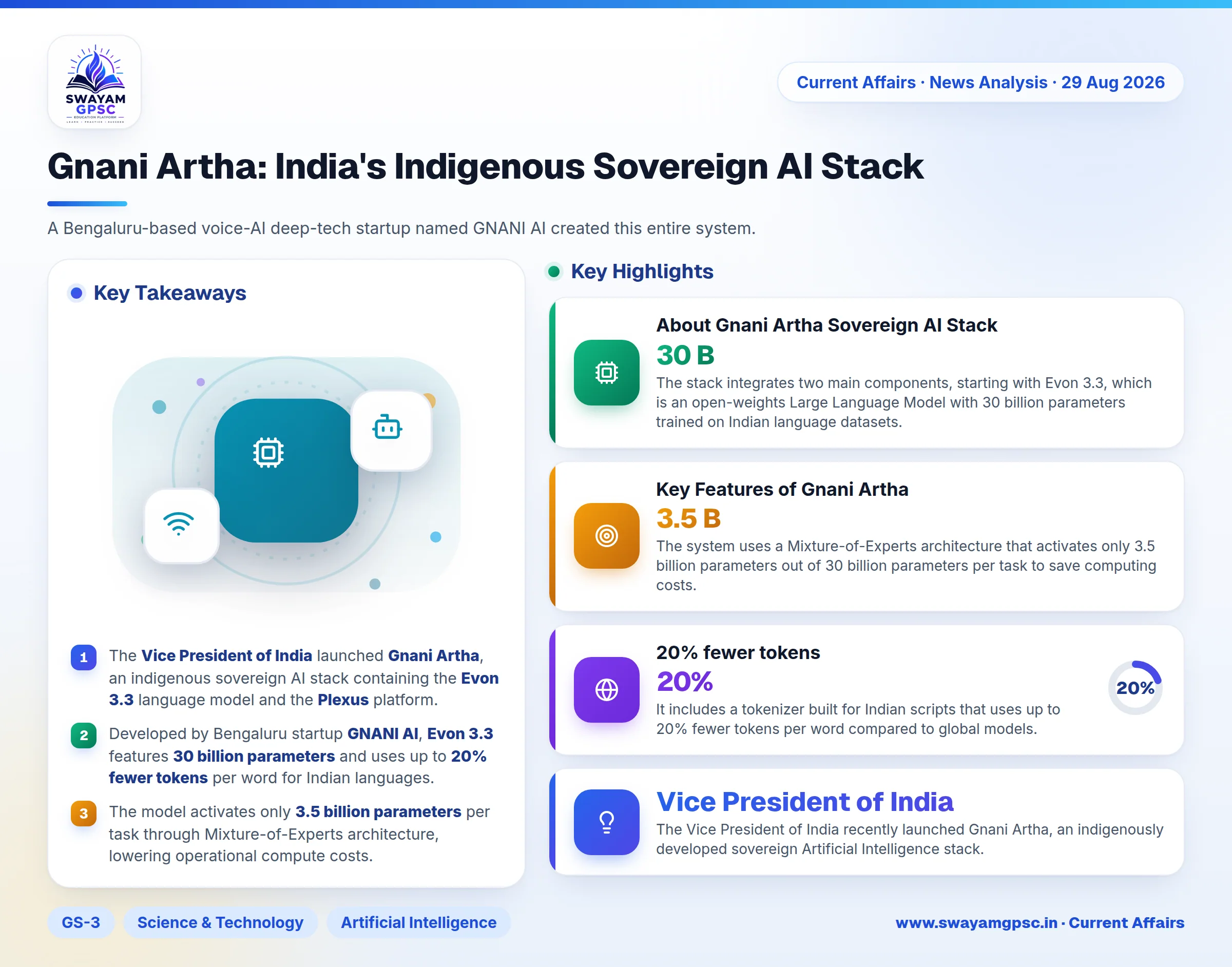
- The Vice President of India launched Gnani Artha, an indigenous sovereign AI stack containing the Evon 3.3 language model and the Plexus platform.
- Developed by Bengaluru startup GNANI AI, Evon 3.3 features 30 billion parameters and uses up to 20% fewer tokens per word for Indian languages.
- The model activates only 3.5 billion parameters per task through Mixture-of-Experts architecture, lowering operational compute costs.
- Deployable on single private nodes, the stack ensures compliance with the Digital Personal Data Protection Act and supports Viksit Bharat 2047.
Why in News
- The Vice President of India recently launched Gnani Artha, an indigenously developed sovereign Artificial Intelligence stack.
- This technology stack includes the Evon 3.3 language model along with the Plexus agentic platform.
About Gnani Artha Sovereign AI Stack
- Gnani Artha serves as an end-to-end sovereign AI stack built specifically for Indian businesses and government bodies.
- The stack integrates two main components, starting with Evon 3.3, which is an open-weights Large Language Model with 30 billion parameters trained on Indian language datasets.
- The second component is Plexus, an enterprise platform that turns machine intelligence into automated, goal-oriented workflows.
- A Bengaluru-based voice-AI deep-tech startup named GNANI AI created this entire system.
- The project aims to build secure, affordable AI tools that protect Indian data sovereignty and cut reliance on foreign cloud platforms.
Key Features of Gnani Artha
- The system uses a Mixture-of-Experts architecture that activates only 3.5 billion parameters out of 30 billion parameters per task to save computing costs.
- It includes a tokenizer built for Indian scripts that uses up to 20% fewer tokens per word compared to global models.
- The software comes under the Apache 2.0 open license, allowing local developers to inspect and adapt its underlying code freely.
- Organizations can run the system on single servers in their private data centers to strictly satisfy data localization rules.
- Non-technical users can use Plexus to build specialized AI agents using simple natural language prompts for automated document checking and database queries.
Significance
- The stack keeps sensitive information within national borders, supporting compliance with the Digital Personal Data Protection Act (DPDP Act).
- It strengthens national initiatives like Aatmanirbhar Bharat and Viksit Bharat 2047 by advancing self-reliant generative AI technology.