Global Mining and Metals Water Dataset Report
#GS-3 #Environment #Sustainable Development #Economy #Infrastructure #Water Resources #Mining Sector #Critical Minerals
Why in News
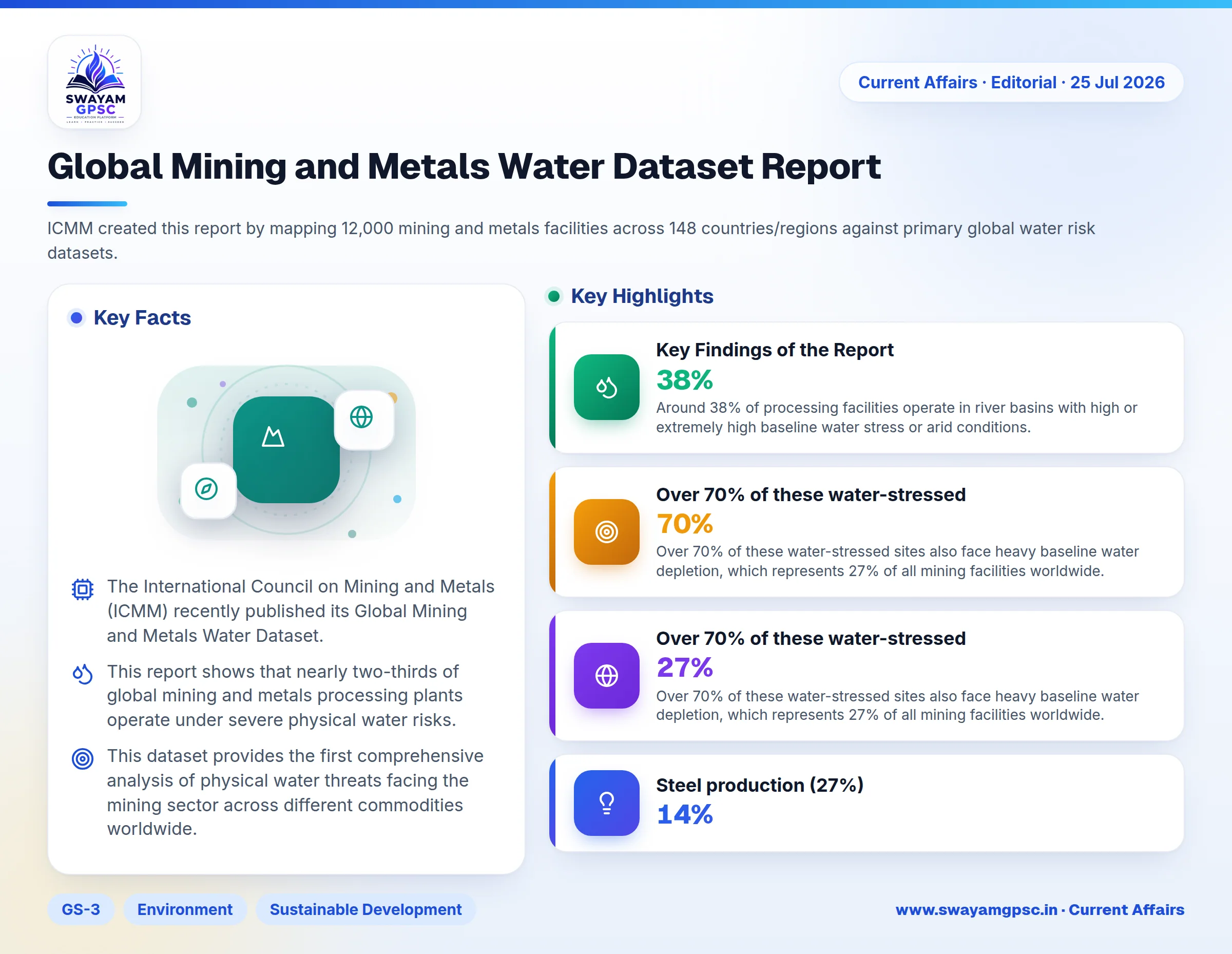
- The International Council on Mining and Metals (ICMM) recently published its Global Mining and Metals Water Dataset.
- This report shows that nearly two-thirds of global mining and metals processing plants operate under severe physical water risks.
About the Report
- This dataset provides the first comprehensive analysis of physical water threats facing the mining sector across different commodities worldwide.
- ICMM created this report by mapping 12,000 mining and metals facilities across 148 countries/regions against primary global water risk datasets.
Key Findings of the Report
- Around 38% of processing facilities operate in river basins with high or extremely high baseline water stress or arid conditions.
- Over 70% of these water-stressed sites also face heavy baseline water depletion, which represents 27% of all mining facilities worldwide.
- High drought hazards affect 27% of global sites, reaching 81% in Africa and the Middle East, 96% in South Africa, and 100% in Zambia, Ghana, and Uzbekistan.
- While overall flood exposure stands at 14%, specific processes face higher hazards, including steel production (27%), alumina refining (27%), molybdenum (25%), and aluminium smelting (24%).
- Extreme yearly water supply changes affect 16% of global facilities, with Oceania seeing severe variations across 74% of its facilities and 79% in Australia.
- Compound risks involving three or more physical hazards affect 5% of global sites, concentrated in Chile, Peru, the Western United States, southern Africa, northern China, central India, and western Australia.
- Critical energy transition minerals face high risks, including Platinum Group Elements (74% drought risk), Manganese (21% compound risk), and Copper (9% compound risk).
- In Chile, which is the top copper producer and major lithium supplier, 86% of facilities face both high baseline water stress and strong annual supply variation at the same time.
Impact of Mining on Water Resources
- Mining processes require massive volumes of water for mineral extraction, dust control, slurry movement, and cooling, which creates stiff competition with local communities.
- Heavy groundwater pumping to drain water out of mine pits lowers local water tables, creating permanent water loss when water is not returned to local basins.
- Unmanaged mine drainage and storage dams can release hazardous heavy metals and chemical processing agents into nearby river systems.
- Digging pits, clearing land, and constructing infrastructure alter natural water flow patterns, making surrounding areas more vulnerable to soil erosion and sudden flash floods.
Implications of Water Risk in Mining
- Water shortages create supply bottlenecks for clean energy transition minerals like copper, lithium, nickel, and rare earths, slowing solar, wind, and battery manufacturing.
- Extreme weather events like severe droughts or heavy floods interrupt operations and damage infrastructure, causing production drops and global metal price shocks.
- Mining in water-stressed areas increases conflicts among mining firms, local farmers, and rural communities, leading to public protests and operational instability.
- Unaddressed water risks lead to regulatory fines, high costs for alternative water supplies, and the risk of turning expensive mining facilities into stranded assets.
Way Forward
- Governments and firms must shift from individual site-level management toward collaborative river basin water stewardship that supports communities, agriculture, and nature.
- Policymakers and investors must include long-term water availability constraints into strategic planning for critical mineral supply chains and green energy goals.
- Companies should invest in water recycling technologies, closed-loop processing, and seawater usage, similar to the ocean pipeline at Chile's Minera Centinela.
- Regulators should set clear water allocation priorities and environmental flow standards before granting new mining permissions in high-stress river basins.
- Processing plants need to improve public reporting on their water extraction, consumption, and discharge metrics to create reliable benchmark standards.
Conclusion
- The ICMM report confirms that water risks pose immediate operational threats to global mining systems rather than distant future challenges.
- Unmanaged water risks directly threaten critical mineral supply chains that drive renewable energy adoption across the world.
- Ensuring long-term supply security for essential transition minerals requires moving toward shared, river-basin-level water stewardship.