Global Initiative on AI for Agri-Food Systems
#GS-2 #GS-3 #Governance & Social Justice #Good Governance #E-Governance #Economy #Agriculture #Infrastructure #Science & Technology #Artificial Intelligence #Government Policies & Interventions #E-Technology in the Aid of Farmers
Key takeaways
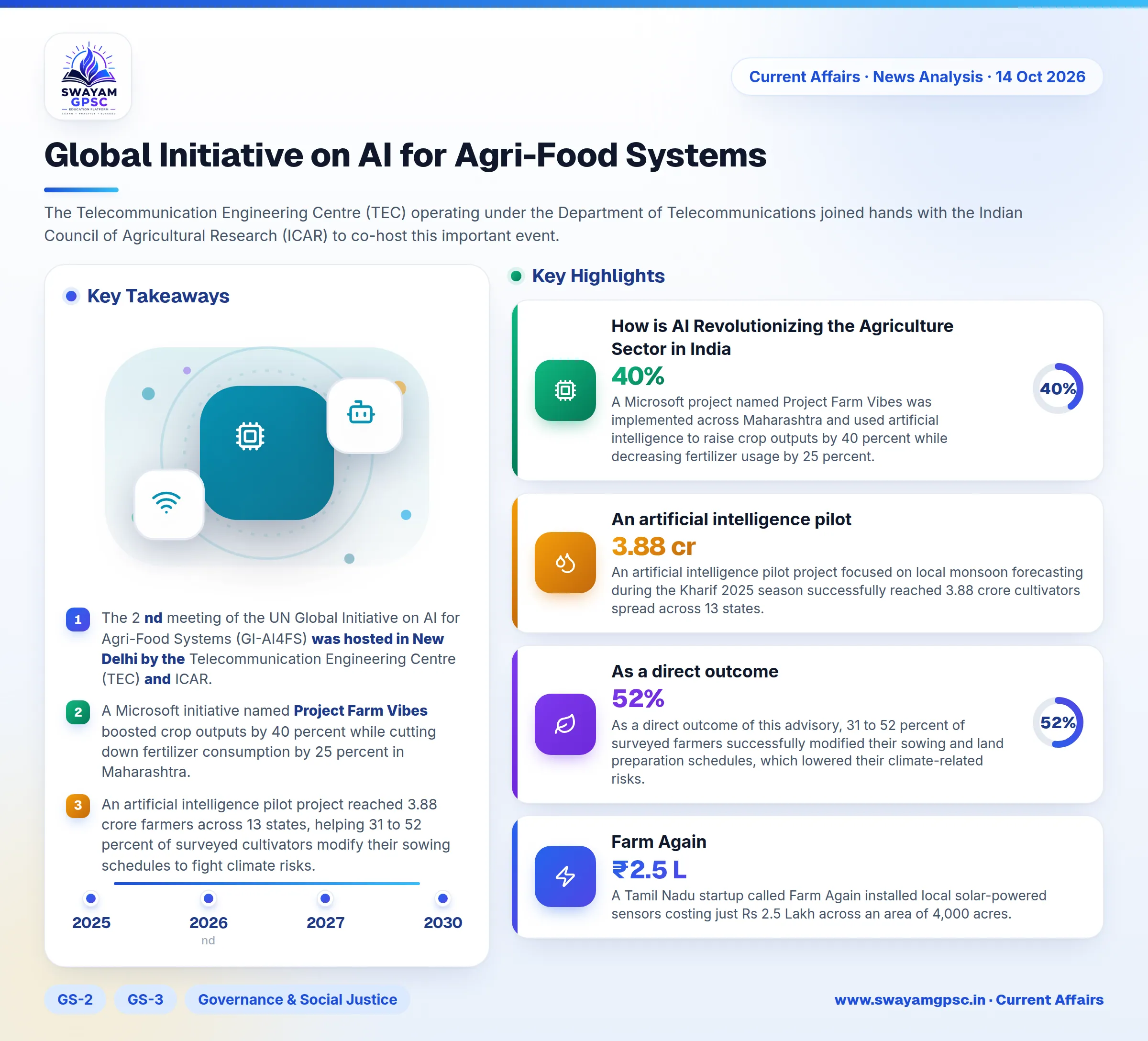
- The 2 nd meeting of the UN Global Initiative on AI for Agri-Food Systems (GI-AI4FS) was hosted in New Delhi by the Telecommunication Engineering Centre (TEC) and ICAR.
- A Microsoft initiative named Project Farm Vibes boosted crop outputs by 40 percent while cutting down fertilizer consumption by 25 percent in Maharashtra.
- An artificial intelligence pilot project reached 3.88 crore farmers across 13 states, helping 31 to 52 percent of surveyed cultivators modify their sowing schedules to fight climate risks.
- Official data reveals that 86% of landholdings in India are small and marginal, operating across less than 2 hectares of land.
- Government platforms generated 7.63 crore Farmer IDs while working toward an ultimate target of 11 crore profiles under AgriStack.
Why in News
- The 2 nd meeting of the UN Global Initiative on AI for Agri-Food Systems (GI-AI4FS) took place at the India Mobile Congress (IMC) 2026 located in New Delhi.
- The Telecommunication Engineering Centre (TEC) operating under the Department of Telecommunications joined hands with the Indian Council of Agricultural Research (ICAR) to co-host this important event.
- Participants during the meeting highlighted the urgent requirement for reliable, interoperable, and farmer-focused artificial intelligence systems to boost global digital governance.
Summary
- Artificial intelligence is reshaping the agricultural landscape in India through precision farming, accurate weather predictions, pest identification, insurance assessment, and price forecasting.
- Government platforms like AgriStack, Bharat-VISTAAR, and Kisan e-Mitra are rapidly building up the digital backbone of the nation's farming sector.
- Major hurdles slowing down adoption include the digital divide, biased algorithms, expensive technology, data privacy threats, and environmental worries.
- Achieving inclusive technology growth requires practical solutions like Farming-as-a-Service, hybrid physical-digital extension models, strict data protection rules, and international teamwork to safeguard food security.
What is the Global Initiative on AI for Agri-Food Systems (GI-AI4FS)
- This multilateral platform receives backing from the United Nations and uses Artificial Intelligence (AI) and the Internet of Things (IoT) to completely overhaul world food systems.
- The goals of this initiative connect directly with the Sustainable Development Goals, specifically aiming for SDG 2 (Zero Hunger) and SDG 12 (Responsible Consumption and Production).
- The International Telecommunication Union (ITU) manages this platform by working closely alongside the Food and Agriculture Organization (FAO), the International Fund for Agricultural Development (IFAD), and the World Food Programme (WFP).
- The core mission focuses on encouraging dependable, farmer-centric artificial intelligence tools while improving global cooperation regarding digital rules, standards, and skill development.
- By organizing this second global meeting following the initial gathering at the FAO headquarters in June 2026, India is cementing its leadership position in AI governance and digital public infrastructure for the Global South.
How is AI Revolutionizing the Agriculture Sector in India
- Artificial intelligence turns farming from an input-heavy process into an intelligence-driven practice by analyzing raw information from IoT sensors, GPS trackers, and drones to deliver hyper-local farm data.
- This targeted approach ensures farmers apply water and chemical inputs only where necessary, which successfully cuts down operational expenses and protects the environment.
- A Microsoft project named Project Farm Vibes was implemented across Maharashtra and used artificial intelligence to raise crop outputs by 40 percent while decreasing fertilizer usage by 25 percent.
- Advanced climate models like NeuralGCM combine with historical rainfall records inside artificial intelligence platforms to forecast highly localized weather trends.
- An artificial intelligence pilot project focused on local monsoon forecasting during the Kharif 2025 season successfully reached 3.88 crore cultivators spread across 13 states.
- As a direct outcome of this advisory, 31 to 52 percent of surveyed farmers successfully modified their sowing and land preparation schedules, which lowered their climate-related risks.
- Digital sensors and mobile applications help automate routine farm tasks and stop excessive irrigation across rural areas.
- A Tamil Nadu startup called Farm Again installed local solar-powered sensors costing just Rs 2.5 Lakh across an area of 4,000 acres.
- This intervention doubled coconut production while saving 4,00,000 cubic metres of water and preventing 20,000 tonnes of carbon dioxide equivalent emissions every single year.
- Artificial intelligence removes the need for expensive laboratory setups by utilizing image recognition software to study photographs taken directly in the fields.
- The National Pest Surveillance System (NPSS) uses smart algorithms to protect 66 different crops against over 432 varieties of pests, delivering instant warnings to more than 10,000 extension workers.
- Sophisticated models process massive meteorological databases to forecast sudden weather shifts, giving cultivators enough lead time to protect vulnerable crops.
- Key interventions include YES-TECH (Yield Estimation System based on Technology) which relies on remote sensing for exact harvest calculations and has been fully adopted by Madhya Pradesh.
- Another tool named CROPIC lets cultivators upload time-stamped, geotagged photos to evaluate field damage quickly and fairly based on solid evidence.
- Backed by the WINDS infrastructure for local weather updates and a smart WhatsApp assistant for farming queries, these systems have turned the Pradhan Mantri Fasal Bima Yojana (PMFBY) into a trusted safety net.
- Predictive analytics running on platforms like e-NAM and AGMARKET study regional market demand and price trends so farmers can avoid selling their produce under distress.
India’s Key Initiatives for AI-Driven Agriculture
- The Indian government has built extensive Digital Public Infrastructure for farming through the overarching Digital Agriculture Mission.
- The AgriStack platform issues a unique Farmer ID linked directly with land ownership, livestock data, and crop history to guarantee smooth service delivery.
- Authorities have already generated 7.63 crore identification numbers while working toward a final goal of 11 crore profiles by the years 2026 and 2027.
- This ecosystem powers the mobile Digital Crop Survey application, which mapped real-time data across 23.5 crore land parcels during the Rabi 2024-25 season to improve policy planning.
- The Krishi Decision Support System (KDSS) combines satellite feeds, weather reports, and soil records mapped across 29 million hectares by the Soil and Land Use Survey of India (SLUSI) to produce accurate crop maps and drought forecasts.
- Proposed during the Union Budget 2026-27, Bharat-VISTAAR (Virtually Integrated System to Access Agricultural Resources) acts as a multilingual artificial intelligence tool combining various AgriStack databases into one single advisory hub.
- Kisan e-Mitra serves as a voice-enabled artificial intelligence helper that communicates fluently in 11 regional languages to assist rural users.
- By December 2025, this assistant successfully answered more than 93 lakh questions, handling 8,000 daily queries about major government schemes like PM-KISAN and PMFBY.
- The Nationwide Soil Resource Mapping Project led by SLUSI creates high-resolution village soil maps at a scale of 1:10,000.
- Using localized camps, teams have successfully surveyed approximately 29 million hectares against an ultimate target of 142 million hectares across six funded states.
- The RKVY programme provides crucial financial grants through Knowledge Partners and incubators, offering up to Rs 5 lakh at the initial idea stage and Rs 25 lakh during the seed phase.
- A grand total of 2,282 agri-tech startups have received direct financial backing to develop innovations involving drones, robotics, and artificial intelligence.
IMPACT AI Framework
- Government authorities released the official Future Farming in India: AI Playbook for Agriculture in October 2025 in partnership with institutions like WEF, IndiaAI, and BCG.
- This playbook introduces the structured IMPACT AI Framework built entirely around three core operational pillars.
- The Enable pillar focuses on creating clear digital policies, supportive regulations, and strong infrastructure like AgriStack for widespread rollout.
- The Create pillar encourages active teamwork among tech firms, startups, and research organizations like ICAR to build localized digital solutions.
- The Deliver pillar ensures artificial intelligence features are built directly into grassroots extension services using constant field feedback to benefit smallholder farmers.
Challenges
- Official statistics show that 86% of landholdings in India are small and marginal, meaning they measure less than 2 hectares in size.
- Artificial intelligence models trained primarily on massive, highly mechanized foreign farms often give incorrect recommendations when deployed across fragmented Indian micro-climates.
- The World Economic Forum (WEF) published its Future Farming in India (2025) report, which points out that cultivators suffer from information overload and hesitation toward new technologies.
- Many traditional farmers remain deeply afraid of abandoning time-tested farming methods in favor of automated software advice without seeing physical proof first.
- While a parliamentary report from 2026 confirms that 97.4% of cadastral maps are now digitized, old mapping disputes and unclear land titles under the Digital India Land Records Modernization Programme (DILRMP) continue to block progress.
- The absence of strict agricultural data protection rules creates serious dangers where corporate entities might misuse farmer information for unfair pricing or biased credit ratings.
- Buying modern precision tools like IoT sensors, drones, and heavy machinery requires massive upfront capital investments.
- This financial entry barrier means wealthy landowners capture most technological benefits, which widens the digital divide across rural communities.
- While artificial intelligence helps save water through smart irrigation, power-hungry data centres could consume up to 9.3 trillion litres annually by 2030.
- This massive water consumption risks worsening local droughts and completely canceling out the water savings achieved on farms.
- Fast technological upgrades in digital hardware threaten to produce 2.5 million tonnes of e-waste every year by 2030.
- Unsafe disposal methods for this electronic waste could poison soil and groundwater supplies, destroying the very ecosystems farming relies upon.
Way Forward
- To overcome high equipment costs, the government must institutionalize shared access through Custom Hiring Centres, Farmer Producer Organizations, and initiatives like Kisan Drones.
- This shared economy approach allows smallholders to rent modern automated machinery like crop-spraying drones managed by Women Self-Help Groups on a pay-per-use basis.
- Digital technologies cannot completely replace human trust, so traditional grassroots extension offices like Krishi Vigyan Kendras (KVKs) must merge with modern software platforms.
- Arming community leaders like Krishi Sakhis linked with the Lakhpati Didi initiative with diagnostic tablets ensures reliable last-mile advisory delivery.
- Authorities must speed up the full rollout of AgriStack and the Digital Crop Survey across every district to provide a solid foundation for future technology.
- Traditional agricultural extension workers need proper training to become digital entrepreneurs who can translate complex data points into simple field advice.
- International platforms like the United Nations GI-AI4FS must be utilized to share open-source algorithms and build universal governance rules for farm data.
- The Data Empowerment and Protection Architecture should expand to cover the agricultural sector immediately.
- This expansion will give farmers legal ownership over their personal field records, stopping corporate monopolies while letting verified startups offer helpful services with proper consent.