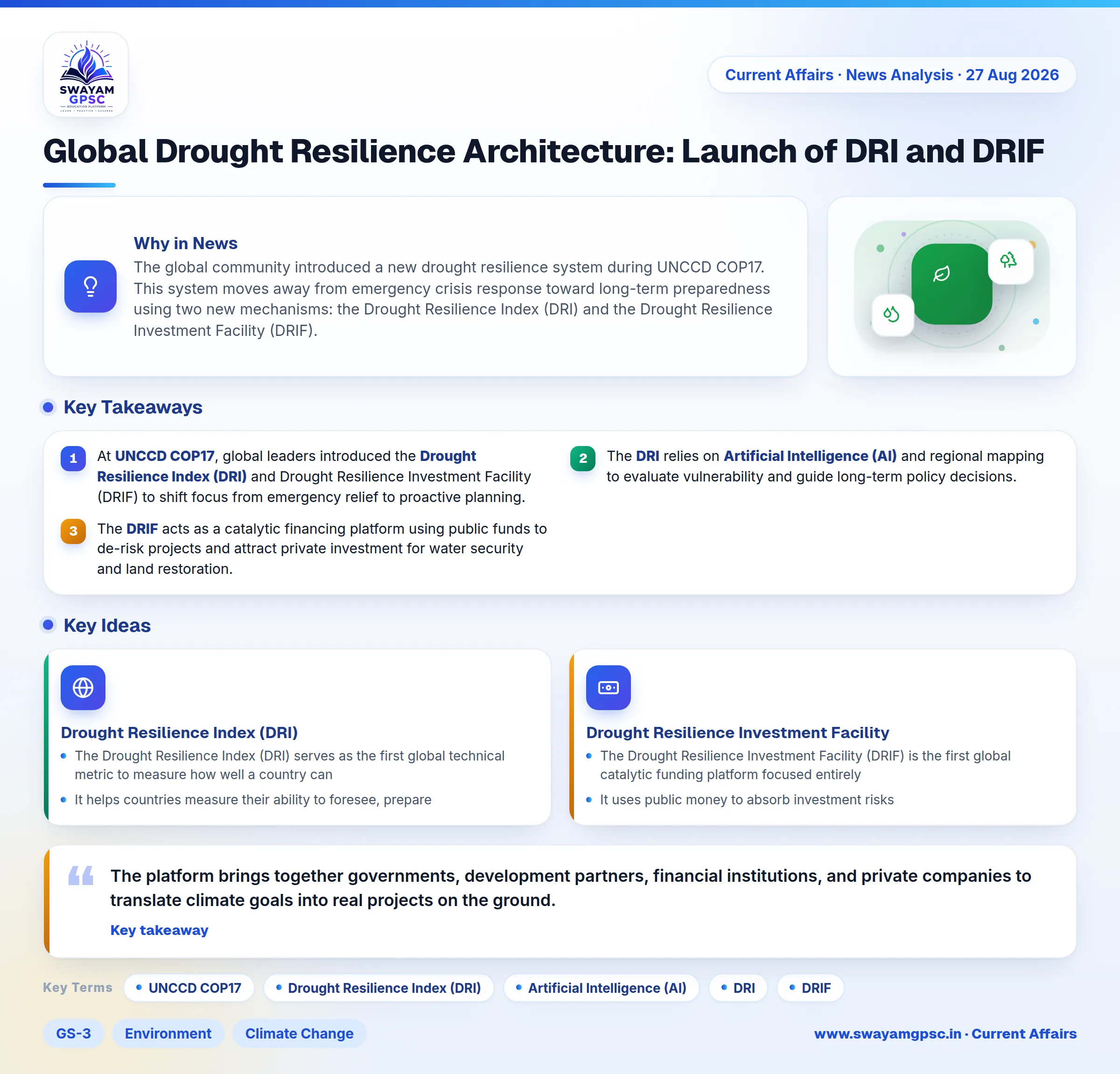
Global Drought Resilience Architecture: Launch of DRI and DRIF
#GS-3 #Environment #Climate Change #Sustainable Development #GS-2 #Current Events #International #DRI #DRIF #UNCCD COP17
Key takeaways
- At UNCCD COP17, global leaders introduced the Drought Resilience Index (DRI) and Drought Resilience Investment Facility (DRIF) to shift focus from emergency relief to proactive planning.
- The DRI relies on Artificial Intelligence (AI) and regional mapping to evaluate vulnerability and guide long-term policy decisions.
- The DRIF acts as a catalytic financing platform using public funds to de-risk projects and attract private investment for water security and land restoration.
Why in News
- The global community introduced a new drought resilience system during UNCCD COP17.
- This system moves away from emergency crisis response toward long-term preparedness using two new mechanisms: the Drought Resilience Index (DRI) and the Drought Resilience Investment Facility (DRIF).
Drought Resilience Index (DRI)
- The Drought Resilience Index (DRI) serves as the first global technical metric to measure how well a country can manage and endure severe drought conditions.
- It helps countries measure their ability to foresee, prepare for, and adapt to droughts while highlighting weaknesses to guide better policy choices and structural investments.
- The tool uses advanced Artificial Intelligence (AI) to convert complex climate and geography data into practical insights for decision-makers and the public.
- It identifies specific regional vulnerabilities so governments can support high-risk areas before water shortages escalate into humanitarian crises.
- It drives a major policy change by replacing emergency relief efforts with early, technology-driven preparation.
- The index turns raw scientific figures into actionable guidance, showing governments where to spend funds and construct protective infrastructure.
Drought Resilience Investment Facility (DRIF)
- The Drought Resilience Investment Facility (DRIF) is the first global catalytic funding platform focused entirely on expanding water and drought management projects worldwide.
- It uses public money to absorb investment risks, encouraging institutional and private investors to contribute larger capital amounts.
- The facility lowers financial risks for private investors by using public capital as a protective buffer for new projects.
- Financial resources under this platform target initiatives that secure local water supplies and support sustainable, drought-resistant farming practices.
- It focuses on funding land restoration and nature-based ecological methods to prevent land degradation and desertification.
- The platform brings together governments, development partners, financial institutions, and private companies to translate climate goals into real projects on the ground.