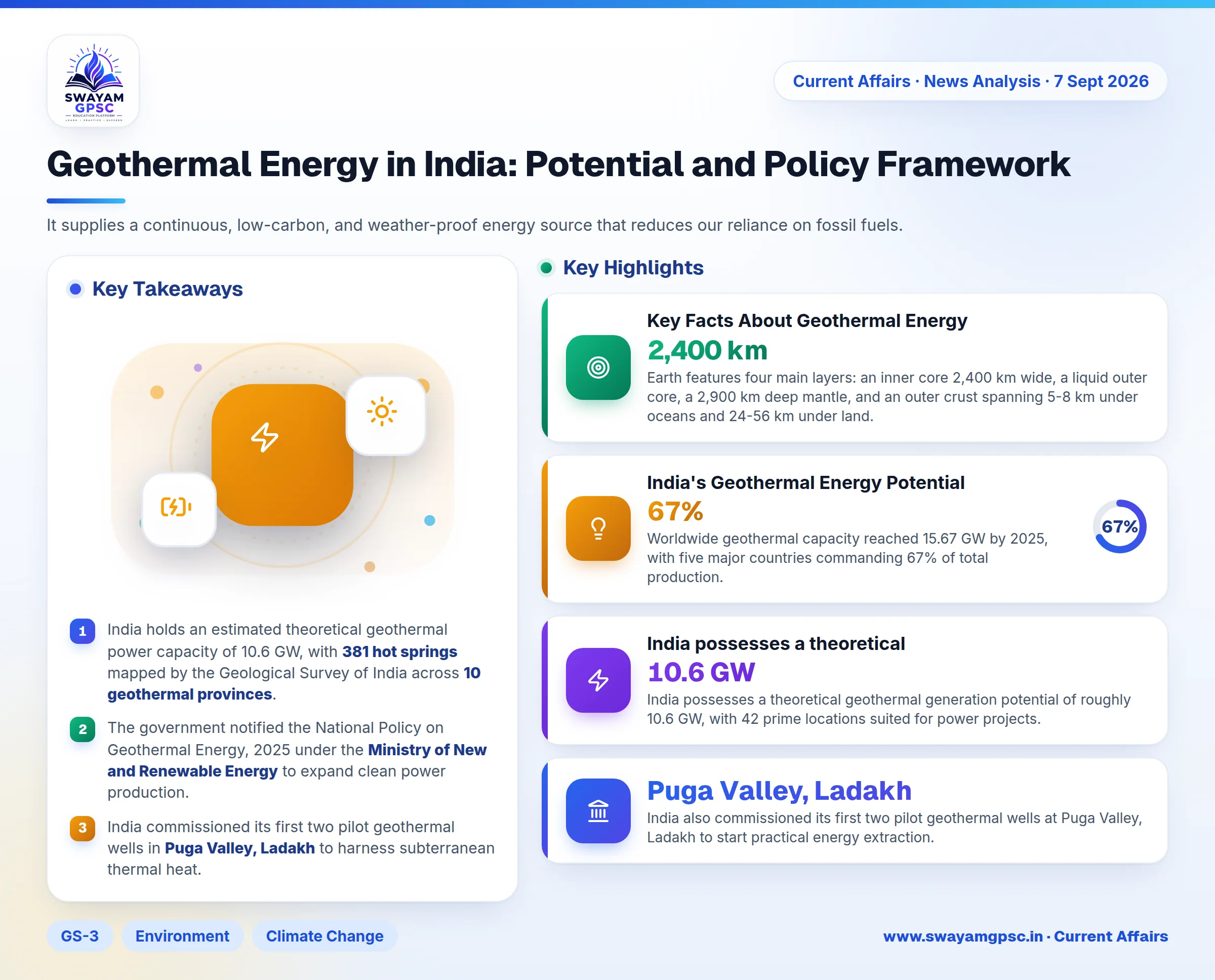
Geothermal Energy in India: Potential and Policy Framework
#GS-3 #Environment #Climate Change #Science & Technology #Energy #Infrastructure #Current Events #National
Key takeaways
- India holds an estimated theoretical geothermal power capacity of 10.6 GW, with 381 hot springs mapped by the Geological Survey of India across 10 geothermal provinces.
- The government notified the National Policy on Geothermal Energy, 2025 under the Ministry of New and Renewable Energy to expand clean power production.
- India commissioned its first two pilot geothermal wells in Puga Valley, Ladakh to harness subterranean thermal heat.
- Global installed geothermal capacity reached 15.67 GW by 2025, with five leading nations controlling 67% of total output.
Why in News
- India is giving a strong push to develop geothermal energy across the country.
- The government recently notified the National Policy on Geothermal Energy, 2025 to guide this clean energy sector.
- India also commissioned its first two pilot geothermal wells at Puga Valley, Ladakh to start practical energy extraction.
Key Facts About Geothermal Energy
- Geothermal energy is a renewable power source that extracts subterranean heat stored inside the Earth.
- It supplies a continuous, low-carbon, and weather-proof energy source that reduces our reliance on fossil fuels.
- Radioactive decay of uranium, thorium, and potassium inside the Earth generates this internal thermal energy.
- Geological fractures allow underground heat to warm up water trapped inside permeable rocks, forming natural reservoirs.
- Power plants drill deep wells to bring up hot water and steam, turn electricity turbines, and pump cooled water back underground.
- Industries directly use subterranean thermal energy for greenhouse heating, fish farming, and space climate control.
- Earth features four main layers: an inner core 2,400 km wide, a liquid outer core, a 2,900 km deep mantle, and an outer crust spanning 5-8 km under oceans and 24-56 km under land.
- Internal temperatures climb sharply deeper down, reaching 3,700°C near the mantle and over 5,000°C in the core.
India's Geothermal Energy Potential
- Worldwide geothermal capacity reached 15.67 GW by 2025, with five major countries commanding 67% of total production.
- The Geological Survey of India (GSI) identified 381 hot springs and classified 10 main geothermal regions.
- India possesses a theoretical geothermal generation potential of roughly 10.6 GW, with 42 prime locations suited for power projects.
- Important potential areas include the Himalayan Geothermal Province, SONATA zone, Cambay Graben, and the West Coast.
- Modern techniques like Enhanced Geothermal Systems (EGS) help extract heat from deeper or less permeable rock structures.
- Energy companies can also convert old or unproductive oil and gas wells into geothermal heat producers to save setup costs.
Policy Framework for Geothermal Potential
- The Ministry of New and Renewable Energy (MNRE) announced the National Policy on Geothermal Energy, 2025 to expand green power choices.
- The policy supports detailed exploration, deep drilling, technology testing, heat pumps, and a centralized national data center.
- New rules invite private companies to invest in geothermal setups and re-use inactive oil wells.
- The RE-RTD programme funds research institutions to design low-cost indigenous technologies for local energy needs.
- India is actively collaborating with expert nations like Australia, Iceland, and Saudi Arabia to share technical knowledge.
Way Forward and Conclusion
- Developing geothermal resources gives India a reliable round-the-clock green power choice to reach its Net Zero 2070 target.