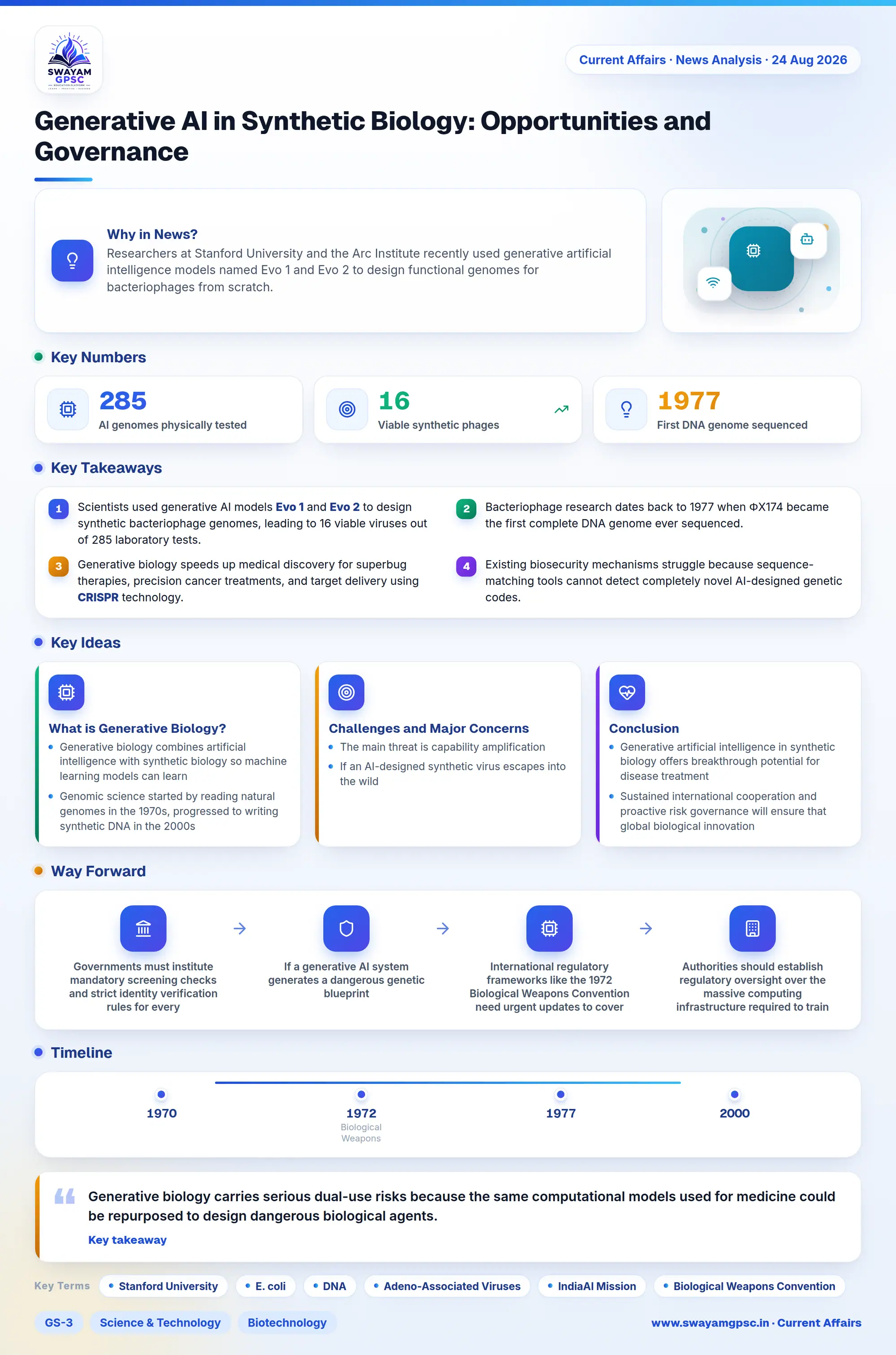
Generative AI in Synthetic Biology: Opportunities and Governance
#GS-3 #Science & Technology #Biotechnology #Artificial Intelligence #Current Events
Key takeaways
- Scientists used generative AI models Evo 1 and Evo 2 to design synthetic bacteriophage genomes, leading to 16 viable viruses out of 285 laboratory tests.
- Bacteriophage research dates back to 1977 when ΦX174 became the first complete DNA genome ever sequenced.
- Generative biology speeds up medical discovery for superbug therapies, precision cancer treatments, and target delivery using CRISPR technology.
- Existing biosecurity mechanisms struggle because sequence-matching tools cannot detect completely novel AI-designed genetic codes.
- Strengthening global safety requires updating the 1972 Biological Weapons Convention and enforcing mandatory screening on physical DNA synthesis.
Why in News?
- Researchers at Stanford University and the Arc Institute recently used generative artificial intelligence models named Evo 1 and Evo 2 to design functional genomes for bacteriophages from scratch.
- Scientists physically synthesized and tested 285 AI-designed genomes in a laboratory, and 16 of these successfully created viable viruses that infected E. coli bacteria.
- This achievement demonstrates that artificial intelligence is moving beyond simple data analysis to generating completely new functional biological designs.
- Bacteriophages are specialized viruses that infect and destroy bacteria, representing some of the most abundant biological structures on Earth.
- The ΦX174 phage holds major historic importance because it was the first complete DNA genome ever sequenced back in 1977.
- Scientists see bacteriophages as powerful biological tools to treat harmful bacteria that no longer respond to standard antibiotic medications.
- However, medical use remains tricky because phages are extremely specific to particular bacterial strains, and target bacteria can quickly evolve resistance against them.
What is Generative Biology?
- Generative biology combines artificial intelligence with synthetic biology so machine learning models can learn the foundational structural rules of DNA, RNA, and proteins.
- Genomic science started by reading natural genomes in the 1970s, progressed to writing synthetic DNA in the 2000s, and enabled gene editing in the 2010s.
- Today, generative biology allows advanced AI models to independently design brand new biological blueprints tailored for specific clinical tasks.
- This technology helps combat antimicrobial resistance by designing custom bacteriophages that target and destroy dangerous multidrug-resistant superbugs.
- It supports targeted gene delivery by creating artificial viral vectors like modified Adeno-Associated Viruses to carry tools like CRISPR into human organs without immune reactions.
- Generative models accelerate vaccine and drug creation by rapidly proposing optimized target antigens, therapeutic proteins, and monoclonal antibodies against emerging diseases.
- The technology advances precision cancer treatments by engineering oncolytic viruses that locate and destroy malignant tumors while leaving healthy cells unharmed.
- For India, these AI advancements directly influence national research in genomics, drug development, target discovery, and antimicrobial resistance.
- India must expand its biomedical computing capabilities and biological database access through initiatives like the IndiaAI Mission while maintaining strict safety checks.
Challenges and Major Concerns
- Generative biology carries serious dual-use risks because the same computational models used for medicine could be repurposed to design dangerous biological agents.
- The main threat is capability amplification, meaning AI gives individuals or small labs with existing biology tools the power to build bioweapons easily.
- If an AI-designed synthetic virus escapes into the wild, it could interact unpredictably with natural ecological systems and potentially jump across species.
- Generative AI algorithms evaluate millions of genetic permutations far faster than human scientists can analyze manually.
- When paired with automated laboratory equipment, AI systems dramatically shorten the timeline between biological design and physical testing.
- Current biosecurity screening models check DNA orders against known pathogen databases, but completely novel AI-designed sequences easily bypass these filters.
- Future security rules must look beyond exact sequence matching to evaluate the real-world biological function and physical safety impact of custom genetic sequences.
- Global intellectual property regulations currently lack clear guidelines on whether machine-generated synthetic biological organisms can receive patent protection.
Way Forward
- Governments must institute mandatory screening checks and strict identity verification rules for every commercial company that manufactures custom DNA sequences.
- If a generative AI system generates a dangerous genetic blueprint, printing that physical DNA must trigger immediate security alerts.
- International regulatory frameworks like the 1972 Biological Weapons Convention need urgent updates to cover artificial intelligence and synthetic organisms.
- Authorities should establish regulatory oversight over the massive computing infrastructure required to train frontier biological AI models.
- AI developers must conduct systematic red-teaming tests to ensure biological models automatically reject user prompts aimed at creating harmful pathogens.
Conclusion
- Generative artificial intelligence in synthetic biology offers breakthrough potential for disease treatment, but its dual-use nature demands strong national biosecurity oversight.
- Sustained international cooperation and proactive risk governance will ensure that global biological innovation prospers safely without creating public security threats.
Frequently Asked Questions
- Generative biology combines machine learning with synthetic biology to create novel biological entities like proteins, RNA, and complete DNA sequences.
- Bacteriophages are naturally occurring viruses that kill specific bacteria, making them ideal candidates for treating drug-resistant infections.
- The principal biosecurity threat is capability amplification, where biological AI significantly reduces the technical obstacles to designing harmful bioweapons.
- Traditional DNA screening fails because it checks for matching patterns of known viruses, whereas AI generates totally unique genetic structures.
- Effective governance requires strict screening of physical DNA orders, international updates to global treaties, and safety evaluations of biological software models.