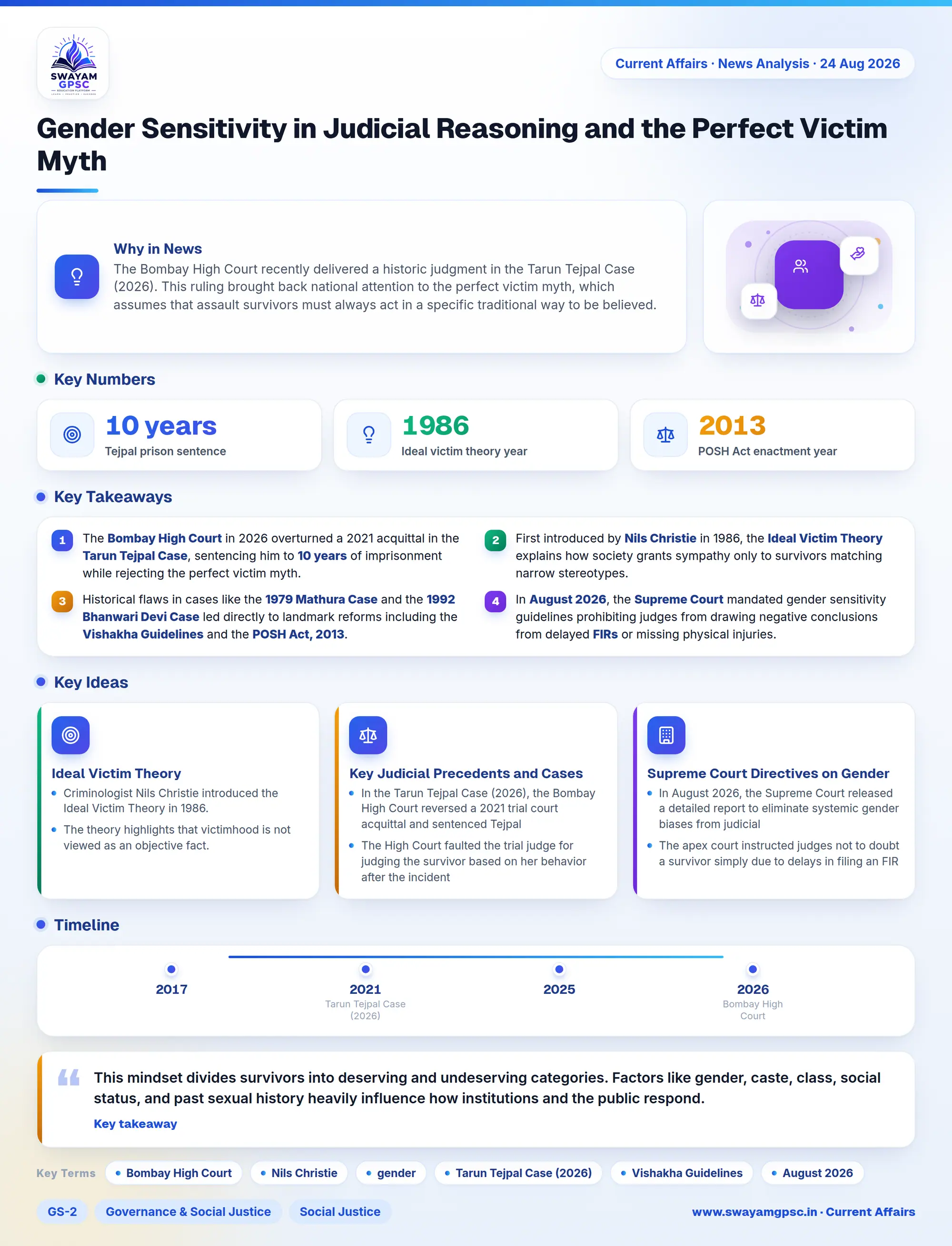
Gender Sensitivity in Judicial Reasoning and the Perfect Victim Myth
#GS-2 #Governance & Social Justice #Social Justice #Women #Indian Polity & Constitution #Judiciary #Current Events #National #Gender Equality
Key takeaways
- The Bombay High Court in 2026 overturned a 2021 acquittal in the Tarun Tejpal Case, sentencing him to 10 years of imprisonment while rejecting the perfect victim myth.
- First introduced by Nils Christie in 1986, the Ideal Victim Theory explains how society grants sympathy only to survivors matching narrow stereotypes.
- Historical flaws in cases like the 1979 Mathura Case and the 1992 Bhanwari Devi Case led directly to landmark reforms including the Vishakha Guidelines and the POSH Act, 2013.
- In August 2026, the Supreme Court mandated gender sensitivity guidelines prohibiting judges from drawing negative conclusions from delayed FIRs or missing physical injuries.
Why in News
- The Bombay High Court recently delivered a historic judgment in the Tarun Tejpal Case (2026). This ruling brought back national attention to the perfect victim myth, which assumes that assault survivors must always act in a specific traditional way to be believed.
Ideal Victim Theory
- Criminologist Nils Christie introduced the Ideal Victim Theory in 1986. This concept explains that society offers sympathy only to victims who fit rigid stereotypes, such as being weak, respectable, or attacked by a complete stranger.
- The theory highlights that victimhood is not viewed as an objective fact. Instead, society treats it as a moral status shaped by gender norms and social expectations.
- This mindset divides survivors into deserving and undeserving categories. Factors like gender, caste, class, social status, and past sexual history heavily influence how institutions and the public respond.
Key Judicial Precedents and Cases
- In the Tarun Tejpal Case (2026), the Bombay High Court reversed a 2021 trial court acquittal and sentenced Tejpal to 10 years of rigorous imprisonment.
- The High Court faulted the trial judge for judging the survivor based on her behavior after the incident, such as smiling on CCTV footage, rather than focusing on physical and circumstantial evidence.
- In the Mathura Custodial Rape Case (1979), courts committed a serious error by assuming consent simply because the survivor lacked physical injuries or had prior sexual experience.
- Reflecting on this historical mistake, former Chief Justice of India B.R. Gavai called the 1979 ruling a moment of institutional embarrassment in 2025.
- During the Bhanwari Devi Gang-Rape Case (1992), the trial court wrongly acquitted the accused by asserting that upper-caste men would never assault a Dalit woman.
- This unjust decision triggered widespread public outrage, leading to the creation of the landmark Vishakha Guidelines and later the Sexual Harassment of Women at Workplace Act, 2013.
- Over the decades, lower courts have often expected survivors to demonstrate visible trauma in a uniform manner before believing their accounts.
- The Jindal Global Law School Gang-Rape Case (2017) demonstrated how lower courts sometimes focus unfairly on a survivor's lifestyle or personal attitude to reject their complaint.
Supreme Court Directives on Gender Sensitivity
- In August 2026, the Supreme Court released a detailed report to eliminate systemic gender biases from judicial decisions and trial proceedings.
- The apex court instructed judges not to doubt a survivor simply due to delays in filing an FIR, absence of physical wounds, or unexpected emotional responses after the crime.