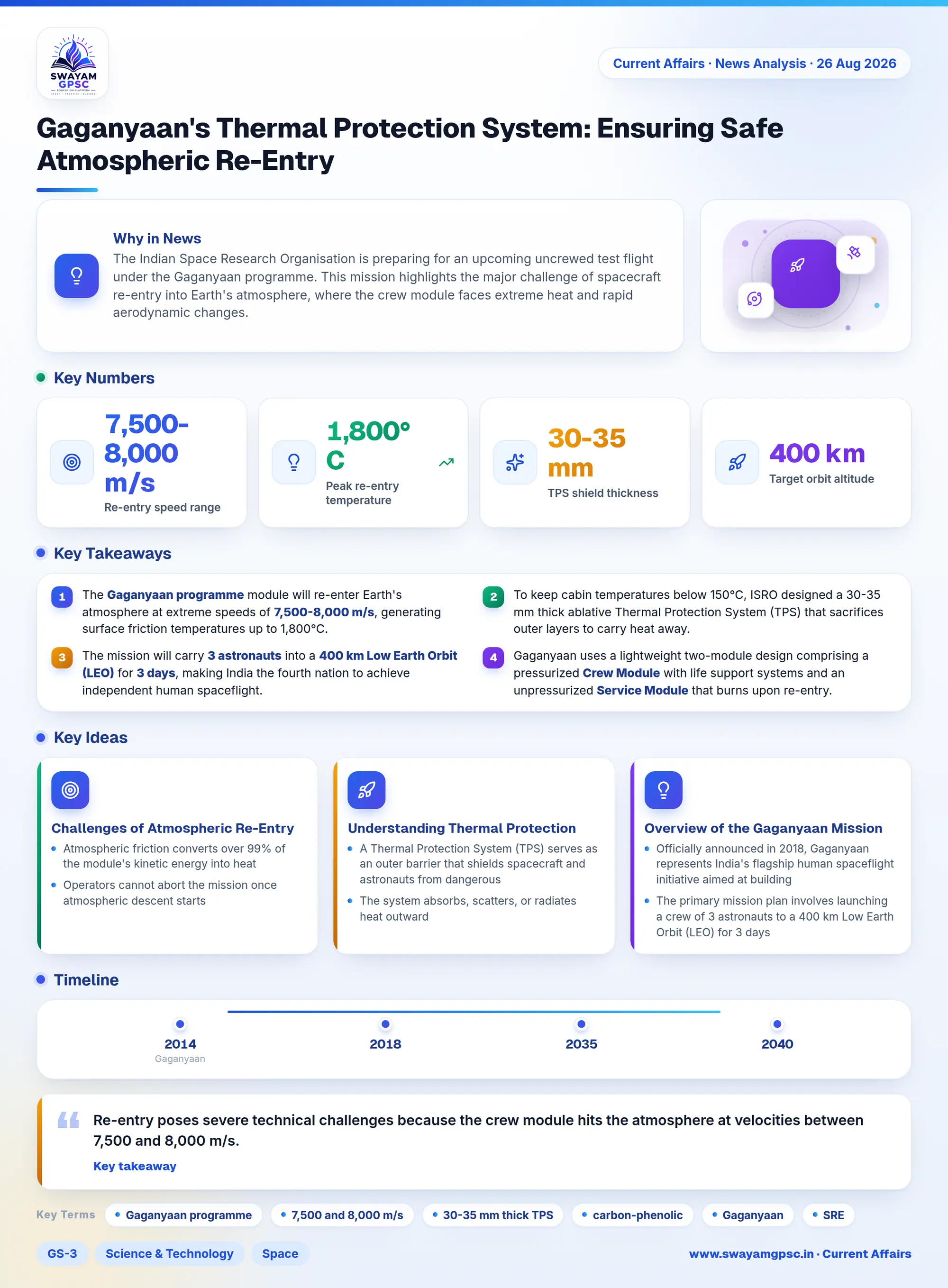
Gaganyaan's Thermal Protection System: Ensuring Safe Atmospheric Re-Entry
#GS-3 #Science & Technology #Space #Current Events #National #Gaganyaan Programme #Thermal Protection System
Key takeaways
- The Gaganyaan programme module will re-enter Earth's atmosphere at extreme speeds of 7,500-8,000 m/s, generating surface friction temperatures up to 1,800°C.
- To keep cabin temperatures below 150°C, ISRO designed a 30-35 mm thick ablative Thermal Protection System (TPS) that sacrifices outer layers to carry heat away.
- The mission will carry 3 astronauts into a 400 km Low Earth Orbit (LEO) for 3 days, making India the fourth nation to achieve independent human spaceflight.
- Gaganyaan uses a lightweight two-module design comprising a pressurized Crew Module with life support systems and an unpressurized Service Module that burns upon re-entry.
- The technology forms the foundation for future goals, including the Bharatiya Antariksh Station by 2035 and a crewed lunar mission by 2040.
Why in News
- The Indian Space Research Organisation is preparing for an upcoming uncrewed test flight under the Gaganyaan programme.
- This mission highlights the major challenge of spacecraft re-entry into Earth's atmosphere, where the crew module faces extreme heat and rapid aerodynamic changes.
- The upcoming test flight also highlights ISRO's decision to use an ablative Thermal Protection System (TPS) to safeguard the crew module.
Challenges of Atmospheric Re-Entry
- Re-entry poses severe technical challenges because the crew module hits the atmosphere at velocities between 7,500 and 8,000 m/s.
- Atmospheric friction converts over 99% of the module's kinetic energy into heat, pushing external surface temperatures up to 1,800°C.
- Operators cannot abort the mission once atmospheric descent starts, making every system's reliability absolute and essential.
- Rapid deceleration creates changing aerodynamic forces during descent, leaving virtually no time for ground operators or astronauts to intervene.
- To protect astronauts and structural components, the 30-35 mm thick TPS shield must keep internal cabin temperatures under 150°C.
Understanding Thermal Protection Systems
- A Thermal Protection System (TPS) serves as an outer barrier that shields spacecraft and astronauts from dangerous re-entry heat.
- The system absorbs, scatters, or radiates heat outward, preserving structural integrity and keeping inner temperatures within safe human limits.
- An ablative TPS gradually burns off its outer layer, decomposing chemically to form a protective char layer and cooler gas barrier that carries heat away.
- Engineers commonly use materials like carbon-phenolic and silica-phenolic compounds for ablative heat shields, as seen on Russia's Soyuz, China's Shenzhou, and NASA's Orion.
- Reusable radiative TPS materials release absorbed heat back into space as radiation without melting, while heat sink TPS systems absorb thermal energy like a sponge.
- ISRO selected an ablative heat shield for Gaganyaan because it has proven reliability from past test missions like the Space Capsule Recovery Experiment (SRE) and the 2014 LVM-3/CARE mission.
- Ablative shields effectively handle fluctuating heat loads without requiring the complex manufacturing and costly inspections of reusable thermal tiles.
- Because the Gaganyaan crew module is built for a single-use mission, single-use ablative technology provides maximum safety at lower operational costs.
- ISRO previously validated carbon-phenolic ablative shields on the nose cap of the SRE capsule and tested full crew module atmospheric re-entry during the 2014 LVM-3/CARE mission.
Overview of the Gaganyaan Mission
- Officially announced in 2018, Gaganyaan represents India's flagship human spaceflight initiative aimed at building independent crewed spaceflight capability.
- The primary mission plan involves launching a crew of 3 astronauts to a 400 km Low Earth Orbit (LEO) for 3 days before returning them via ocean splashdown.
- Successful completion will make India the fourth country to achieve crewed spaceflight capability, joining the United States, Russia, and China.
- ISRO will launch the spacecraft using the heavy-lift Human-rated Launch Vehicle Mark 3 (HLVM3).
- India's designated astronaut group includes Group Captain Prasanth Balakrishnan Nair, Group Captain Ajit Krishnan, Group Captain Angad Pratap, and Wing Commander Shubhanshu Shukla.
- The overall spacecraft, known as the Orbital Module (OM), features a streamlined bi-modular structure to minimize weight.
- The pressurized Crew Module (CM) contains an Environmental Control and Life Support System (ECLSS) to maintain Earth-like conditions, along with TPS shields, avionics, and parachutes.
- The unpressurized Service Module (SM) provides propulsion, electrical power, thermal control, and navigation support while in orbit, separating before re-entry to burn up in the atmosphere.
- Unlike the three-module designs of Russia's Soyuz or China's Shenzhou, ISRO's two-module configuration reduces overall launch mass while preserving full functionality.
- Beyond spaceflight capability, Gaganyaan will support microgravity experiments in biology, materials science, and medicine while testing systems for the Bharatiya Antariksh Station planned for 2035 and a crewed lunar landing targeted for 2040.